

Saudi Arabia set to host 41st GCC Summit in ancient city of AlUla

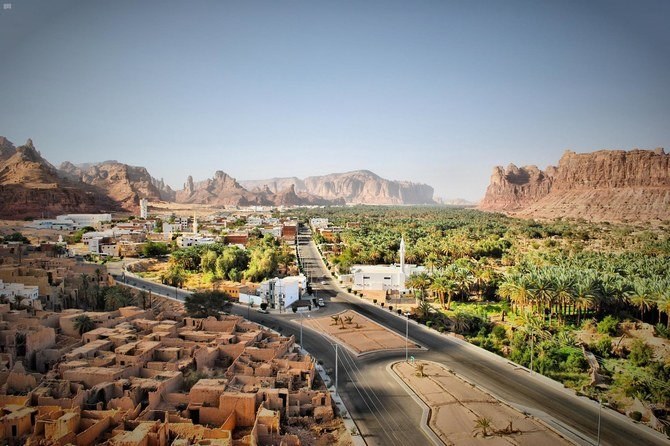
The ruins of the ancient city of Dadan is seen side by side with modern structures in AlUla. (SPA)
Short Url
Updated 04 January 2021
Follow

Saudi Arabia set to host 41st GCC Summit in ancient city of AlUla

  • AlUla Valley will host the event at Maraya Concert Hall, a cube-shaped structure covered by mirrors

JEDDAH: Saudi Arabia is set to host the 41st Gulf Cooperation Council (GCC) Summit at the ancient capital of historic civilizations, AlUla.

Once at the crossroads of antiquity, AlUla Valley will host the summit on Jan. 5 at Maraya Concert Hall, a cube-shaped structure covered by more than 9,500 square meters of mirrors reflecting the striking surrounding landscape.
Inaugurated in 2019 and dubbed the “mirrored wonder” due to the giant sheets of glass attached to the structure, the hall is located in Wadi Ashaar near the volcanic freeway, where it is surrounded by mountainous terrain. It can can seat up to 500 guests and has hosted a number of cultural events since its opening.
The location of the summit is significant. Tucked away in the shadows of the Hijaz Mountains that span the length of the western region, AlUla was once a city bustling with activity and its influence reached across the Arabian Peninsula and beyond.

Opinion

This section contains relevant reference points, placed in (Opinion field)

Today, AlUla is rediscovered and thriving, and the former trade capital of ancient kingdoms will hold one of the most important summits of the region, re-establishing its significance in the modern world.
In his weekly Cabinet meeting, King Salman said that he hoped the summit would succeed in promoting joint action and expanding cooperation and integration among member states. At King Salman’s request, the secretary-general of the GCC, Nayef Falah Al-Hajjraf, invited the leaders of the member states to the summit. The six member states of the GCC are Saudi Arabia, UAE, Bahrain, Oman, Qatar and Kuwait.

“The 41st summit marks the beginning of a new chapter for the GCC as it enters its fifth decade,” Al-Hajjraf said.
Sheikh Ali Al-Khalid Al-Sabah, the Kuwaiti ambassador to Saudi Arabia, underscored the significance of the 41st session of the Gulf summit due to the region’s recent political developments.

The envoy said that the summit hosted by the Kingdom would have a positive and fraternal atmosphere. The atmosphere among GCC leaders reflected “the spirit of responsibility and sincere belief in the importance of strengthening Gulf solidarity in facing common challenges and establishing peace and stability for the benefit” of the council.

BACKGROUND

Inaugurated in 2019 and dubbed the ‘mirrored wonder’ due to the giant sheets of glass attached to the structure, the hall is located in Wadi Ashaar near the volcanic freeway, where it is surrounded by mountainous terrain.

The region was facing great political and economic challenges, he said. GCC leaders would discuss these issues with a united vision that stemmed from their belief in a common destiny and a keenness to preserve the interests of the region’s countries and their peoples.
The Kingdom is hosting the GCC summit for the 10th year. AlUla Valley contains a number of historic sites that were once home to the ancient Dadan and Lihyan civilizations. The Royal Commission for AlUla has made it its mission to return it to its rightful place as a cultural oasis.
Inaugurated in 1981, the GCC Summit was hosted by Sheikh Zayed Al Nahayan in Abu Dhabi and paved the way for the region to enhance and strengthen cooperation and ties among member states.


Experimental farm in Al-Lith looks into future of Saudi Arabian agriculture

Updated 02 February 2026
Follow

Experimental farm in Al-Lith looks into future of Saudi Arabian agriculture

  • Research initiative reflects strategic transformation

JEDDAH: An experimental farm in Saudi Arabia’s Al-Lith Governorate is one of the research initiatives reflecting the strategic transformation taking place in the Kingdom’s agricultural sector.

The farm uses highly efficient, sustainable production models that combine scientific research with commercial application, contributing to strengthening the country’s food security system and the sustainability of water resources.

Located in the Ghumaiqa Center on an area of about 10 hectares, the cutting-edge farm is a testing platform for modern agricultural technologies that tackle the challenge of water scarcity.

The farm includes developed open fields and modern greenhouses, supported by smart irrigation encompassing drip and sprinkler irrigation alongside surface and subsurface technologies.

All the systems operate via smart controls that enable the monitoring of water consumption and ensure improved efficiency, thereby achieving a balance between agricultural production and water conservation.

The farm also uses treated and diluted low-salinity seawater.

It aims to diversify agricultural water sources, reduce reliance on freshwater, and open new horizons for agriculture in coastal and semi-arid environments.

A view of the experimental farm in Al-Lith. (SPA)

The project represents a promising investment opportunity in the field of smart agriculture, enabling the development of commercially scalable production models, particularly for high-value vegetables and fruits, while reducing operational costs associated with water and energy, enhancing the economic feasibility of future agricultural projects.

In addition, the project contributes to transferring and localizing agricultural expertise, supporting local food supply chains, and creating an attractive environment for agricultural investment.

This aligns with Sustainable Development Goals and enhances the efficiency of the private sector in adopting innovative agricultural solutions.

Yahya bin Abdulrahman Al-Mahabi, the director of the Ministry of Environment, Water and Agriculture office in Al-Lith Governorate, told the Saudi Press Agency that the project represented the future of agriculture in the Kingdom.

He explained that the vision was based on investing in technology, enhancing the return on water per unit, and integrating scientific research with investment opportunities.

Al-Mahabi spoke of the experimental farm as a modern, scalable and replicable model applicable in several regions of the Kingdom, particularly in coastal environments.

Al-Mahabi highlighted the Ministry of Environment, Water and Agriculture’s commitment to supporting distinctive projects that contributed to achieving food security while developing rural areas and enhancing agricultural production efficiency, in line with the objectives of the Kingdom’s Vision 2030.