

Lucid Motors to expand Saudi presence, scouting retail locations

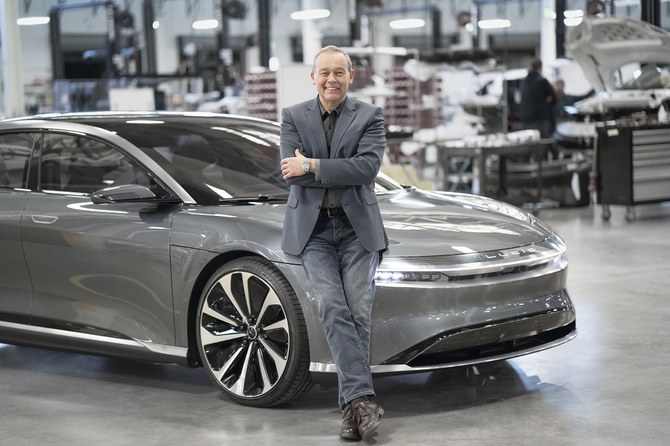
Peter Rawlinson, CEO of Lucid Motors, the Californian electric vehicle (EV) carmaker part-owned by Saudi Arabia’s Public Investment Fund. (Supplied)
Short Url
Updated 02 January 2021
Follow

Lucid Motors to expand Saudi presence, scouting retail locations

  • PIF-backed American carmaker keen to help develop Kingdom’s solar power capabilities
  • Rawlinson said the $1 billion investment by the Kingdom’s PIF was “vital” in allowing the company to move forward with its larger vision to manufacture an affordable, efficient and sustainable transportation

CHICAGO: Lucid Motors, the Californian electric vehicle (EV) carmaker part-owned by Saudi Arabia’s Public Investment Fund (PIF), is scouting out locations for retail sales outlets in the Kingdom, CEO Peter Rawlinson told Arab News.

The cutting-edge manufacturer of high-end EVs broke ground on a manufacturing center in Arizona last year and is due to start full production on its first vehicles in spring 2021.

Although many compare Lucid to Tesla, Rawlinson called Lucid the first EV to compete with traditional luxury manufacturers such as Mercedes, BMW and Porsche. Lucid is on track, he said, to provide more affordable models that will offer higher mileage and nearly double the voltage capacity offered by Tesla.

Rawlinson said the $1 billion investment by the Kingdom’s PIF was “vital” in allowing the company to move forward with its larger vision to manufacture an affordable, efficient and sustainable transportation that will eventually replace gasoline-based vehicles.

“We are reciprocating, and we are going to do something amazing with PIF in the Middle East and Saudi Arabia, and that will be very much in line with Vision 2030 to really reduce their economy’s dependence upon fossil fuels,” Rawlinson said.

“I think sunshine will last future generations longer than oil. And if they can leverage that sunshine with the energy-storage solutions that Lucid Technologies can provide, linked to our cars and our automotive technology, we are going to do something huge in the Kingdom, and hopefully, we are going to make an announcement regarding those plans very soon.”
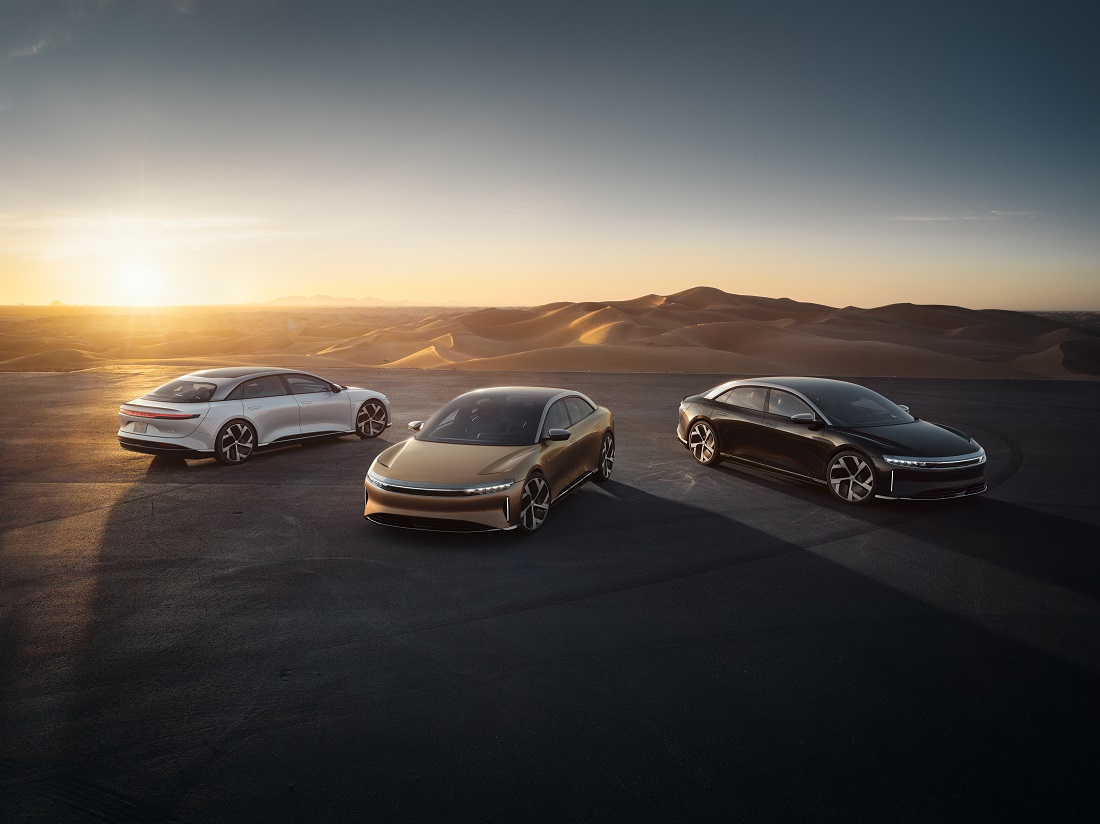


Lucid Motors, the Californian electric vehicle (EV) carmaker part-owned by Saudi Arabia’s Public Investment Fund (PIF), broke ground on a manufacturing center in Arizona last year and is due to start full production on its first vehicles in Spring 2021. (Supplied)

PIF announced its investment in Lucid Motors in September 2018. “By investing in the rapidly expanding electric vehicle market, PIF is gaining exposure to long-term growth opportunities, supporting innovation and technological development, and driving revenue and sectoral diversification for the Kingdom of Saudi Arabia,” the fund said in a statement at the time.

The carmaker has also partnered with the fund to train young Saudis and give them exposure to the innovative vehicles the company is developing. “PIF strongly believes in actively engaging with youth to develop our Kingdom’s sustainable future. Since 2019, our internship partnership with Lucid Motors has trained the future innovators of our economy,” PIF said in a tweet on Sept. 2.

In terms of the carmaker’s immediate partnership with the Kingdom, the CEO said his teams are scrutinizing possible locations in Saudi Arabia to open retail outlets — what Lucid calls “Studios” — for their luxury EVs.

“We are already looking,” he said. “My retail team just returned from a scouting trip in the Kingdom, and that is very much on the road there. Hopefully, we can get a retail outlet there right at the tail end of 2021, probably early 2022.”

Rawlinson said a major priority is to address the public’s concerns over affordability and “range anxiety,” noting that Lucid’s vehicles offer as much as 517 miles on a charge. He said Lucid will bring down costs through efficiencies and technology improvements focused, in part, on improving the battery performance and reducing battery size.

“The key is to achieve range through efficiency. That means how far I can go for a given amount of energy. It’s like miles per gallon for a gasoline car. And the best metric for measuring that is miles per kilowatt-hour,” he explained.

“We are able to get over four-and-one-half miles per kilowatt-hour, and that is extraordinary. That is a measure of our technology. We are achieving our over 500-mile range through our tech and not just through the size of our battery pack, and that is a big difference.”

He envisions a time when costs could drop as low as $25,000 a vehicle and the availability of EV charging stations could resemble the gasoline station construction boom that followed the launch of the first gasoline-powered vehicles at the turn of the 20th century. The current Lucid Air models range between $69,900 and $161,500.

Rawlinson said that Tesla, where he worked previously, has done an “amazing job” in focusing the market’s attention to EVs as the future for personal and business transportation.

“They are in the pre-eminent position here. What has surprised me and disappointed me is the reluctance of traditional car companies and the rest of the industry to rise to this challenge to take the baton and to proceed,” Rawlinson said, emphasizing that Lucid is not competing with Tesla. “I don’t actually think we are directly competing with Tesla, although a lot of the media likes to portray it that way. There is an inevitability about that.

“Right now, Tesla is running six years ahead of the competition. And it befalls Lucid to take up this challenge. That’s one of the reasons we are here, that’s why I am doing what I am doing.”


Saudi Aramco achieves significant progress in its gas production plan

Updated 26 February 2026
Follow

Saudi Aramco achieves significant progress in its gas production plan

RIYADH: Saudi Aramco has announced the achievement of significant progress in its plan to expand gas production, with the start of production at the Jafurah field, the largest unconventional gas field in the Middle East, and the commencement of operational activities at the Tanajib Gas Plant, one of the largest gas plants in the world.

The oil giant aims to increase its sales gas production capacity by approximately 80 percent by 2030 compared to 2021 production levels, reaching nearly 6 million barrels of oil equivalent per day from total gas and associated liquids production, according to the Saudi Press Agency.

This is expected to generate additional operating cash flows ranging between $12 billion and $15 billion in 2030, subject to future demand for sales gas and liquids prices.

President and CEO of Saudi Aramco, Amin Al-Nasser, said: “We are proud to commence production at the Jafurah field and begin operations at the Tanajib Gas Plant. These are major achievements for Saudi Aramco and the future of energy in the Kingdom. Our ambitious gas program is expected to become a key source of profitability.”

He affirmed that these mega-projects contribute to meeting the growing domestic demand for gas, supporting industrialization and development in several key sectors, in addition to producing significant quantities of high-value liquids.

Al-Nasser expressed his gratitude for the support, trust, and attention that Saudi Aramco receives from the Custodian of the Two Holy Mosques, King Salman bin Abdulaziz Al Saud, and His Royal Highness Prince Mohammed bin Salman bin Abdulaziz Al Saud, crown prince and prime minister, noting that this has had the most profound impact on the company’s achievements and distinguished projects that serve the Kingdom’s Vision 2030.

The gas extracted from the Jafurah field is expected to support the Kingdom’s growth targets in key sectors such as energy, artificial intelligence, major industries, and petrochemicals, potentially providing a major boost to the Kingdom’s economy and strengthening its position among the world’s top ten gas producers.

Saudi Aramco began first producing unconventional shale gas from the Jafurah field in December 2025, with technology playing a pivotal role in unlocking the potential of the Jafurah field and establishing it as a global benchmark for unconventional gas development. 

Since its inception, the project has leveraged technology to help reduce drilling and stimulation costs and enhance well productivity, contributing to its strong economic prospects.

The Jafurah area covers 17,000 sq. km and is estimated to contain 229 trillion standard cubic feet of raw gas and 75 billion barrels of condensates. The Jafurah field project aims to produce 2 billion standard cubic feet per day of sales gas, 420 million standard cubic feet per day of ethane, and approximately 630,00 barrels per day of gas liquids and condensates by 2030.

The Tanajib Gas Plant is a key pillar in Aramco’s strategy to increase gas processing capacities and diversify its energy product portfolio, helping to foster long-term economic growth. 

Operations began in December 2025, and its raw gas processing capacity is expected to reach 2.6 billion standard cubic feet per day in 2026. The start of operations at the Tanajib Plant coincided with the commencement of production from the Marjan field expansion and development program. 

The plant is distinguished by its digital integration, enhanced operational efficiency, capability to execute complex projects, and optimal use of resources. It processes raw gas associated with crude oil production from the offshore Marjan and Zuluf fields.

Aramco’s gas expansion is expected to create thousands of direct and indirect job opportunities, generating significant added value and strengthening its position as a reliable energy provider. 

It also helps meet the growing demand for natural gas and enhances its supply to national industries. 

The expansion strategy supports efforts aimed at achieving the optimal energy mix for local electricity generation, advancing the Kingdom’s liquid fuel displacement program, which will have a positive environmental impact, supporting the Kingdom’s ambition to achieve net-zero emissions by 2060, enhancing energy security, and contributing to building a more diversified national economy.