Syrian refugee killed by stray bullet during Lebanon’s New Year celebrations

1 / 2
A Lebanese woman takes a selfie while celebrating New Year at a restaurant, ignoring the mask appeal of the health minister, in Beirut on Friday. (AP)
2 / 2
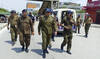
Lebanese security forces patrol a street full of restaurants where revelers celebrating the New Year Eve, in Beirut, Lebanon, Friday, Jan. 1, 2021. (AP)
Short Url
Updated 02 January 2021
Follow

Syrian refugee killed by stray bullet during Lebanon’s New Year celebrations

  • Lilian Shiito wakes from coma caused by the Beirut port explosion five months ago
  • A Middle East Airlines plane on the tarmac at Beirut’s airport was hit as people in a southern Beirut neighborhood fired in the air

BEIRUT: A Syrian refugee at a camp in Baalbeck was killed on New Year’s Eve by a stray bullet, which had been fired into the air to celebrate the arrival of 2021 at midnight. Head of the Internal Security Forces public relations department Col. Joseph Mousallem told Arab News: “The number of injuries caused by stray bullets was modest because people chose to bid farewell to 2020 in their homes, as a result of the COVID-19 outbreak and because of the measures taken by the security forces, who were patrolling the streets. People were asked not to stay out in the open as midnight approaches to avoid stray bullets.”

According to security reports, the majority of those shooting bullets into the air were based in the Bekaa region, as well as in some Palestinian refugee camps in southern Lebanon, and some neighborhoods and suburbs of Beirut.

The Syrian victim was named as Houria Ali Al-Jasem. She was 38 years old. Initial security reports said that others had also been wounded by stray bullets in the area of ​​Baalbek, in the vicinity of Beirut airport, and in Tripoli.

Chairman and director general of Middle East Airlines Mohamad El-Hout told Arab News that three of the company’s planes parked at Beirut’s airport had been struck by stray bullets.

“The engineering team inspected all the planes at dawn before takeoff. They also withdrew the bullet-struck aircraft from service,” El-Hout said.

He called on authorities to “strengthen their control over the area surrounding the airport and in other areas to prevent … unacceptable practices.”

Lebanon’s National News Agency stated: “The ambiance of the Palestinian camps in Rashidieh, the Borj El-Chmali and El-Buss in the vicinity of Tyre witnessed heavy gunshots on the occasion of the New Year, and the whizzing of bullets was clearly heard — tracer rounds were seen exploding in the air.”

Beirut MP Rola Al-Tabash condemned the practice. “It is neither manhood nor heroism, shooting over people's heads,” she said. “It is a backward and criminal phenomenon.”

It is neither manhood nor heroism, shooting over people’s heads … It is a backward and criminal phenomenon.

Rola Al-Tabash, Beirut MP

Al-Tabash called on the security and judicial agencies to “strike hard,” saying: “It is not right for us to all be hostages to some outlaws.”

One person died and 12 were injured in 10 road traffic accidents over Thursday night into Friday morning, according to reports.

The COVID-19 pandemic caused the cancellation of several New Year's Eve events. A number of people contacted by Arab News said they had canceled their plans and stayed home in isolation.

The Ministry of Health announced on Thursday that 3,507 new cases, and 12 deaths had been recorded in the 24 hours leading up to its announcement.

Many took to social media to plead for help to get relatives admitted to hospital, as the occupancy rate in intensive care rooms in Beirut reached a reported 95 percent.

The Ministry of Health said that areas in which Christmas gatherings took place had seen the largest number of new infections.

Public health advisor Petra Khoury said, “The number of Corona infections exceeded our expectations. We are entering a difficult phase, especially in January and February. There are no available beds in intensive care, and the problem is very complex. We need a change in the citizens’ behaviors.”

In happier news, it was announced on Friday that 26-year-old Lebanese citizen Lilian Shiito, who had been in a coma since August 4 as a result of injuries sustained during the Beirut port explosion, had woken up.

Shiito had given birth to her first child just six weeks prior to suffering a fractured skull and internal bleeding during the explosion.


Washington presses Syria to shift from Chinese telecom systems

Updated 26 February 2026
Follow

Washington presses Syria to shift from Chinese telecom systems

  • Syria is exploring the possibility of procuring Chinese technology
  • It was unclear whether the United States ⁠pledged financial or logistical support to Syria to do so

DAMASCUS: The United States has warned Syria against relying on Chinese technology in its telecommunications sector, arguing it conflicts with US interests and threatens US national security, according to three sources familiar with the matter.
The message was conveyed during an unreported meeting between a US State Department team and Syrian Communications Minister Abdulsalam Haykal in San Francisco on Tuesday. Washington has been coordinating closely with Damascus since 2024, when Syria’s now President Ahmed Al-Sharaa ousted longtime leader Bashar Assad, who had a strategic partnership with China.
Syria is exploring the possibility of procuring Chinese technology to support its telecommunications towers and the infrastructure of local Internet service providers, according to a Syrian businessman involved in the procurement talks.
“The US side asked for clarity on the ministry’s plans regarding Chinese telecom equipment,” said ⁠another source briefed on ⁠the talks.
But Syrian officials said infrastructure development projects were time-critical and that Damascus was seeking greater vendor diversity, the source added.
SYRIAN OFFICIALS CITE US EXPORT CONTROLS AS TELECOMS BARRIER
Syria is open to partnering with US firms but the matter was urgent and export controls and “over-compliance” remained an issue, according to person familiar with the meeting in San Francisco.
A US diplomat familiar with the discussions told Reuters that the US State Department “clearly urged Syrians to use American technology or technology from allied countries in the telecoms sector.”
It was unclear whether the United States ⁠pledged financial or logistical support to Syria to do so.
Responding to Reuters questions, a US State Department spokesperson said: “We urge countries to prioritize national security and privacy over lower-priced equipment and services in all critical infrastructure procurement. If it seems too good to be true, it probably is.”
The spokesperson added that Chinese intelligence and security services “can legally compel Chinese citizens and companies to share sensitive data or grant unauthorized access to their customers’ systems” and promises by Chinese companies to protect customers’ privacy were “entirely inconsistent with China’s own laws and well-established practices.”
China has repeatedly rejected allegations of it using technology for spying purposes.
The Syrian Ministry of telecommunications told Reuters any decisions related to equipment and infrastructure are made “in accordance with national technical and security standards, ensuring data protection and service continuity.”
The ministry said it is also prioritizing the diversification of partnerships and technology sources to ⁠serve the national interest.
Syria’s telecom ⁠infrastructure has relied heavily on Chinese technology due to US sanctions imposed on successive Assad governments over the civil war that grew from a crackdown on anti-government protests in 2011.
Huawei technology accounts for more than 50 percent of the infrastructure of Syriatel and MTN, the country’s only telecom operators, according to a senior source at one of the companies and documents reviewed by Reuters. Huawei did not immediately respond to a request for comment.
Syria is seeking to develop its private telecommunications sector, devastated by 14 years of war, by attracting foreign investment.
In early February, Saudi Arabia’s largest telecom operator, STC, announced it would invest $800 million to “strengthen telecommunications infrastructure and connect Syria regionally and internationally through a fiber-optic network extending over 4,500 kilometers.”
The ministry of telecommunications says that US restrictions “hinder the availability of many American technologies and services in the Syrian market,” emphasizing that it welcomes expanding cooperation with US companies when these restrictions are lifted.
Syria has inadequate telecommunications infrastructure, with network coverage weak outside city centers and connection speeds in many areas barely exceeding a few kilobits per second.