China gives its first COVID-19 vaccine approval to Sinopharm

No detailed efficacy data of the vaccine has been publicly released but its developer. (File/AFP)
Short Url
Updated 31 December 2020
Follow

China gives its first COVID-19 vaccine approval to Sinopharm

  • Sinopharm subsidiary China National Biotec Group said the vaccine 79.34% effective in preventing people from developing the disease
  • More than 3 million additional doses have been given since Dec. 15 as the drive to vaccinate priority groups gathers pace

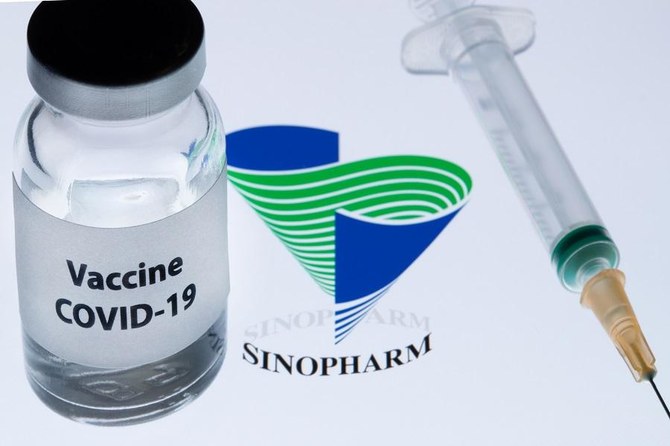
BEIJING: China approved its first COVID-19 vaccine for general public use on Thursday, a shot developed by an affiliate of state-backed pharmaceutical giant Sinopharm, as it braces for greater transmission risks over the winter.
No detailed efficacy data of the vaccine has been publicly released but its developer, Beijing Biological Products Institute, a unit of Sinopharm subsidiary China National Biotec Group (CNBG), said on Wednesday its vaccine was 79.34% effective in preventing people from developing the disease based on interim data.
The approval, announced by the National Medical Products Administration, comes after the UAE this month became the first country to roll out the vaccine to the public.
While China has been slower than several other countries in approving COVID-19 vaccines, it has been inoculating some citizens for months with three different shots still undergoing late-stage trials.
China launched an emergency use program in July aimed at essential workers and others at high risk of infection and as of the end of November, had administered more than 1.5 million doses using at least three different products — two developed by CNBG and one by Sinovac.
More than 3 million additional doses have been given since Dec. 15 as the drive to vaccinate priority groups gathers pace.
While the efficacy of the Sinopharm shot trails the more than 90% success rate of rival vaccines from Pfizer Inc. and its partner BioNTech and Moderna Inc, it points to progress China has made in the global race to develop successful COVID-19 vaccines.
Four other vaccines from Sinovac, CNBG’s Wuhan unit, CanSino Biologics and the Chinese Academy of Sciences are also in late stage trials, underscoring China’s efforts to develop a homegrown vaccine to challenge Western rivals.
President Xi Jinping has pledged to make China’s vaccines a global public good and it has won several large supply deals with countries including Indonesia and Brazil — the most populous countries in Southeast Asia and Latin America respectively.

Call to get vaccinated
While China has kept new outbreaks of the coronavirus under control, it is ramping up the emergency program to contain the risks over the winter. The virus emerged a year ago in a market in the central city of Wuhan.
The South China Morning Post reported that China would vaccinate as many as 50 million people from high-priority groups before the Lunar New Year holiday in February.
“We call on people ... to take an active part in vaccination to protect themselves, family members and others, which is also contributing to global epidemic control,” Zeng Yixin, an official with National Health Commission, told a briefing on Thursday.
The price of the vaccine would depend on the scale of use, but the “premise” was that it would be free for the public in China, he said.
The vaccine’s approval is officially “regulatory,” a conditional green light given to vaccines deemed urgently needed to cope with major public health emergencies even though complete clinical trials have yet to be completed.
The approval comes as Britain on Wednesday approved a second COVID-19 vaccine, a shot developed by Oxford University and AstraZeneca, as it battles a major winter surge driven by a new variant of the virus.


Trump to host Colombia’s Petro just weeks after insulting him as a ‘sick man’ fueling drug trade

Updated 1 sec ago
Follow

Trump to host Colombia’s Petro just weeks after insulting him as a ‘sick man’ fueling drug trade

WASHINGTON: President Donald Trump is set to welcome Colombian President Gustavo Petro to the White House on Tuesday for talks only weeks after threatening military action against the South American country and accusing the leader of pumping cocaine into the United States.
US administration officials say the meeting will focus on regional security cooperation and counternarcotics efforts. And Trump on Monday suggested that Petro — who has continued to criticize Trump and the US operation to capture Venezuela’s Nicolás Maduro — seems more willing to work with his administration to stem the flow of illegal drugs from Colombia.
“Somehow after the Venezuelan raid, he became very nice,” Trump told reporters. “He changed his attitude very much.”
Yet, bad blood between the leaders overshadows the sit-down, even as Trump sought to downplay any friction on the eve of the visit.
The conservative Trump and leftist Petro are ideologically far apart, but both leaders share a tendency for verbal bombast and unpredictability. That sets the stage for a White House visit with an anything-could-happen vibe.
In recent days, Petro has continued poking at the US president, calling Trump an “accomplice to genocide” in the Gaza Strip, while asserting that the capture of Maduro was a kidnapping.
And ahead of his departure for Washington, Petro called on Colombians to take to the streets of Bogotá during the White House meeting.
There’s been a shift in US-Colombia relations
Historically, Colombia has been a US ally. For the past 30 years, the US has worked closely with Colombia, the world’s largest producer of cocaine, to arrest drug traffickers, fend off rebel groups and boost economic development in rural areas.
But relations between the leaders have been strained by Trump’s massing US forces in the region for unprecedented deadly military strikes targeting suspected drug smuggling boats in the Caribbean Sea and eastern Pacific. At least 126 people have been killed in 36 known strikes.
In October, the Trump administration announced it was imposing sanctions on Petro, his family and a member of his government over accusations of involvement in the global drug trade.
The Treasury Department leveled the penalties against Petro; his wife, Veronica del Socorro Alcocer Garcia; his son, Nicolas Fernando Petro Burgos; and Colombian Interior Minister Armando Alberto Benedetti.
The sanctions, which had to be waived to allow Petro to travel to Washington this week, came after the US administration in September announced it was adding Colombia to a list of nations failing to cooperate in the drug war for the first time in three decades.
Then came the audacious military operation last month to capture Maduro and his wife to face federal drug conspiracy charges, a move that Petro has forcefully denounced. Following Maduro’s ouster, Trump put Colombia on notice, and ominously warned Petro he could be next.
Colombia is “run by a sick man who likes making cocaine and selling it to the United States,” Trump said of Petro last month. “And he’s not gonna be doing it very long, let me tell you.”
But a few days later, tensions eased somewhat after a call between the leaders. Trump said Petro in their hourlong conversation explained “the drug situation and other disagreements.” And Trump extended an invitation to Petro for the White House visit.
Trump on a couple of occasions has used the typically scripted leaders’ meetings to deliver stern rebukes to counterparts in front of the press.
Trump and Vice President JD Vance lashed out at Ukrainian President Volodymyr Zelensky in February for showing insufficient gratitude for US support of Ukraine. Trump also used a White House meeting in May to forcefully confront South African President Cyril Ramaphosa,accusing the country, with reporters present, of failing to address Trump’s baseless claim of the systematic killing of white farmers.
It was not clear that the meeting between Trump and Petro would include a portion in front of cameras.