



RIYADH: Leejam Sports Co., Saudi Arabia’s largest fitness company, on Dec. 13 opened its first gym in Jeddah under its newly launched brand Fitness Time — Xpress Ladies.
More launches have since followed, bringing the total number of outlets Leejam operates to 138 and demonstrating that despite one of the most challenging years since it opened in 2005, it is pushing ahead with its ambitious expansion plans.
When coronavirus disease (COVID-19) struck earlier this year, all gyms in Saudi Arabia were closed on March 15 and did not reopen until June 21.
“COVID-19 was pretty devastating because we had to close the doors, having an income of millions of riyals to zero overnight,” Leejam CEO Justin Musgrove told Arab News.
“So we found ourselves with a big overhead, 3,000 employees, all our gyms and centers and our head offices, to keep those costs rolling over. Despite the inevitable pressure of incurring significant costs through the closed period, Leejam cash reserves were sufficient to carry us through.”
According to Leejam’s latest published financial results, revenue for the first nine months of 2020 fell 36 percent year-on-year to SR429 million ($114.40 million). The company estimated that the pandemic closures cost it SR257 million in lost earnings. 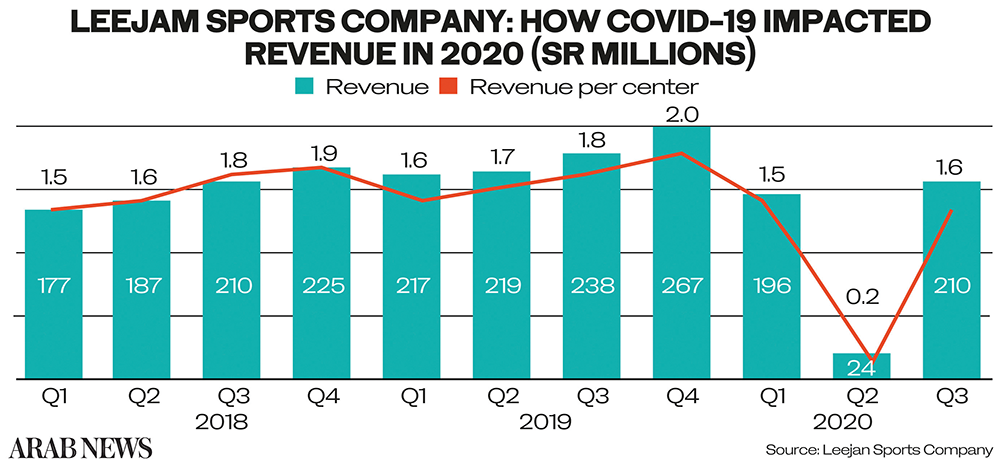
As a result, net income fell 142 percent over the same period, from SR138 million profit between January and September 2019 to a loss of SR58 million for the same period this year.
If COVID-19 had not happened, the company said it was on course to make a profit of SR119 million.
However, there are some positive signs. Revenue in the third quarter has already bounced back after the slump in the second, and is actually higher than the first quarter.
Over the period when gyms were closed, Leejam negotiated lease discounts of SR3.6 million from its landlords, and is expecting to get further discounts of SR6 million in the coming quarters.
In terms of staffing levels, the third quarter financial figures showed staff salaries were held at 50 percent, and 300 employees benefited from the Saudi government’s pandemic support initiative.
On the cost side, the company has seen its hygiene bill increase by around SR2 million per month in order to comply with the new regulations and help control the spread of COVID-19.
Figures showed that the total number of members in September grew 17 percent year-on-year to 292,000.
Attendance has also improved, with the number of members using the gyms rising to 80 percent in September compared to 33 percent in July.
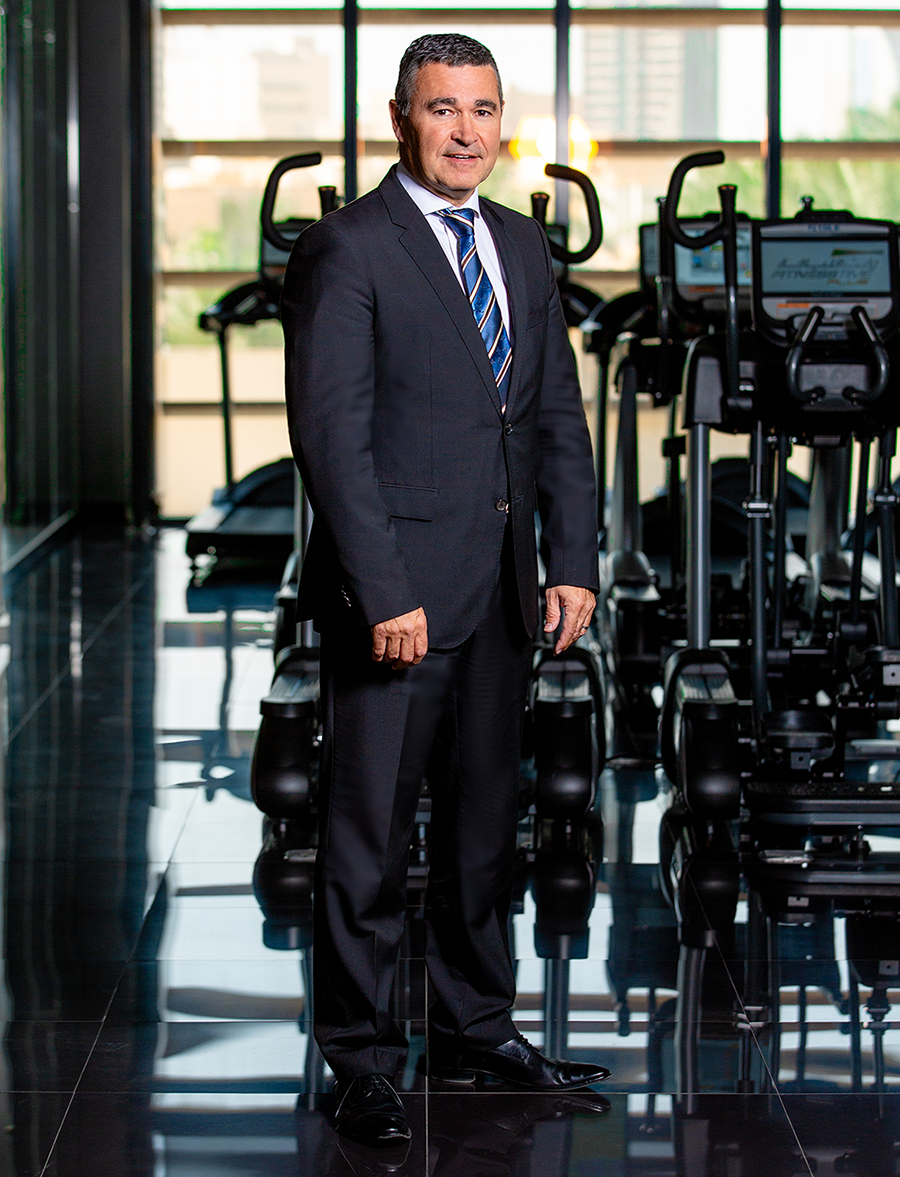
Justin Musgrove, CEO of Leejam, Saudi Arabia's largest fitness company. (Supplied)
“We’ve seen that being fit and healthy is the most important antidote for COVID-19, so how to get the best immunity, working out as well as a great diet are your medicine,” Musgrove said.
During the lockdown, Leejam’s teams used the time to add more elements to the business to make it more than just a gym, offering members coffee, protein shakes, healthy foods and nutritional advice.
“The closed period enabled us to refocus on how to accelerate our strategy. We brought our teams together every single day. Instead of focusing on our customers in the clubs, it (the lockdown) enabled us to improve our gyms and look at the future rather than today and evolve our concept,” Musgrove said.
“In terms of new developments for our members, we’re hoping to introduce physiotherapy, a place where the ladies can have a spa treatment, have their nails done, a blow dry etc. We want to provide more services for our members’ convenience, a one-stop-shop. This will give Leejam and Fitness Time new unique selling points for the future.”
Musgrove said due to COVID-19, fewer gyms have opened in Saudi Arabia today than a year ago.
“We’re not happy about that. We’d like more exposure, more competition. Typically, competition brings choice, flexibility. So COVID-19 has reduced the number of competitors, which isn’t a good thing. Competition is good,” he added.
“Today, Saudi market penetration is at 4 percent, while in the US and Europe it ranges between 15 and 20 percent — a clear indication of the industry’s immense potential.”
In order to remain competitive, Musgrove stressed the importance of building more “state-of-the-art” centers and embracing the digital revolution.
The closed period enabled us to refocus on how to accelerate our strategy.
Justin Musgrove, Leejam CEO
“We’ve all probably tried a gym workout on our phones. We’ve all tried some working out from our homes where there’s a TV screen,” he said.
“Inevitably, some people now are working out from home instead of the gym. It’s not a detriment. I think more people who’ve tried the home workout will say, ‘Now I know I want to join the gym’.”
In the last few weeks, the company launched its Fitness Time Xpress brand, which is aimed at lower-income earners, with low-cost subscription and more flexible contracts.
“It’s aimed at people with lower incomes and students, in areas we haven’t previously been to that have no gyms at all,” Musgrove said, adding that he is aiming to open 30 Xpress gyms by the end of the second quarter next year.
“We’re quite excited by this because if Saudi Arabia is going to hit the targets of people who are physically active and getting fit, we need to provide more choice through pricing options, from the low cost through to the high cost,” he said.
Leejam is aiming to have 250 gyms open by 2025. “Ultimately, we’d like to get about 100 ladies’ gyms and 150 men’s gyms by 2025,” Musgrove said.
The company is aiming for half a million members by the end of next year, and while it has expanded into the UAE, it is also looking further afield and even franchising the Fitness Time brand to other markets.


