Ghislaine Maxwell is denied bail by US judge

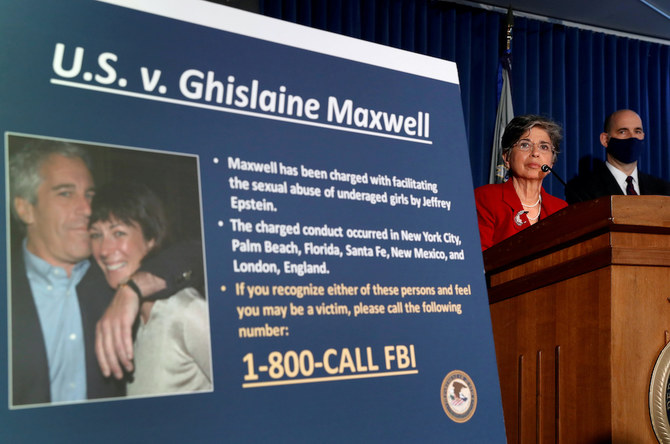
Audrey Strauss, acting US Attorney for the Southern District of New York, speaks alongside William F. Sweeney Jr., Assistant Director-in-Charge of the New York Office, at a news conference announcing charges against Ghislaine Maxwell for her role in the sexual exploitation and abuse of minor girls by Jeffrey Epstein in New York City, New York, US, July 2, 2020. (Reuters)
Short Url
Updated 29 December 2020
Follow

Ghislaine Maxwell is denied bail by US judge

  • Federal prosecutors said that Maxwell ‘poses a flight risk’
  • She has been jailed in Brooklyn following her July 2 arrest

NEW YORK: A US judge on Monday denied bail to Ghislaine Maxwell, citing the risk the British socialite might flee from charges she assisted in the late financier Jeffrey Epstein’s sex trafficking of girls.
US District Judge Alison Nathan in Manhattan said federal prosecutors persuaded her that Maxwell “poses a flight risk” despite her proposed $28.5 million bail package, and should remain jailed because “no conditions of release” reasonably assured she would appear in court.
Lawyers for Maxwell did not immediately respond to requests for comment. A spokesman for Acting US Attorney Audrey Strauss in Manhattan declined to comment.
Maxwell, 59, has pleaded not guilty to helping Epstein recruit and groom girls as young as 14 years old for sex in the mid-1990s, and not guilty to perjury for denying her involvement under oath.
She has been jailed at the Metropolitan Detention Center in Brooklyn following her July 2 arrest at her New Hampshire home, where prosecutors said she was hiding out.
The proposed bail package included $22.5 million posted by Maxwell and her husband, as well as home confinement with electronic monitoring and 24-hour guard to ensure Maxwell remained safe and would not escape.
Maxwell said she wanted to stay in New York to clear her name, while her lawyers objected to jail conditions including invasive searches and surveillance by flashlight-toting guards who woke her every 15 minutes to ensure she was still breathing.
But Nathan, who rejected a $5 million bail package for Maxwell in July, said none of the new arguments had a “material bearing” on whether Maxwell was a flight risk.
In opposing bail, prosecutors cited Maxwell’s abilities to hide her wealth and evade capture, and the prospect she might flee to France or the United Kingdom, where she holds citizenships and they said she might elude extradition.
Maxwell faces up to 35 years in prison if convicted. Her trial is scheduled for July 12, 2021.
Epstein, 66, killed himself in a Manhattan jail in August 2019 while awaiting trial on sex trafficking charges.
Former US Attorney General William Barr criticized errors by jail personnel that he said contributed to Epstein’s death.
Nathan described her “bottom line” conclusions in a two-page order. A longer opinion explaining her reasoning will be filed after lawyers for Maxwell and the government propose redactions to account for potentially confidential information.


Mexico and El Salvador make big cocaine seizures at sea as US continues lethal strikes

Updated 2 sec ago
Follow

Mexico and El Salvador make big cocaine seizures at sea as US continues lethal strikes

MEXICO CITY: The navies of El Salvador and Mexico announced drug seizures in the Pacific Ocean this week of more than 10 tons of cocaine, in contrast to deadly strikes by the US government that just this week left 11 people dead on three boats suspected of carrying drugs in Latin American waters.
The latest announcement came Thursday, when Mexico said it had seized nearly four tons of suspected drugs and detained three people from a semisubmersible craft, 250 nautical miles (463 kilometers) south of the port of Manzanillo.
Mexican Security Secretary Omar García Harfuch said via X that the seizure from the sleek, low-riding boat with three visible motors brought the weekly total to nearly 10 tons, but he did not provide detail on the other seizures.
Mexican authorities said the seizure was made with intelligence shared US Northern Command and the US Joint Interagency Task Force South.
On Sunday, El Salvador’s navy announced the largest drug seizure in the country’s history of 6.6 tons of cocaine. The navy had intercepted a 180-foot boat registered to Tanzania, 380 miles (611 kilometers) southwest of the coast. Navy divers found 330 packages of cocaine hidden in the boat’s ballast tanks. Ten men were arrested from Colombia, Nicaragua, Panama and Ecuador.
On Thursday, Salvadoran authorities gave access to the seized ship FMS Eagle, which had just arrived in the port of La Union. More than 200 wrapped bundles were lined up on the deck.
The Trump administration has pressured Mexico to make more drug seizures over the past year. The trafficking of drugs like fentanyl was the president’s justification for tariffs on Mexican imports.
Mexican President Claudia Sheinbaum has responded with a more aggressive stance toward drug cartels than her predecessor, that has included sending dozens of drug trafficking prisoners to the United States for prosecution.
Sheinbaum has also expressed her disagreement with strikes by the US military in the Caribbean Sea and Pacific Ocean against boats suspected of carrying drugs.
At least 145 people have been killed in those strikes since the US government began targeting those it calls “narcoterrorists” last September.
The US strikes this week included two vessels carrying four people each in the eastern Pacific Ocean and another boat in the Caribbean carrying three people. The administration provided images of the boats being destroyed, but not evidence they were carrying drugs.