

Sunday trading: Abo Moati is the top gainer

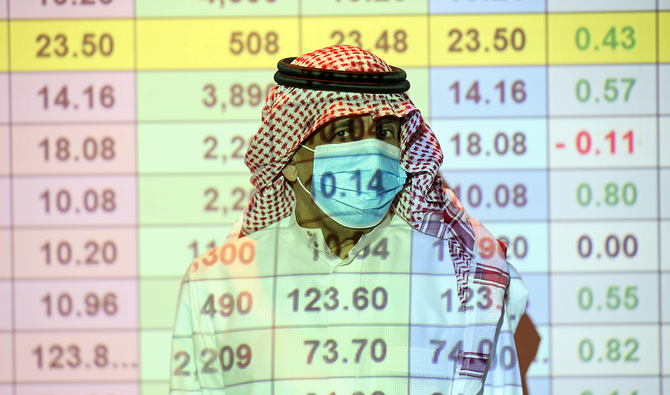
A Saudi trader wears a mask as he monitors stock information at the Saudi stock market in Riyadh, Saudi Arabia. (Reuters/File)
Short Url
Updated 27 December 2020
Follow

Sunday trading: Abo Moati is the top gainer

  • TASI rises 0.4% to 8,741 points, turnover at $2.61bn

RIYADH: Saudi Arabia’s benchmark Tadawul All Share Index (TASI) gained 0.4 percent, or 38 points, to close at 8,741 points on Sunday.

Total turnover reached SR9.8 billion ($2.61 billion), with advance-decline ratio at 131:52.

Blue chip SABIC rose 0.8 percent to SR102, while oil giant Saudi Aramco edged up 0.1 percent to SR35.05.

Aseer gained 0.7 percent to SR16.70 after the company said the court order, issued on Nov. 8, 2020, in its favor against the seller of the land located in north of Riyadh became final and enforceable.

Ayyan climbed 1.3 percent to SR17.34. The firm appointed Aljazira Capital as a financial advisor for acquiring stakes held by non-controlling shareholders in its 69.9 percent-owned subsidiary Al Ahsa Medical Services Co.

Abo Moati was the top gainer, rising 7.6 percent to SR55.20.

On the other hand, Naseej was the top decliner, slipping 4.3 percent to SR106.80.

Powered by Argaam


G7 countries to release oil reserves in global push to tackle Iran war energy price surge 

Updated 8 sec ago
Follow

G7 countries to release oil reserves in global push to tackle Iran war energy price surge 

  • IEA expected to recommend the largest oil reserve release in the agency’s history

RIYADH: Germany, the US, Japan and Austria will release part of their oil reserves after the International Energy Agency recommended the release of 400 million barrels of oil ‌from stockpiles, the largest ‌such move in IEA ​history.

Germany’s Economy ⁠Minister ​Katherina Reiche ⁠confirmed on Wednesday the government plans to limit petrol price increases at filling stations to once a day and to introduce more stringent antitrust regulation of the sector.

She did not ⁠give an exact timing for ‌those measures, but added that ‌the US and ​Japan would be the ‌largest contributors to the release of the ‌oil reserves.

The announcements did not stop oil prices rising, with Brent crude up 3.26 percent to $90.66 a barrel at 4:29 p.m Saudi time, and West Texas Intermediate up 3.12 percent to $86.05. Both were some way below the $119 a barrel seen earlier in the week.

“The situation regarding oil supplies is tense, as the Strait of Hormuz is currently virtually impassable,” Reiche said.

“We will comply with this request and ‌contribute our share, because Germany stands behind the IEA’s most important principle: mutual ⁠solidarity,” Reiche ⁠said about the IEA’s request.

According to a statement by Reiche’s ministry, Germany will contribute 2.64 million tonnes of oil. This corresponds to 19.51 million barrels.

Reiche stressed there was no supply shortage in the country, which has a legally mandated reserve of oil and oil products intended to cover 90 days’ demand.

The IEA’s move comes as countries are grappling with ​soaring crude prices amid ​the US-Israeli war with Iran. 

Austrian Economy Minister Wolfgang Hattmannsdorfer said his country was releasing part of the emergency oil reserve and extending the national strategic gas reserve, adding: “One thing is clear: in a crisis, there must be no crisis winners at the expense of commuters and businesses.”

Acting ahead of the IEA move, G7 ​member Japan announced plans to release 15 days' worth of ‌private-sector oil reserves and one month's worth of state oil reserves.

“Rather than wait for formal IEA approval ‌of a coordinated international reserve release, Japan will act first to ease global energy market supply and demand, releasing reserves as early as the 16th of this month,” Prime Minister Sanae Takaichi said in a broadcast statement.