

Saudi crown prince sparks rush for vaccine as registrations jump fivefold

1 / 2
Saudi Crown Prince Mohammed bin Salman receives his first dose of a coronavirus vaccine on Dec. 25, 2020. (SPA)
2 / 2
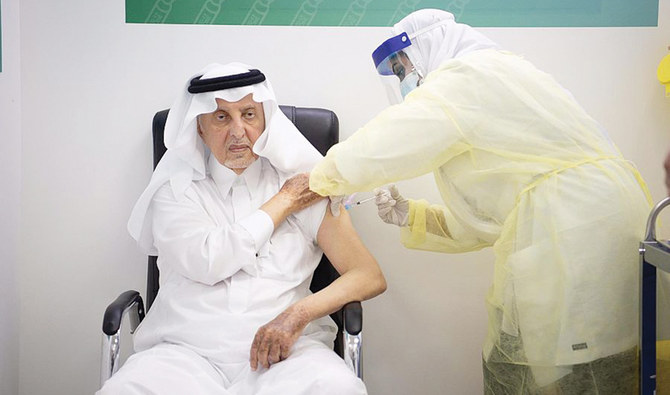
Makkah Gov. Prince Khaled Al-Faisal receives his first dose of a coronavirus vaccine on Saturday. (SPA)
Short Url
Updated 27 December 2020
Follow

Saudi crown prince sparks rush for vaccine as registrations jump fivefold

  • Numbers seeking vaccination increased fivefold in a single hour: Al-Rabiah
  • Prince Khalid Al-Faisal received his first COVID-19 vaccine at a vaccination center in Jeddah on Saturday

JEDDAH: Saudi Arabia’s Crown Prince Mohammed bin Salman appears to have sparked a surge in the number of people registering for the coronavirus vaccine after receiving the inoculation on Friday.
About 500,000 people had registered for the vaccine by last Thursday following the Ministry of Health’s rollout of a national inoculation plan.
But after the crown prince was photographed one day later receiving the vaccine, the numbers seeking vaccination jumped fivefold in a single hour, according to Health Minister Dr. Tawfiq Al-Rabiah.
The vaccination rate is also believed to have surged with up to 10,000 already inoculated.

Meanwhile, the number of active coronavirus cases in the Kingdom continues to fall, with the Kingdom yet to record a single case of the COVID-19 variant.
However, Dr. Abdullah Asiri, assistant deputy minister for preventive medicine, urged caution, warning that the virus remains a real threat.
“What we know for sure is that these mutations won’t change the behavior of the virus or its ability to infect people, resulting in severe symptoms,” he said.
Asiri said that the mutation did not appear to cause more harm than other strains of the coronavirus.
“Without mutations, coronaviruses rarely infect people twice since the antibodies created by the human body are able to prevent a second infection for up to four or five months,” he said.

FASTFACT

362,066 Total cases

In Jeddah, health workers have begun receiving coronavirus vaccinations at the King Abdul Aziz International Airport South Terminal inoculation centers as the first phase of the program focuses on front-line staff.
Daily cases in the Kingdom are holding steady below the 200 mark, with 163 new cases reported on Saturday, raising the number to 362,066 since the beginning of the pandemic.
There are currently 2,886 active cases, 383 of which are in critical care.
A total of 189 new recoveries were also reported, raising the number to 353,004. The Kingdom’s recovery rate is at 97.49 percent.
Eight people died due to complications caused by COVID-19 infection, raising the total number of deaths to 6,176.


Defense Minister Prince Khalid bin Salman inaugurates 3rd World Defense Show in Riyadh

Updated 09 February 2026
Follow

Defense Minister Prince Khalid bin Salman inaugurates 3rd World Defense Show in Riyadh

  • Organized by the General Authority for Military Industries (GAMI), the five-day event will run until February 12
  • Prince Khalid launched several key initiatives, including the launch of several defense firms and signing of cooperation deals
  • The show is also serving as a launchpad for cutting-edge security technologies across various government sectors

RIYADH: Minister of Defense Prince Khalid bin Salman inaugurated the third edition of the World Defense Show (WDS) on Sunday on behalf of Crown Prince Mohammed bin Salman.

Organized by the General Authority for Military Industries (GAMI), the five-day event will run until February 12, showcasing the Kingdom’s rapid strides toward strategic independence and technological leadership in the defense sector.

The 2026 edition features a purpose-built venue with a 2,700-meter runway for live air and land demonstrations, underscoring the show’s status as a premier global defense event.

GAMI Governor Ahmad Al-Ohali emphasized that the show reflects Saudi Arabia's commitment to localizing over 50 percent of military spending in line with Vision 2030, fostering an integrated ecosystem where government bodies and international partners collaborate on innovation.

The event brings together official delegations, government entities, and leading international companies specializing in the defense and security sectors. (SPA)

Strategic agreements and major launches

The opening day witnessed significant activity at the Saudi Arabian Military Industries (SAMI) Group pavilion, where Prince Khalid launched several key initiatives:

New entities: The inauguration of SAMI Land Company, SAMI Autonomous Company, and the SAMI Land Industrial Complex.

Supply chain: The unveiling of the SAMI Local Content Program (RUKN) and the HEET Program.

International cooperation: A memorandum of understanding was signed between the Saudi General Authority for Defense Development and the Korean Agency for Defense Development to cooperate on advanced military research.

Defense deals: The Minister signed cooperation agreements with Slovakia, Malaysia, and Somalia.

Defense Minister Prince Khalid signed cooperation agreements with Slovakia, Malaysia, and Somalia. (SPA)

Technological debuts & innovations

The show is also serving as a launchpad for cutting-edge security technologies across various government sectors:

AI-Powered Lucid Gravity: Public Security debuted its advanced Lucid Gravity electric security vehicle at the Ministry of Interior's pavilion. The vehicle integrates state-of-the-art artificial intelligence and specialized security equipment designed to accelerate emergency response times and support field operations.

Public Security’s advanced Lucid Gravity electric security vehicle is displayed at the Ministry of Interior’s pavilion. (SPA)

This high-tech addition highlights Public Security’s shift toward smart, sustainable security solutions. By leveraging predictive intelligence and advanced command-and-control systems, the Lucid Gravity exemplifies the ministry’s commitment to protecting the Kingdom through integrated technological innovation and sustainable mobility.

Smart Helmet: Also at the Ministry of Interior’s pavilion, the General Directorate of Civil Defense unveiled its smart helmet. Designed to revolutionize public safety and emergency response, the helmet features day-and-night cameras and specialized sensors to detect hazardous materials in hard-to-reach locations.

The device serves as a mobile command node, delivering live video feeds directly to command-and-control centers. By enabling real-time data analysis and faster decision-making, the smart helmet significantly reduces incident response times and enhances personnel safety in high-risk environments.

The smart helmet features day-and-night cameras and specialized sensors to detect hazardous materials in hard-to-reach locations. (SPA)

Border Security: The General Directorate of Border Guard (GDBG) showcased an integrated security system featuring radar and thermal cameras capable of detecting drones and classifying moving targets to protect critical infrastructure.

It also functions as an early warning system for critical facilities and border areas and is fully integrated with command and control systems.

Border Guard's ntegrated security system features radar and thermal cameras capable of detecting drones and classifying moving targets to protect critical infrastructure. (SPA)

Counter-Terrorism: The Islamic Military Counter Terrorism Coalition (IMCTC) presented a comprehensive framework integrating intellectual, media, and military domains to combat extremism and terror financing.

Visitors are briefed on specialized programs designed to raise the readiness of national personnel and foster sustainable institutional cooperation among member states to combat extremism. On the event’s opening day, the pavilion hosted high-level delegations, including ministers, military leaders, and ambassadors who reviewed the coalition's pivotal role in coordinating international security efforts and commended its initiatives that support regional and global stability.

A view of the Islamic Military Counter Terrorism Coalition pavilion. (SPA)

Meteorology: The National Center for Meteorology (NCM) displayed advanced weather systems essential for ensuring the safety of the event's air shows and military operations.

At its dedicated pavilion, the NCM is showcasing its latest advanced meteorological technologies and systems. These solutions serve both the military and civilian sectors, providing accurate data to support beneficiary entities' operational processes and highlighting the center's pivotal role in national security and safety.

NCM's latest meteorological technologies and systems serve both the military and civilian sectors

World Defense Show CEO Andrew Pearcey noted that participation is expected to surpass previous records, reflecting the event's growing importance on the international stage. The show continues through February 12.