

Yemen’s new government sworn in, ending months of wrangling

1 / 2
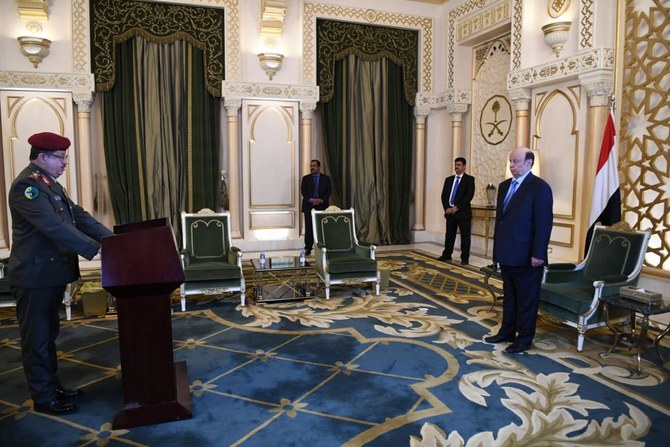
Yemen’s new unity government was sworn in on Saturday before President Abed Rabbo Mansour Hadi in Riyadh. (Saba News Agency)
2 / 2
Yemen’s new unity government was sworn in on Saturday before President Abed Rabbo Mansour Hadi in Riyadh. (Saba News Agency)
Short Url
Updated 26 December 2020
Follow

Yemen’s new government sworn in, ending months of wrangling

  • The new government is formed of 24 ministers, representing major political forces in Yemen
  • The prime minister said that his government is aware of the big challenges

AL-MUKALLA: Yemen’s new unity government was sworn in on Saturday before President Abed Rabbo Mansour Hadi in Riyadh, closing months of violence and political wrangling in southern Yemen provinces that weakened the anti-Houthi bloc.

Led by Prime Minister Maeen Abdul Malik Saeed, the new government is formed of 24 ministers, representing major political forces in Yemen, including the powerful Southern Transitional Council (STC).

Setting the new government’s priorities, the Yemeni president met with the ministers after the ceremony, in which he ordered them to focus their attention and efforts on addressing economic woes including managing a plunging currency, boosting revenues and defeating the Houthis, official news agency SABA reported. Hadi told the ministers that Yemenis are pinning hopes on this government to restore peace and stability to the liberated provinces, revive government bodies and unify forces to confront the Iran-backed Houthis.

“We want a revival of institutions, recovery of the economy, restoration of security and a confrontation of the coup. This in short is what awaits you,” Hadi said, pledging his full support and the dismissal of ineffective ministers. Addressing the ministers of defense and interior, Hadi said that the new government is responsible for merging and disarming factions, getting them under the state’s control and putting into place the remaining security and military components of the Riyadh Agreement.

“We want the temporary capital Aden free of all military units. Security services must carry out their duties. We do not want conflicts after today. No more blood. Our enemy is the Houthis,” he said. 

During the meeting, Hadi thanked Saudi Arabia for paving the way for the implementation of the Riyadh Agreement, expressing hope for a new bailout from the Kingdom to steady the country’s troubled economy. 

At the same time, the new prime minister said that his government is aware of the big challenges and would collectively work in accordance with agendas set by President Hadi.

After months of political stalemate, the Arab coalition announced on Dec. 11 that Yemeni parties would immediately implement security and military arrangements under the Riyadh Agreement, agreeing to form a new government when the deployment of forces came to an end. 

Under the supervision of the Saudi de-escalation committee in Yemen, hundreds of military troops from the former government and the STC departed contested areas in the southern province of Abyan. Military units also withdrew from Aden and were redeployed in battlefields with the Houthis. 

Positive news about the formation of the new government and its expected return to Aden have pushed the Yemeni riyal into recovering against foreign currencies. Moneychangers told Arab News on Saturday afternoon that the riyal surged to 720 against the US dollar after sinking to 920 a couple of weeks ago, shortly after ministers took the constitutional oath.



Thousands of Libyans gather for the funeral of Qaddafi’s son who was shot and killed this week

Updated 06 February 2026
Follow

Thousands of Libyans gather for the funeral of Qaddafi’s son who was shot and killed this week

  • As the funeral procession got underway and the crowds swelled, a small group of supporters took Seif Al-Islam’s coffin away and later performed the funeral prayers and buried him
  • Authorities said an initial investigation found that he was shot to death but did not provide further details

BANI WALID, Libya: Thousands converged on Friday in northwestern Libya for the funeral of Seif Al-Islam Qaddafi, the son and one-time heir apparent of Libya’s late leader Muammar Qaddafi, who was killed earlier this week when four masked assailants stormed into his home and fatally shot him.
Mourners carried his coffin in the town of Bani Walid, 146 kilometers (91 miles) southeast of the capital, Tripoli, as well as large photographs of both Seif Al-Islam, who was known mostly by his first name, and his father.
The crowd also waved plain green flags, Libya’s official flag from 1977 to 2011 under Qaddafi, who ruled the country for more than 40 years before being toppled in a NATO-backed popular uprising in 2011. Qaddafi was killed later that year in his hometown of Sirte as fighting in Libya escalated into a full-blown civil war.
As the funeral procession got underway and the crowds swelled, a small group of supporters took Seif Al-Islam’s coffin away and later performed the funeral prayers and buried him.
Attackers at his home
Seif Al-Islam, 53, was killed on Tuesday inside his home in the town of Zintan, 136 kilometers (85 miles) southwest of the capital, Tripoli, according to Libyan’s chief prosecutor’s office.
Authorities said an initial investigation found that he was shot to death but did not provide further details. Seif Al-Islam’s political team later released a statement saying “four masked men” had stormed his house and killed him in a “cowardly and treacherous assassination,” after disabling security cameras.
Seif Al-Islam was captured by fighters in Zintan late in 2011 while trying to flee to neighboring Niger. The fighters released him in June 2017, after one of Libya’s rival governments granted him amnesty.
“The pain of loss weighs heavily on my heart, and it intensifies because I can’t bid him farewell from within my homeland — a pain that words can’t ease,” Seif Al-Islam’s brother Mohamed Qaddafi, who lives in exile outside Libya though his current whereabouts are unknown, wrote on Facebook on Friday.
“But my solace lies in the fact that the loyal sons of the nation are fulfilling their duty and will give him a farewell befitting his stature,” the brother wrote.
Since the uprising that toppled Qaddafi, Libya plunged into chaos during which the oil-rich North African country split, with rival administrations now in the east and west, backed by various armed groups and foreign governments.
Qaddafi’s heir-apparent
Seif Al-Islam was Qaddafi’s second-born son and was seen as the reformist face of the Qaddafi regime — someone with diplomatic outreach who had worked to improve Libya’s relations with Western countries up until the 2011 uprising.
The United Nations imposed sanctions on Seif Al-Islam that included a travel ban and an assets freeze for his inflammatory public statements encouraging violence against anti-Qaddafi protesters during the 2011 uprising. The International Criminal Court later charged him with crimes against humanity related to the 2011 uprising.
In July 2021, Seif Al-Islam told the New York Times that he’s considering returning to Libya’s political scene after a decade of absence during which he observed Middle East politics and reportedly reorganized his father’s political supporters.
He condemned the country’s new leaders. “There’s no life here. Go to the gas station — there’s no diesel,″ Seif Al-Islam told the Times.
In November 2021, he announced his candidacy in the country’s presidential election in a controversial move that was met with outcry from anti-Qaddafi political forces in western and eastern Libya.
The country’s High National Elections Committee disqualified him, but the election wasn’t held over disputes between rival administrations and armed groups.