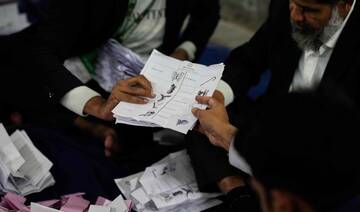
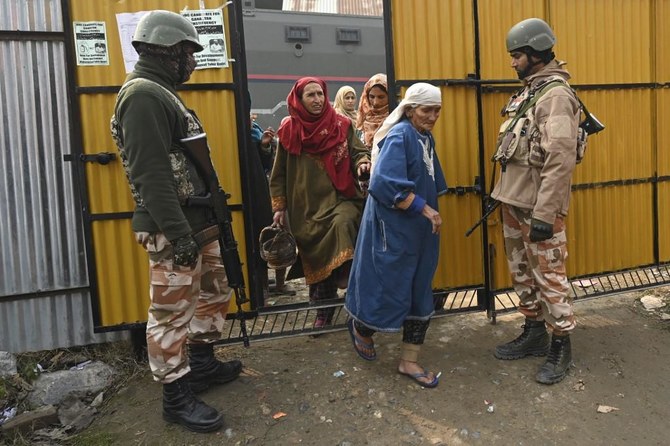
SRINAGAR, India: India’s government detained at least 75 Kashmiri political leaders and activists to forestall political unrest after an alliance of Kashmir’s regional political parties won a local election, leaders and a police official said on Saturday.
The District Council election, concluded early this week, was the first such exercise since Prime Minister Narendra Modi’s government last year revoked the special status of the Muslim-majority, Indian-controlled region. New Delhi then cracked down on the opposition and rounded up hundreds of people to preempt protests and violence.
The new detentions, including separatist leaders and members of the banned Jamat-e-Islami group, were for preventive custody, said a senior police official, who asked not to be identified in line with official policy.
India and Pakistan have claimed all of the Kashmir region since the partition of British-ruled India into Muslim Pakistan and Hindu-majority India in 1947. Two of the three wars they have fought have been over the Himalayan region.
The detentions undermine the verdict of the people, said Imran Nabi Dar, spokesman for the National Conference, a regional party and a key member of the alliance.
The alliance’s victory shows that Kashmiris have not accepted Modi’s decision to end Kashmir’s special status, said Omar Abdullah, a former chief minister and head of the National Conference.
After their release from lengthy detention, Abdullah and Mehbooba Mufti, chief of the Jammu and Kashmir People’s Democratic Party, announced the alliance in October to seek a peaceful restoration of Kashmir’s autonomy.


India detains 75 in Kashmir after local election
https://arab.news/pwh3y
India detains 75 in Kashmir after local election

- The new detentions, including separatist leaders and members of the banned Jamat-e-Islami group, were for preventive custody
Related

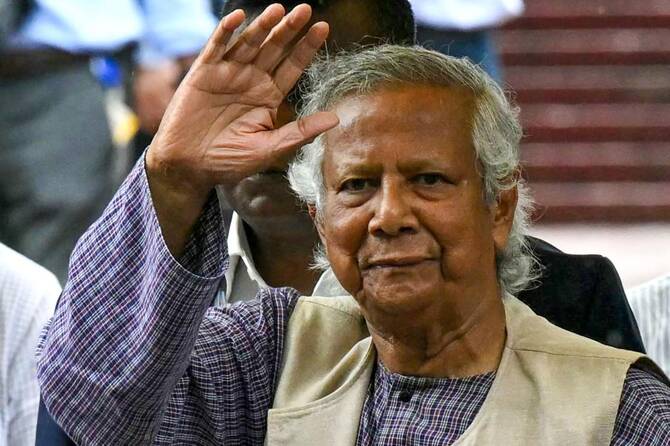
Bangladesh’s Yunus announces resignation, end of interim govt
- Yunus handed over power after congratulating the Bangladesh Nationalist Party and its leader Tarique Rahman
DHAKA: Bangladesh’s interim leader Muhammad Yunus stepped down on Monday in a farewell broadcast to the nation before handing over to an elected government.
“Today, the interim government is stepping down,” the 85-year-old Nobel Peace Prize winner said.
“But let the practice of democracy, freedom of speech, and fundamental rights that has begun not be halted.”
Yunus returned from self-imposed exile in August 2024, days after the iron-fisted government of Sheikh Hasina was overthrown by a student-led uprising and she fled by helicopter to India.
“That was the day of great liberation,” he said. “What a day of joy it was! Bangladeshis across the world shed tears of happiness. The youth of our country freed it from the grip of a demon.”
He has led Bangladesh as its “chief adviser” since, and now hands over power after congratulating the Bangladesh Nationalist Party (BNP) and its leader Tarique Rahman on a “landslide victory” in elections last week.
“The people, voters, political parties, and stakeholder institutions linked to the election have set a commendable example,” Yunus said.
“This election has set a benchmark for future elections.”
Rahman, 60, chief of the BNP and scion of one of the country’s most powerful political dynasties, will lead the South Asian nation of 170 million.
‘Rebuilt institutions’
Bangladeshi voters endorsed sweeping democratic reforms in a national referendum, a key pillar of Yunus’s post-uprising transition agenda, on the same day as the elections.
The lengthy document, known as the “July Charter” after the month when the uprising that toppled Hasina began, proposes term limits for prime ministers, the creation of an upper house of parliament, stronger presidential powers and greater judicial independence.
“We did not start from zero — we started from a deficit,” he said.
“Sweeping away the ruins, we rebuilt institutions and set the course for reforms.”
The referendum noted that approval would make the charter “binding on the parties that win” the election, obliging them to endorse it.
However, several parties raised questions before the vote, and the reforms will still require ratification by the new parliament.
The BNP alliance won 212 seats, compared with 77 for the Jamaat-e-Islami-led alliance, according to the Election Commission.
Jamaat chief Shafiqur Rahman conceded on Saturday, saying his party would “serve as a vigilant, principled, and peaceful opposition.”
Newly elected lawmakers are expected to be sworn in on Tuesday, after which Tarique Rahman is set to become Bangladesh’s next prime minister.
Police records show that political clashes during the campaign period killed five people and injured more than 600.
However, despite weeks of turbulence ahead of the polls, voting day passed without major unrest and the country has responded to the results with relative calm.