



LONDON: In 2005 and at the young age of 23, Nayla Tueini’s whole world virtually turned on its head. The young journalist was catapulted from undergoing a month-long training program at French newspaper Le Figaro, to being prepped to take over and lead one of the biggest Lebanese dailies, Annahar, after her father — renowned editor and publisher Gebran Tueini — was killed in a car bombing in the Mkalles suburb of Beirut.
“It was a big challenge because I was a young woman starting. I was in the middle of people with 30, 40, 50 years’ experience, and they were saying, ‘Who is she? She doesn’t know anything. She’s just a young girl … trying to have fun’,” Nayla told Arab News.
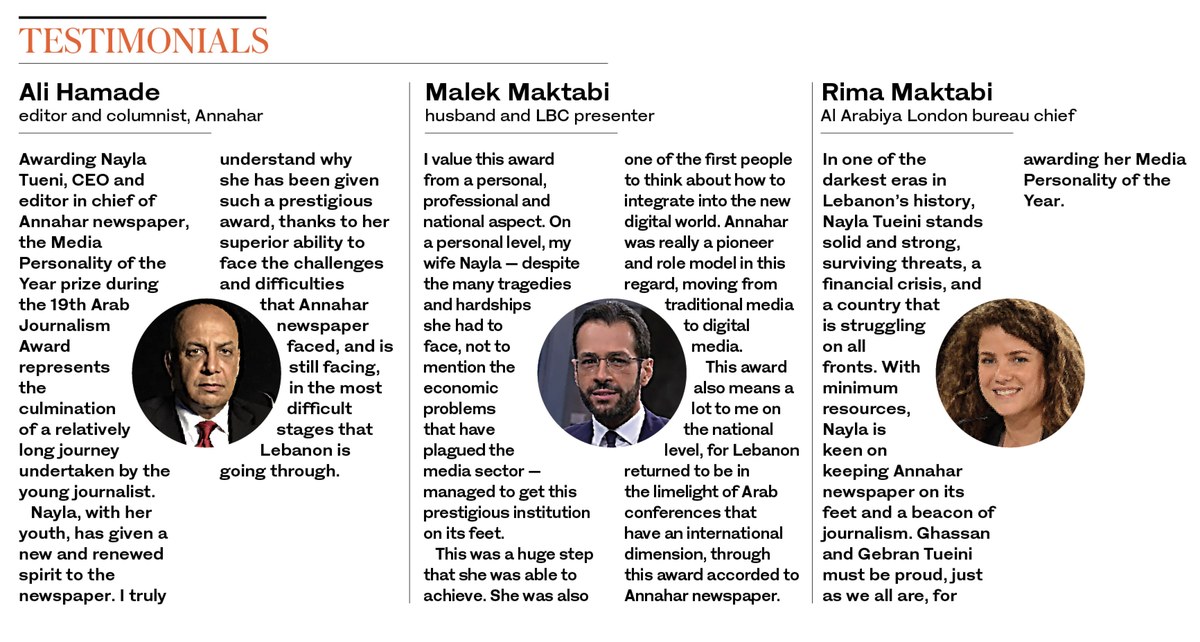
Fifteen years later, at 38, she has been chosen as Media Personality of the Year at the 2020 Arab Media Forum, held virtually from Dubai, for her strong and steady leadership of Annahar through what has been described as Lebanon’s worst year ever.
In 2020, the country experienced an unprecedented financial crisis, devaluation of the local currency, the coronavirus pandemic, the Aug. 4 blast at the Port of Beirut and ongoing political corruption.
The blast shattered the newspaper’s glass-facade headquarters, which stands not 700 meters from the port.
“Having 30 injured people, blood around you, all the glass, everything … it was worse than the war,” Nayla said. “It was a difficult year.”
Fresh start
After arduous work and training in journalism and newspaper management under her grandfather Ghassan Tueini from 2005 until his death in 2012, Nayla took the reins of Annahar with fresh, innovative ideas to inspire a publication suffering in an industry in turmoil.
When the alarm bells of the financial crisis began sounding in 2017, newspapers across the country started shutting their printing presses, some even shuttering their doors.
Nayla was adamant to both keep the paper circulating and adapt to the rapid rise of digital and social media, regardless of some of her colleagues’ criticisms.
When we have a success it’s not just for me, it’s for all the Annahar family. They were what made Annahar keep going.
Nayla Tueini
“They weren’t taking me seriously (with) what I was trying to do, and when I started the online … and becoming 24 hours with live news, with putting lifestyle, health, gossip … and to have more readers in a different way with videos, web TV, social media,” the mother of three said.
“They’d say, ‘No, we have a scoop, we have to keep it for tomorrow.’ And I just always told them … ‘You can’t with all those changes. Social media users, bloggers, if they have news they’ll post it as soon as they have it. They won’t wait for the next day’,” she said, adding that the paper now also includes special issues, editions and the newly launched Annahar Al-Arabi that caters to a pan-Arab audience and was announced mere hours before the port blast.
Looking back at her 15 years at the paper, Nayla humbly brings it all down to the editors, reporters and photographers who have kept Annahar going.
“When we have a success it’s not just for me, it’s for all the Annahar family,” she said. “When they suffered with me, they really suffered. They were what kept Annahar alive. They were what made Annahar keep going.”
Among the special issues that came out was the Naharoki edition, the feminine connotation of “Your Day” in Arabic, which featured an altered version of the Lebanese national anthem across the front page that included the line “for the women,” given that the original only has “for the men.”
During the October 2019 nationwide protests against government corruption, “we had an idea of doing Naharoki for women because the women were leading the revolution, they were the frontlines, and we decided to salute the women in the national anthem,” Nayla said.
Another special issue came out in 2018. Annahar printed eight blank, white pages of its newspaper, and had its website and social media accounts do the same, in protest at the government-formation paralysis that had seen the country without an official Cabinet for months.
“Just to make a shock and to really express the anger we had, we had to put white paper, not black, because we believe in a better tomorrow, we believe in better days, we believe in everything, but we’re speechless in front of those conditions,” Nayla said.
A calling
Despite the uphill task of trying to keep a newspaper afloat in an ailing economy, the editor in chief asserts that she is a fighter.
“I always try, even when I’m not feeling well, to be positive and optimistic. Someone always sends me a message from above. I always get a sign that, ‘You have to continue in the toughest of times. You have to fight’,” she said.
“To lead this institution, and to follow what it was made to be from my father and my grandfather and to make it what it is — this responsibility is in my hands.”
Ever since Annahar started publishing in 1933, Nayla said, the paper and its team have always had two role models: Her grandfather Ghassan and her father Gebran.
Ghassan was a “calm person who’d think, who was a philosopher, who believed in Lebanon and the Arab countries and would defend the Lebanese and Arab projects,” she said.
“Then you had Gebran who was full of passion and full of revolution and believed in the freedom of journalism and freedom of speech. For him, Lebanon was more than his love — he gave his life for Lebanon. And he knew he was going to give his life to Lebanon for this freedom and for this journalism, and for Lebanon to be free from any interference.”


