Retired Aramco staff recall Christmas festivities in Saudi Arabia’s Eastern Province

1 / 4
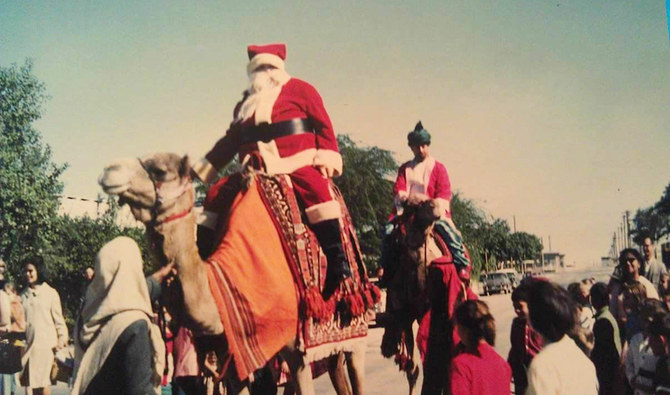
Celebrating Christmas in Dhahran and Ras Tanura is a tradition that goes back to the late 1940s, when the first American families arrived in Saudi Arabia after the Second World War. (Supplied)
2 / 4
Photo/Supplied
3 / 4
Photo/Supplied
4 / 4
Photo/Supplied
Short Url
Updated 27 December 2020
Follow

Retired Aramco staff recall Christmas festivities in Saudi Arabia’s Eastern Province

  • Remembering his childhood in Saudi Arabia, Tim Barger, author of “Christmas in Khobar,” was 8-years-old when he used to live with his family at an Aramco residential camp

JEDDAH: Expats in Saudi Arabia have been celebrating Christmas for decades, especially in the country’s Eastern Province, where Aramco foreign employees have freely marked the occasion among others.
Ali M. Baluchi, a retired Aramco executive, told Arab News that he used to help his company’s foreign colleagues prepare for their Christmas celebration.
“I remember when I was young, I assisted them decorate their buildings in preparation for the occasion. Inside Aramco, they were able to practice Christmas freely,” he said.
He added that he has recently sent letters to his old friends, most of whom are now retired, on Christmas, congratulating them on the occasion and reminding them of the old days. Wishing his friends joyous and beautiful holidays, Baluchi said in his letter: “I still recall the 1950s when I was engaged with some of you in decorating the Dhahran quarter-riyal banquet room for the New Year’s Eve.”
He added that he remembers the competition among the residents for the best decorated house in the community. “Those days were nice and beautiful and it reminds me of the good days we all shared and enjoyed together immensely.”

According to a print edition of the Saudi Aramco World, issued in 1975, celebrating Christmas in Dhahran and Ras Tanura was a tradition that went back to the late 1940s, when the first American families arrived after the Second World War.
The article added that another familiar custom was decorating windows and rooftops with wreaths, lights, reindeers, sleighs and snowmen — an artificial one, of course, since Dhahran’s lawns are at their greenest around Christmastime.
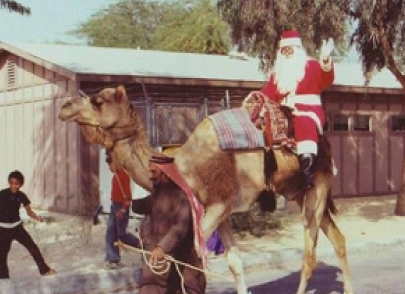


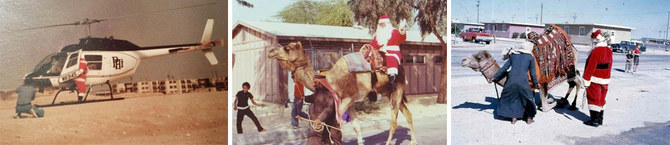
Santa used to come by helicopter from Dhahran, and then ride a camel down Surf Avenue with the entire camp lining the street. Dhahran was a melting pot of different cultures and religions. (Supplied)

Remembering his childhood in Saudi Arabia, Tim Barger, author of “Christmas in Khobar,” was 8-years-old when he used to live with his family at an Aramco residential camp.
He said that Alkhobar in the early 1950s was the most cosmopolitan city in eastern Arabia. In an article posted in Aramco ExPats, he said that the Saudis seemed to be relaxed about Christmas which they considered an Eid holiday for Americans.

“They knew it was a celebration of the birth of Jesus; he was respected within the Qur’an, and it seemed like a reasonable thing for Christians to commemorate,” he said. “The one thing that they couldn’t really comprehend was ‘how did the bearded, fat guy in a red outfit figure into this whole program?’  It was an endless source of fascination,” Barger, who died in 2018 at the age of 72, added.
In her article posted in January on Aramco ExPats, Anushka Bose, who grew up in Dhahran after her family moved to Saudi Arabia in 2006, wrote: “As I drove around the city of Dhahran, I saw houses with lights, wreaths, inflatables, and I thought to myself, how beautiful is it that so many religions and cultures live among Dhahran and yet during festive seasons like Christmas, Ramadan, Eid — we all come together to bring out the energy in the city.”

FASTFACTS

• In the Eastern Province, Aramco’s foreign employees have freely marked Christmas for decades.

• There used to be a competition among the residents for the best decorated house in the community.

She added that decorating the Christmas tree with her family is something she looks forward to for months.
“With Christmas music, chocolates, laughing about inside jokes, and spending grueling efforts to fit all the ornaments on the tree, it’s a very special time for my family.
“A parent’s greatest joy is to be in the company of their kids, especially during such a beautiful season, and I recognize this feeling every time I look at their faces. They lead busy lives, sometimes full of uncertainty, but always have enough energy and affection left to make the best of each day,” Bose said.
In her Aramco ExPats blog, Bose published her interview with Adrienne Costas Belaire, who had grown up between Ras Tanura and Udhailiyah as a child. She asked her about her favorite memories from her childhood in Aramco.
“The memories of Halloween and Christmas were the best. Santa used to come by helicopter from Dhahran, and then ride a camel down Surf Avenue with the entire camp lining the street, it was very cool,” she said. “And Halloween was huge; the camp was completely full of expats who were mostly Americans, and we used to take out pillowcases to collect all our candy, and we had a huge costume parade, too.”


Saudi Arabia witnessing comprehensive cultural development, says expert

Updated 14 February 2026
Follow

Saudi Arabia witnessing comprehensive cultural development, says expert

  • Clotilde Entrecanales of Acciona hails pace of change in Kingdom

JEDDAH: Museums, exhibitions and art centers play a crucial role in the development of free and educated societies such as the one now burgeoning in Saudi Arabia, an expert has told Arab News.

Clotilde Entrecanales, the Spanish art historian and cultural executive who heads Acciona Living & Culture, a leading creator of technology-driven interactive museums, exhibits and events, said the Kingdom is making efforts to expand the role of culture development to show the world the greatest possible cultural offer.

She added that the Kingdom has quickly infused new energy into the region, and is rapidly establishing itself as a global cultural hub through massive investment in world-class museums, public art and international events, aligning with its 2030 vision.

She said: “With around 70 percent of the population under 30, cultural consumption looks very different than in Europe or the US. These spaces can’t feel like quiet, isolated institutions … they need to be fast, dynamic, brave and deeply connected to the city, blending into everyday urban life rather than sitting apart from it.”

Asked about the role of these sites in the evolving global cultural landscape, particularly in emerging cultural hubs like Saudi Arabia, Entrecanales said: “Our vision is to be a purpose-led partner for cultural and entertainment institutions, helping them be more relevant, connected, inclusive and sustainable.”

She added: “In emerging cultural hubs like Saudi Arabia, that approach feels especially relevant. The cultural transformation underway is moving fast — with major heritage and cultural destinations being developed and opened to the world.”

Speaking about her impression of the Kingdom’s approach to blending heritage with modernity face, Entrecanales said: “Others who attempt to achieve this balance often end up turning heritage into a theme, a layer of storytelling or a cultural program. What feels different about Saudi’s approach is how much pressure there is to treat heritage as the foundation, not just the surface.

“When you’re building at this speed and scale, there’s always a risk that history becomes a backdrop instead of a backbone. The projects that work best are the ones that slow down just enough to let the past set the rhythm for the present.”

Regarding opportunities and challenges, she said: “The opportunity is nothing less than positioning Saudi Arabia as a global cultural center. The challenge, as always, lies in balancing the speed and scale of that ambition with long-term sustainability and a sense of authenticity that remains credible and rooted.”

She added: “You can really feel this in places like the Islamic Arts Biennale, which shows hundreds of historical artefacts of the Islamic world, while re-framing them through contemporary scenography and designs by some of the best design studios in the world; or in AlUla, a world-class heritage site that hosts a major contemporary platform like Desert X, allowing ancient context and present-day artistic practice to coexist in a way that feels genuine.”

Under her guidance, ACCIONA Cultura aspires to create museums and cultural experiences that function as landmarks while fostering sustainable, inclusive and immersive interactions.

She elaborated on how the company is integrating technology, culture, and sustainability to preserve and promote the region’s cultural heritage: “We always start with human connection and storytelling: what’s the story, what should people leave with? Tech comes later.”

Recently, ACCIONA Cultura has been involved in significant projects in Saudi Arabia and is looking forward for more.

She said: “Right now, for example, we’re designing and curating a museum gallery where the entire space is shaped by the practice of a Saudi artist. Another example is the Net Zero exhibition at the King Abdulaziz Center for World Culture (Ithra), where we brought together Saudi and international artists to explore sustainability and our relationship with the planet, including voices like Dina Haddadin, Mohammed Al-Faraj, and Zahrah Al-Ghamdi.”

She added: “One of the projects I’m most proud of isn’t a museum, but our NEXT IN Summit, which we’ve hosted in two editions in our ACCIONA Campus in Madrid, highlighting the Kingdom’s unprecedented cultural momentum as it builds future-facing institutions with a startup mindset.”

About further collaboration with Saudi Arabia, she said: “Let’s just say … something’s definitely simmering in the kitchen.”

Commenting on being recognized among the Blooloop 50 Museum Influencers for 2025, she said: “It means a lot. More than anything, it feels like a nod to the years of teamwork and dedication behind Acciona Cultura, rather than to me personally.”