UN rights office slams Trump pardon of Blackwater guards

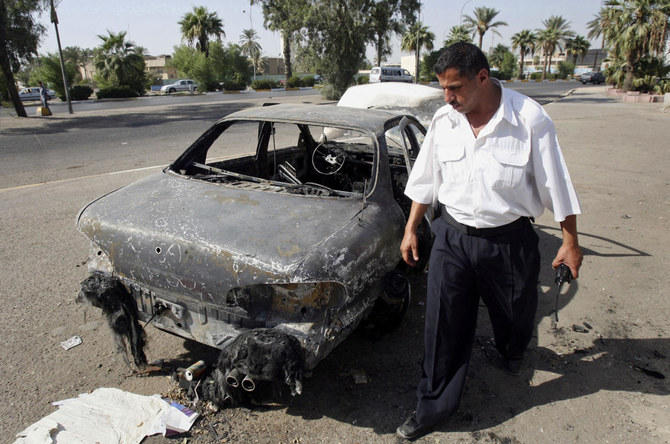
An Iraqi traffic policeman inspects a car destroyed by a Blackwater security detail in Al-Nisoor Square in Baghdad, Iraq. (File/AP)
Short Url
Updated 24 December 2020
Follow

UN rights office slams Trump pardon of Blackwater guards

  • The four massacred 17 Iraqi civilians in an unprovoked rampage in Baghdad in 2007
  • The killings sparked global outrage

NEW YORK: The Office of the UN High Commissioner for Human Rights (OHCHR) on Thursday said it is “deeply concerned” about US President Donald Trump’s pardon of four military veterans working in Iraq for the private security contractor Blackwater.
The four had been tried and convicted in what a US court determined were unjustified and unprovoked shootings with machine guns and grenade launchers that left 17 Iraqi civilians dead.
The massacre took place on Sept. 16, 2007, in Baghdad’s Nisour Square. One of the victims was a medical student who died with his mother. Two were boys aged 9 and 11. The killings sparked global outrage.
Blackwater was founded by former Navy SEAL member Erik Prince, who later became a close ally of Trump.
The military company won billions of dollars in contracts, and multiple accusations of abuses did nothing to stop its expansion.
The four Blackwater guards — Nicholas Slatten, Paul Slough, Evan Liberty and Dustin Heard — were convicted in 2014.
Slatten, who fired the first shots, was given a life sentence, while the three others were sentenced to 30 years in prison for manslaughter.
The protracted investigation saw 30 Iraqi witnesses who lost their loved ones in the shootings travel to the US to testify at the trial.
“Pardoning (the four) contributes to impunity and has the effect of emboldening others to commit such crimes in the future,” said Marta Hurtado, OHCHR spokeswoman.
The White House said in a statement that the four had “a long history of service to the nation,” and their pardon is “broadly supported by the public” and some elected officials.
The White House also claimed that there are evidentiary issues around the case, and that the lead Iraqi investigator on whom prosecutors relied “may have had ties to insurgent groups himself.”
The statement recast the story of the massacre as an unfortunate moment where suddenly “the situation turned violent, which resulted in (the) deaths and injuries of Iraqi civilians.”
But Hurtado said: “By investigating these crimes and completing legal proceedings, the US complied with its obligations under international law.”
She added: “Victims of gross human rights violations and serious violations of international humanitarian law also have the right to a remedy. This includes the right to see perpetrators serve punishments proportionate to the seriousness of their conduct.”
She urged Washington “to renew its commitment to fighting impunity for gross human rights violations and serious violations of international humanitarian law, as well as to uphold its obligations to ensure accountability for such crimes.”


UN’s development chief says living conditions in Gaza are worst he has ever seen

Updated 4 sec ago
Follow

UN’s development chief says living conditions in Gaza are worst he has ever seen

  • Alexander De Croo urges Israeli authorities to allow more access for removal of debris, provision of temporary housing, and efforts to restart the private sector
  • 90 percent of territory’s population living amid rubble in ‘extremely painful’ and dangerous circumstances, he says after 3-day visit to Gaza

NEW YORK CITY: The head of the UN Development Programme said on Tuesday that living conditions in Gaza are the worst he has witnessed in his career, as he urged Israeli authorities to grant more access for the removal of debris, the provision of temporary housing, and private-sector recovery efforts.
Speaking in East Jerusalem after a three-day visit to Gaza, Alexander De Croo said 90 percent of the territory’s population was living amid rubble in “extremely painful” and dangerous circumstances.
“I have been minister of development for six years in the past; this is the worst living conditions that I have ever seen,” he said.
Teams from his agency are focusing their recovery efforts in Gaza on three main areas, he explained: the removal of rubble and other solid waste, temporary housing, and restarting parts of the private sector.
UNDP has removed about 5 percent of the rubble from the war-ravaged enclave so far, De Croo said, but at the current pace clearing it all will take seven years.
“90 percent of the people of Gaza today live in the middle of that rubble, which is extremely dangerous,” he warned, adding that unexploded ordnance and other health risks pose additional ongoing dangers to residents.
Regarding housing, he said most people were living in what he described as very rudimentary tents. UNDP has built 500 “recovery housing” units and has a further 4,000 ready to go, but he estimated that between 100,000 and 203,000 units were needed to provide even the most basic improvements to shelter.
“This is definitely not reconstruction,” he said. “But it’s an improvement on what is available for the moment.”
His agency’s third area of focus is restoration of the private sector, which he said has been “in hibernation.” It aims to help businesses resume operations and provide income for residents through limited investments and cash-for-work programs, including the processing of food.
The main request his agency is making to Israeli authorities is greater access for the delivery of materials and equipment, De Croo said, including heavy machinery for the removal of debris, and components for temporary housing.
“We understand the security concerns of the Israeli authorities,” he said. “But that would not be a reason to not provide organizations such as UNDP, other UN organizations and international (nongovernmental organizations) the more access that is definitely needed to be able to help more people.”
Asked about Israel’s objections to the deployment of large bulldozers and the provision of additional housing units, De Croo said discussions with Israeli officials often centered on “dual-use” concerns over materials that could potentially have military as well as civilian applications.
“We are in continuous discussions with the Israeli authorities on what are the right conditions to have more access,” he said, adding that UNDP takes steps to ensure all materials are used solely for humanitarian purposes.
He reiterated his call for expanded access to enable support for humanitarian and recovery efforts, and said such assistance is an obligation on every state.
“We really have only one ask: Please provide organizations such as UNDP and the others the necessary access to be able to provide the humanitarian and recovery support,” he added.