

Iranian foreign minister’s remarks ‘irresponsible,’ could harm Kabul-Tehran ties — Afghan Taliban

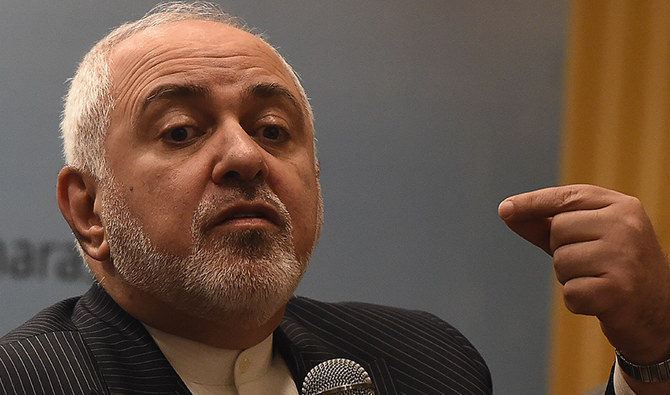
Iran's Foreign Minister Mohammad Javad Zarif addressees a gathering in Mumbai on January 17, 2020. (AFP)
Short Url
Updated 23 December 2020
Follow

Iranian foreign minister’s remarks ‘irresponsible,’ could harm Kabul-Tehran ties — Afghan Taliban

  • Calls Zarif’s statements in a Tolo News interview “irresponsible and misconceived” 
  • Zarif had said the Taliban were still on Iran’s “terrorist group” list, had committed many “terrorist acts“

ISLAMABAD: An Afghan Taliban spokesman on Tuesday rejected the Iranian foreign minister’s remarks in a recent interview calling the Taliban a “terrorist group,” saying Mohammad Javad Zarif’s statement had the potential to damage relations between Iran and Afghanistan.

In an interview with Afghanistan’s Tolo News last week, when asked if Iran considered the Afghan Taliban a “terrorist group,” Zarif replied: “Our definition of the Taliban is that the Taliban has committed many terrorist acts. Before naming the Taliban as terrorists, the Taliban is a group in Afghanistan that has committed terrorist acts ... Regarding recognition of the Taliban as a terrorist group, we have not removed the Taliban [from our list of] terrorist groups, in our laws.” 

“Such irresponsible and misconceived remarks by Iranian officials have the potential of harming relations between two friendly and neighboring countries,” Taliban spokesperson Zabihullah Mujahid said in a statement. “The Islamic Emirate is not in any UN terror list … We urge Iranian officials to avoid aggravating Afghan sensitives with such irresponsible statements.”

He added: “We have always sought and continue to seek positive relations with all neighboring countries including Iran and we expect the same from them, therefore we call on them to desist from such remarks in the future so that we are also not forced to respond.”


Pakistan disburses record $9.2 billion agricultural loans in FY25, central bank says

Updated 5 sec ago
Follow

Pakistan disburses record $9.2 billion agricultural loans in FY25, central bank says

  • State Bank says farm lending rose 16 percent year-on-year to Rs2.58 trillion
  • Inflation eased to 5.8 percent in January as GDP growth hits 3.7 percent in Q1 FY26

KARACHI: Pakistan disbursed a record Rs2.58 trillion ($9.2 billion) in agricultural loans during fiscal year 2024–25, a 16 percent increase from the previous year, State Bank of Pakistan (SBP) Governor Jameel Ahmad said on Thursday while chairing a meeting of the Agricultural Credit Advisory Committee (ACAC).

Agricultural financing is considered critical to Pakistan’s rural economy, where farming contributes nearly one-fifth of GDP and employs a large share of the workforce. The government has repeatedly emphasized expanding credit access to small farmers as part of broader efforts to boost productivity, stabilize food supply and support economic recovery under an IMF-backed reform program.

According to official data shared at the meeting, agricultural credit disbursement reached Rs2.58 trillion in FY25, marking a record high. In the first half of FY26 alone, banks disbursed Rs1,412 billion in agricultural loans, while the number of borrowers increased to 2.97 million.

“During fiscal year 2025, record agricultural loans of Rs2.58 trillion were disbursed, reflecting an annual growth of 16 percent,” the State Bank governor said, according to a statement issued after the meeting.

He added that Pakistan had regained macroeconomic stability and that the economy was moving toward sustainable growth.

The governor said GDP growth in the first quarter of FY26 stood at 3.7 percent, while full-year growth was projected between 3.75 percent and 4.75 percent.

He also noted that headline inflation had declined to 5.8 percent in January 2026.

The committee reviewed measures to further expand credit access, including greater use of the central bank’s Zarkhez-e scheme to facilitate agricultural lending. Members also discussed promoting electronic warehouse receipt financing to enhance post-harvest liquidity and reduce distress sales of crops.

The statement said the purpose of electronic warehouse receipt financing was to “reduce forced sales of crops and strengthen linkages within the agricultural market.”

Agricultural lending has been a focus of Pakistan’s financial inclusion strategy, particularly as policymakers seek to improve rural incomes, stabilize food prices and strengthen export-oriented crop production amid broader economic reforms.