ISLAMABAD: Chyang Dawa Sherpa is in Pakistan to attempt what no human has ever achieved before: a winter ascent of the K2, the world’s second-tallest mountain. He is not alone.
Over five dozen climbers from different countries, including Nepal, the United States, Iceland, and Spain, have arrived in Pakistan in the last few weeks to claim one of the last remaining great prizes in mountaineering.
Of the 14 mountains that rise to at least 8,000 meters (26,246 feet), the K2, at 28,251 feet, is the only one unclimbed during winter, when avalanches are an ever-present risk, temperatures can fall to -65C and winds blow with the power of cyclones. The mountain has earned the nickname ‘savage mountain’ or ‘killer mountain’ for the large number of mountaineers — 86 — who have lost their lives climbing it.
In 2008, 11 mountaineers from international expeditions died on the K2 in what is considered the single worst accident in the history of mountaineering on the peak.
“I really want to make this mountaineering dream come true,” Sherpa, 38, who is leading a team of climbers from over 15 countries to K2’s peak, told Arab News.

Nepali climber Chyang Dawa Sherpa talks to Arab News in Islamabad, Pakistan, on December 19, 2020 (AN photo by Nisar Ali)
The K2 straddles the Pakistan-China border and though it is about two and a half football fields shorter than Everest, it is widely considered earth’s toughest and most dangerous mountain to climb. In fact, a winter ascent has only been attempted five times prior to 2019, according to the National Geographic.
“K2 is very technical and also very cold, very harsh weather, it’s very challenging,” said Sherpa, who until last year was the youngest person in the world to have summited all 14 peaks over 8,000 meters other than the K2. His younger brother has now broken his record. “People who tried and failed; they say it’s very cold. They never see the sun on this mountain.”
When asked if he was afraid to attempt the winter summit of the K2 given that so many others had failed and many had died, Sherpa smiled and said: “This is a mountain … it’s risky, there is danger … Sometimes airplanes also crash but people don’t stop flying. In mountaineering [it is] also the same: some people [go] missing, some accidents [happen] but we don’t care. We keep trying.”
Over 300 climbers have scaled the K2 in spring and summer and none in winter. Italians Achilli Compagnoni and Lino Lacedelli were the first climbers to reach its summit in the summer of 1954.
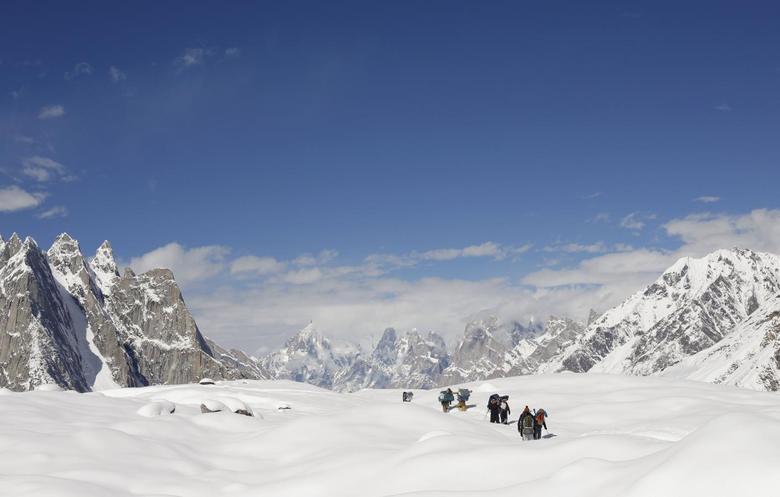
Trekkers and porters hike down the Baltoro glacier in the Karakoram mountain range in Pakistan, on September 7, 2014. (REUTERS)
Gilgit-Baltistan Tourism Director Iqbal Hussain said three teams of climbers had been given permits for the K2 winter expedition this year.
“Two teams of climbers have kicked off their expeditions while the third team, comprising more than fifty members from over fifteen countries, will leave Skardu on December 21,” he said.
Geographically, Pakistan is considered a climbers’ paradise, rivalling Nepal for the number of peaks over 7,000 meters. Other than being home to the K2, Pakistan also has four of the world’s 14 summits higher than 8,000 meters.
Northern Pakistan’s unscarred beauty was once a major tourist attraction but the industry was destroyed by years of violence, starting in the early 2000s when militant attacks led to a decrease in the number of expeditions and wrecked communities dependent on climbing for income.
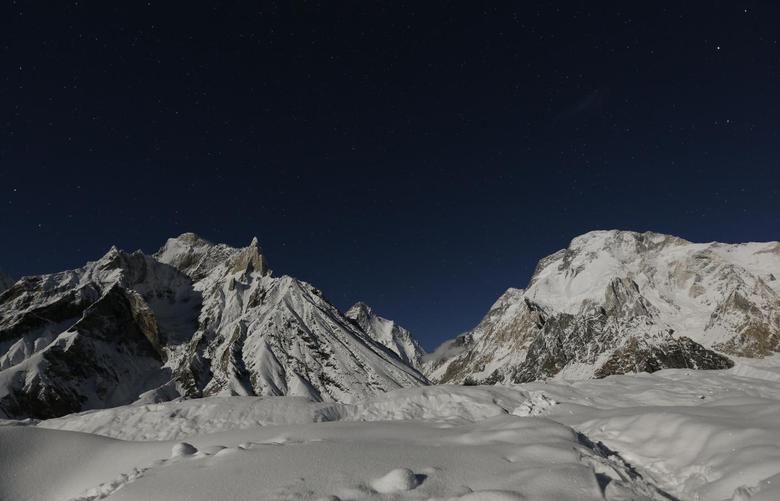
The world's second largest mountain, K2 (seen in the distance), and Broad Peak (R) in the Karakoram mountain range in Pakistan, on September 7, 2014 (REUTERS)
But security has improved dramatically in recent years, with militant assaults down sharply in the mainly Muslim country of 220 million people.
Hussain said the trekking business had also picked up again in recent years and the K2 winter expedition had gained momentum since 2017.
“Despite the fear of coronavirus, three international teams are vying to defeat K2 in the winter,” Hussain said. “This is a good omen for Pakistan’s tourism sector.”
Sherpa’s team, the largest one attempting the winter summit this year, plans to reach the K2 base camp by December 24. The team comprises 27 climbers from Nepal and 23 from Britain, Germany, Switzerland, Belgium, Bulgaria, Netherlands, Poland, Greece, Spain, Canada, Finland, USA, Chile, Italy,
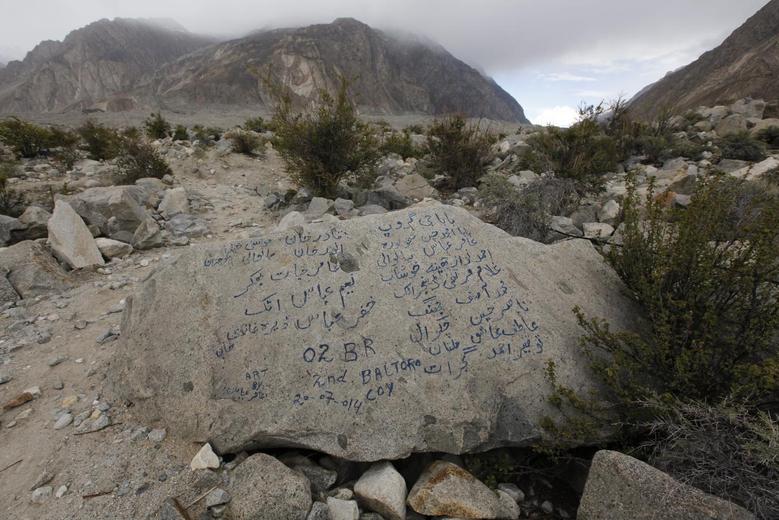
The names of the porters and members of a recent K2 trekking tour are written on a glacial stone along the K2 base camp trek near Korophong in the Karakoram mountain range in Pakistan, on September 11, 2014 (Reuters)
Romania and Slovenia. Climbers Imtiaz Hussain and Akbar Ali from Pakistan are also part of the expedition, which has been organized by Blue Sky Treks and Tours.
Another three-member team from Nepal, led by Mingma Gyalje Sherpa, left for the K2 base camp on December 8.
A third team, of three members, John Snorri from Iceland and Pakistanis Mohammad Ali Sadpara and his son Sajid Sadpara, has already reached the advanced base camp. The group had planned to fix lines up to camps 1 and 2 but bad weather forced them to return.
“The Christmas lights are ready. Today it is sunny, -11 Celsius and it feels like a heat wave, really nice. But the weather is still harsh in the mountains, so we are waiting,” Snorri wrote on his Facebook page on Sunday, sharing pictures of a tent decorated for Christmas.
“Limber winds and most chilly weathers are the main obstacles to reach the top of K2; that’s why no one can scale K2 in the winter,” Alpine Club General Secretary Karrar Haidri said, adding that he was hopeful of success since such a large number of climbers were attempting the ascent this year.
Noel Hanna, 54, from Northern Iceland, who has summited Mount Everest nine times and many other peaks, including K2 in the summer of 2018, said this year would be his first attempt to climb the K2 in winter.
“Obviously, I will just have to see how to cope with the cold carefully and will not act stupidly by putting my life into danger,” he told Arab News. “If the weather does not cooperate, then no one can summit. But we are hopeful that we may get favor from the weather and will succeed in our mission.”
Nepal-based Arnold Coster, 44, from Netherland, said he had climbed mountain peaks above 8,000 meters 21 times in his life.
“I have no fear of scaling K2 in the winter as we have enough experience,” he told Arab News. “We have a big team with well experienced climbers and are hopeful to defeat K2 in the winter.”