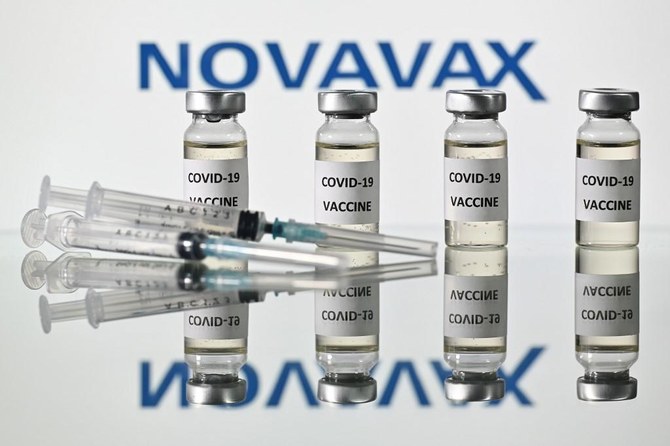
MANILA: The Philippines expects to receive 30 million doses of Novavax Inc’s COVID-19 vaccine by July next year, its foreign minister said on Monday, boosting the country’s effort to secure supplies to inoculate more than 100 million people.
Despite consultations with numerous vaccine makers, the Philippines has so far signed only one supply deal, with the help of its private sector, to acquire 2.6 million shots of a vaccine developed by AstraZeneca.
It plans to buy 25 million doses of a vaccine from China’s Sinovac Biotech for delivery by March and aims to secure between four and 25 million doses of vaccines from Moderna and Arcturus Therapeutics Holdings Inc.
“Thirty million dosages of the Indian-made Novavax vaccines are assured possibly with no cash advance. It will be available by July 2021,” Foreign Affairs Secretary Teodoro Locsin said in an interview with CNN Philippines.
He said the information came from Serum Institute of India, the world’s largest vaccine producer, and that the terms of the supply deal may be signed before the end of the year.
There was no immediate comment from the institute, which in August entered a supply and license agreement with Novavax Inc. for the development and commercialization of its COVID-19 vaccine candidate.
Talks with Moderna, which has been granted emergency use authorization by the US Food and Drug Administration, will begin next week, Locsin said.
With 459,789 infections and 8,947 deaths, the Philippines has recorded the second-highest number of COVID-19 infections and casualties in Southeast Asia after Indonesia.

Philippines to get 30 million doses of Novavax COVID-19 vaccine
https://arab.news/4fsqn
Philippines to get 30 million doses of Novavax COVID-19 vaccine
- The Philippines has so far signed only one supply deal with the help of its private sector
- It plans to buy 25 million doses of a vaccine from China’s Sinovac Biotech for delivery by March
Indonesia’s new state mosque to hold first Eid prayers this year
- Mosque is located in Nusantara Capital City on Borneo island, a $32bn project set for 2045 completion
- Famous sculptor Nyoman Nuarta designed mosque, other government structures in new capital
JAKARTA: The state mosque in Indonesia’s planned new capital city, Nusantara, will hold its inaugural Eid Al-Fitr prayer this year, as the $62 million facility opens for its first run of Ramadan programs.
The Indonesian government has plans to relocate the capital to Borneo island to replace the overcrowded and sinking Jakarta on Java island, with the $32 billion megaproject scheduled for completion in 2045.
With a capacity of about 60,000 people, the mosque in East Kalimantan opened to the public last month, at the beginning of Ramadan.
“This mosque symbolizes that we are building the Nusantara Capital City with careful attention to spiritual, social and environmental aspects,” Troy Pantouw, spokesperson for the Nusantara Capital City Authority — the agency overseeing the new capital city — told Arab News on Saturday.
“We will hold Eid Al-Fitr prayers here and we are hoping that it would mark a historic momentum of unity here at Nusantara Capital City.”
Locally known as Masjid Negara, construction of the state mosque began in 2024. Its design was spearheaded by Balinese sculptor Nyoman Nuarta at the request of former President Joko Widodo.
Nuarta is one of Indonesia’s most famous visual artists and creator of the country’s tallest statue, Garuda Wisnu Kencana, located in Bali.
The 72-year-old is also the designer behind other main structures in Nusantara, including the new state palace.
This Ramadan marked many firsts for Masjid Negara, including its first taraweeh on Feb. 18, which was attended by thousands of worshippers in East Kalimantan.
In the same complex where the state mosque is located, the government has plans to build Christian churches, and Buddhist, Hindu and Confucian temples.
Indonesia, home to the world’s largest population of Muslims, officially recognizes Islam, Protestantism, Catholicism, Buddhism, Hinduism and Confucianism as religions.
“A church is now being built in the complex, and in the future there will also be houses of worship belonging to other religions. This reflects Nusantara’s values of harmony and respect,” Pantouw said.
“From the start, this area was designed to represent inter-religious harmony. We want the Nusantara Capital City to stand as a concrete example of how physical developments can be parallel to efforts to build tolerance in society.”