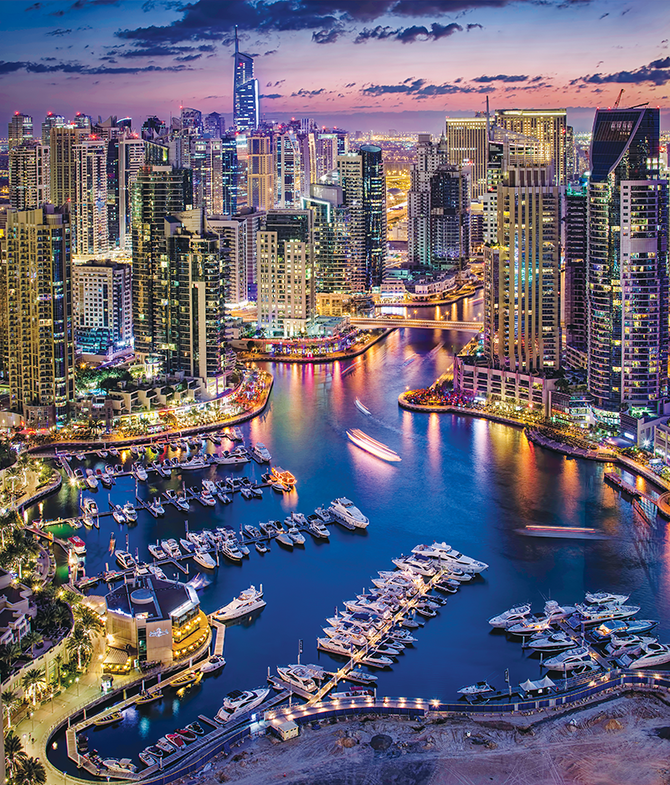

RIYADH: One hundred branded residences opened across the Middle East in 2020 despite strained economic conditions caused by the coronavirus pandemic, demonstrating the growing popularity of the real estate sector in the region.
According to a report by global real estate consultancy firm Savills, the growth of such schemes over the past decade has outpaced hoteliers, rising from 11 percent of the market in 2010 to 16 percent in 2020.
The study said that 11 new non-hotelier brands are expected to enter the market by 2025. However, hotel brands still dominate the hospitality industry, accounting for 84 percent of current schemes and 88 percent of the pipeline.
Marriott, whose brands include W, The Ritz-Carlton and St. Regis, is by far the leader in the sector and is set to remain so.
In terms of geography, Miami topped the list with 32 branded residential schemes, followed by Dubai (29) and New York (25).
Twelve countries will see their first branded residential projects over the next four years in locations as diverse as Iceland, Paraguay and Nigeria.
Egypt is forecast to grow the fastest of any country over the same time period, rising from one to 18 schemes. Other countries moving from a low base include Spain, with an increase of 83 percent, followed by Bahrain, Belize and Costa Rica, all set to see an 80 percent increase in such schemes. 
Commenting on the study, Richard Paul, head of professional services for the Middle East at Savills, said: “When it comes to price, branded residences achieve a premium, on average, of 31 percent over equivalent non-branded properties, although this figure can vary significantly by location. If we look at Dubai, it is forecast to become the largest city based on pipeline schemes, with a notable increase from Dubai-based master developer Emaar.”
The report found that Emaar has risen swiftly up the rankings of top branded residential developers, currently 10th on the list compared with 24th in 2007.
Jaidev Menezes, vice president of Marriott International’s mixed-use development, Middle East and Africa section, said: “Marriott International has a strong pipeline of branded residences across the Middle East and Africa. The growth of the portfolio is fueled by developer and purchaser demand for our well-established premium and luxury brands, and our proven track record of operating 100+ branded residence schemes globally.”
He added: “We see continued growth opportunities across the region for co-located projects (hotel/branded residences) as well as standalone branded residences across urban, suburban and resort markets.”
The UAE, Mexico and Brazil are expected to add the most schemes by number among the fastest-growing countries, which are classed as set to increase their existing supply by more than 50 percent.
Vietnam, the UK, Morocco, Malaysia, Australia and Saudi Arabia also have a pipeline of at least six schemes per country.
Commenting on the trend, Paul Tostevin, director, Savills World Research, said: “This mixture of emerging and established prime markets illustrates the ever-widening reach of the sector today. Now a proven formula, brands are confident entering new territories.”
According to Savills, the highest brand premiums are achieved in the emerging markets. Recently established markets such as Bangkok, Beijing and Phuket achieved premiums of between 40 percent and 45 percent, comparatively higher than more mature markets.
Truly emerging markets with few branded properties can command prices that are double to non-branded stock, as demonstrated by Almaty in Kazakhstan and Belgrade, with premiums of 150 percent and 120 percent, respectively.