

Post-Brexit talks continue as fish spat threatens Britain-EU agreement

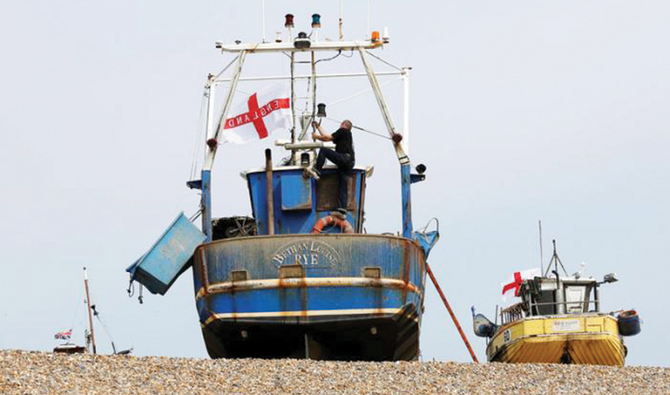
Fishing remains the main sticking point between Britain and the EU. (Reuters/File)
Short Url
Updated 20 December 2020
Follow

Post-Brexit talks continue as fish spat threatens Britain-EU agreement

  • Fishing is now the main obstacle to any pact

BRUSSELS: EU and UK negotiators pressed on with talks on Saturday with no sign of them breaking an impasse over post-Brexit fishing rights in time to save a trade deal.

Fishing is now the main obstacle to any pact that could be in place on Jan. 1 to prevent an economic jolt on both sides of the Channel as Britain leaves the single market.

“It remains very blocked,” one EU diplomat told AFP.

Another said Brussels had made Britain its last offer on fishing access and it was down now to UK Prime Minister Boris Johnson to decide whether he wants a deal.

“If Britain doesn’t accept the latest EU offer of it will be a ‘no deal’ over fish,” he warned.

The EU’s pointman in the talks, Michel Barnier, has proposed EU fishermen giving up nearly a quarter of the value of the fish they currently catch in UK waters. Britain is understood to be holding out for getting back much more than half.

The UK has suggested this compromise last for three years before it is renegotiated, whereas Europe is holding out for seven. “It’s all down to numbers now,” the second European diplomat said.

Barnier has consulted member states that share fishing waters with Britain, but has been told to stand his ground.

The European Parliament has highlighted a deadline of midnight on Sunday to receive a deal for review if MEPs are to ratify it before the end of the year.

Their UK parliamentary counterparts are in recess, but can be recalled within 48 hours to do likewise.

But EU capitals are not binding themselves to the European Parliament’s deadline. The second diplomatic source said Britain effectively had until the end of the year to make its mind up.

France’s European Affairs Minister Clement Beaune warned that time left to get a deal was “a matter of hours,” echoing words used by Barnier a day earlier.


Saudi minister at Davos urges collaboration on minerals

Global collaboration on minerals essential to ease geopolitical tensions and secure supply, WEF hears. (Supplied)
Updated 20 January 2026
Follow

Saudi minister at Davos urges collaboration on minerals

  • The reason of the tension of geopolitics is actually the criticality of the minerals

LONDON: Countries need to collaborate on mining and resources to help avoid geopolitical tensions, Saudi Arabia’s minister of industry and mineral resources told the World Economic Forum on Tuesday.

“The reason of the tension of geopolitics is actually the criticality of the minerals, the concentration in different areas of the world,” Bandar Alkhorayef told a panel discussion on the geopolitics of materials.

“The rational thing to do is to collaborate, and that’s what we are doing,” he added. “We are creating a platform of collaboration in Saudi Arabia.”

Bandar Alkhorayef, Saudi Minister of Industry and Mineral Resources 

The Kingdom last week hosted the Future Minerals Forum in Riyadh. Alkhorayef said the platform was launched by the government in 2022 as a contribution to the global community. “It’s very important to have a global movement, and that’s why we launched the Future Minerals Forum,” he said. “It is the most important platform of global mining leaders.”

The Kingdom has made mining one of the key pillars of its economy, rapidly expanding the sector under the Vision 2030 reform program with an eye on diversification. Saudi Arabia has an estimated $2.5 trillion in mineral wealth and the ramping up of extraction comes at a time of intense global competition for resources to drive technological development in areas like AI and renewables.

“We realized that unlocking the value that we have in our natural resources, of the different minerals that we have, will definitely help our economy to grow to diversify,” Alkhorayef said. The Kingdom has worked to reduce the timelines required to set up mines while also protecting local communities, he added. Obtaining mining permits in Saudi Arabia has been reduced to just 30 to 90 days compared to the many years required in other countries, Alkhorayef said.

“We learned very, very early that permitting is a bottleneck in the system,” he added. “We all know, and we have to be very, very frank about this, that mining doesn’t have a good reputation globally.

“We are trying to change this and cutting down the licensing process doesn’t only solve it. You need also to show the communities the impact of the mining on their lives.”

Saudi Arabia’s new mining investment laws have placed great emphasis on the development of society and local communities, along with protecting the environment and incorporating new technologies, Alkhorayef said. “We want to build the future mines; we don’t want to build old mines.”