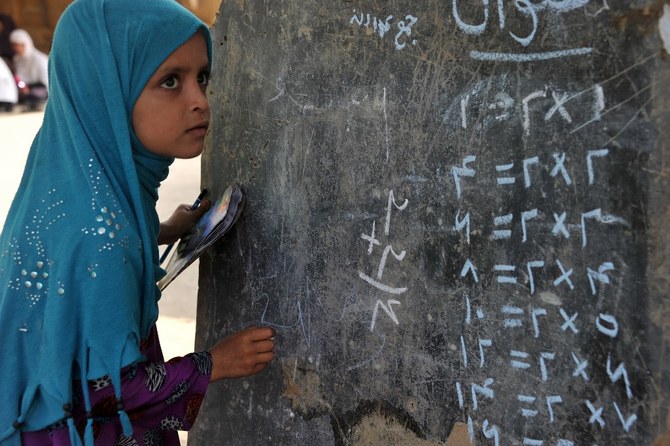

KABUL: In an unprecedented move, the Taliban have agreed to a United Nations Fund for Children (UNICEF) program to provide access to education to over 100,000 Afghan girls and boys in regions under the group’s control, UNICEF and the Taliban confirmed on Saturday.
The breakthrough follows nearly two years of discussions between the UN agency and Taliban leaders based in Qatar. According to UNICEF’s estimates, 3.7 million children are out of school in Afghanistan, where decades of armed conflict destroyed educational infrastructure. Sixty percent of out-of-school children are girls, who during Taliban rule from 1996 until the group’s ouster in a US-led invasion in 2001 were barred from education.
“The agreement with the Taliban is to scale-up Community Based Education (CBE) classes up to 4,000 and reach around 100,000-140,000 children, including girls,” Sam Mort, UNICEF Afghanistan chief of communication, advocacy and civic engagement, told Arab News.
On the basis of the agency’s agreement with the Taliban, UNICEF will enlarge its already existing CBE program with funding from Global Partnership for Education, the Bill and Melinda Gates Foundation and the European Commission, Mort said. “We expect these classes to start early next year, when schools across Afghanistan resume, and the start date will be in line with precautions around the COVID-19 pandemic.”
CBE classes are normally established in community buildings or houses. Each class can accommodate 25-35 students and girls are taught by female teachers.
The UNICEF initiative started from a polio campaign in 2018.
“Since 2018, we started exploring how to further the polio outreach … and we started these conversations at the local level, which then took place in Doha, at a higher level, and it really became a conversation about what other services the Taliban and their community wanted,” Mort said.
“And so the conversation evolved … and the Taliban said, ‘Why just two drops of polio vaccine? Why can’t we expand into other services for children?’ And that is the background against which we started discussions around increasing access to education for every child.”
During discussions in Doha, the Taliban, Mort added, were “willing to accept girls’ education until the end of primary school,” but under the current agreement it will be the first three years of school. The program will be implemented UNICEF’s partners in cooperation with the Taliban.
Zabihullah Mujahid, a spokesman for the Taliban, told Arab News that further discussions were needed between the group and UNICEF for the implementation of the project. Neither UNICEF nor Taliban were able to estimate how much the program will cost.
“This is a good thing. It is a vital issue, people need education, particularly our war-torn and impoverished areas where people have been deprived from education,” Mujahid said.
“We support and approve this … it is not clear how many of the classes will be for boys and how many for girls, but both girls and boys will study.”
Afghan government officials did not respond to requests for comment. Education ministry spokeswoman Najiba Aryan told Arab News that UNICEF had not informed the ministry about the agreement.
“But we welcome any move that enables Afghans to earn education,” she said.
Canada-based Afghan analyst Said Azam described the development as the “best news” since the Taliban ouster.
“Hopefully, with this, all educational facilities in the country are designated and recognized immune from any violent action by Taliban,” he told Arab News.
Former Afghan government adviser Torek Farhadi said that when only 17 percent of Afghan women are literate, the Taliban agreeing for girls to go to school is “great news for Afghanistan.”
“For Afghanistan, it is better that its children have access to schooling than being deprived (of it), because some areas are not controlled by its struggling government,” he told Arab News, adding that “in the past, high ranking-officials in the government side have pocketed the money given by donors meant to build schools.”