

UK-EU face weekend ‘last attempt’ to get trade deal

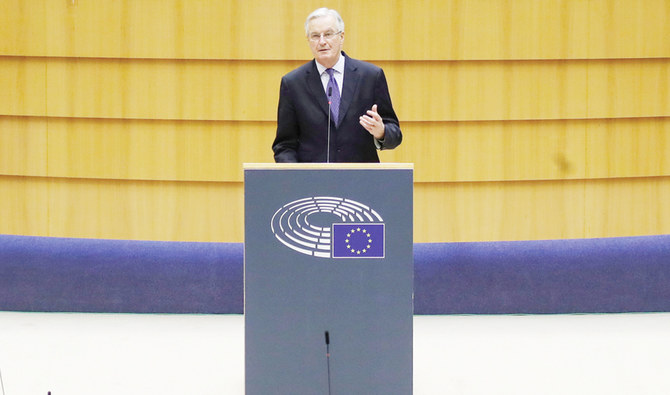
EU chief Brexit negotiator Michel Barnier addresses the European Parliament in Brussels. (Reuters)
Short Url
Updated 19 December 2020
Follow

UK-EU face weekend ‘last attempt’ to get trade deal

  • Fishing rights in British waters is the most notable obstacle to avoid a costly changeover in the new year

BRUSSELS: The EU and the United Kingdom are heading into the weekend on a “last attempt” to clinch a post-Brexit trade deal, with EU fishing rights in British waters the most notable remaining obstacle to avoid a chaotic and costly changeover in the new year.

British Prime Minister Boris Johnson said Friday that the only way to get a deal is for the 27-nation bloc to compromise since “the UK has done a lot to try and help, and we hope that our EU friends will see sense and come to the table with something themselves.”
“That’s really where we are,” Johnson said, adding “no sensible government” could agree to the EU demands as they stand.
EU chief negotiator Michel Barnier told the EU parliament both sides were in the “home straight of the negotiations,” which have already come a long way in nine months of talks but are still short of a final compromise.
Barnier called it “a very serious and somber situation” if a deal falls through, with the jobs of hundreds of thousands of people at stake.
The European Parliament has set a Sunday night deadline for the talks since it still will have to approve any deal before Dec. 31, when a transition period following Britain’s Jan. 31 withdrawal from the EU will expire.
“It’s the moment of truth,” Barnier said. “We have very little time remaining — just a few hours.”
A failure to reach a post-Brexit deal would lead to more chaos on the borders at the start of 2021 as new tariffs would add to other impediments to trade enacted by both sides. The talks have bogged down on two main issues over the past days — the EU’s access to UK fishing waters and assurances of fair competition between businesses.
“We have reached the hard nuts to crack,” Barnier said. Johnson has made fisheries and UK control over its waters a key demand in the long saga of Britain’s departure from the EU.

HIGHLIGHTS

• A failure to reach a post-Brexit deal would lead to more chaos on the borders at the start of 2021 as new tariffs would add to other impediments to trade enacted by both sides.

• The talks have bogged down on two main issues over the past days — the EU’s access to UK fishing waters and assurances of fair competition between businesses.

Barmier said the EU understood and respected the UK’s desire to rule its own waves, but said that “a credible period of adjustment” had to be given, if EU boats are to be kicked out of British waters despite centuries of tradition of sharing them.
On top of that, the more London denies access to its waters, the more the EU can impose duties and tariffs.
“The European Union also has to maintain its sovereign right to react or to compensate,” Barnier said, highlighting that the UK seafood industry is extremely dependent on exports to the 27-nation bloc.
The European Parliament issued a three-day ultimatum to negotiators to strike a trade deal if it’s to be in a position to ratify an agreement this year. European lawmakers said they will need to have the terms of any deal in front of them by late Sunday if they are to organize a special gathering before the end of the year.
If a deal comes later, it could only be ratified in 2021, as the parliament wouldn’t have enough time to debate a proposed agreement before that.
A trade deal would ensure there are no tariffs and quotas on trade in goods between the two sides, but there would still be technical costs, partly associated with customs checks and non-tariff barriers on services.



First EU–Saudi roundtable on critical raw materials reflects shared policy commitment

Updated 16 January 2026
Follow

First EU–Saudi roundtable on critical raw materials reflects shared policy commitment

RIYADH: The EU–Saudi Arabia Business and Investment Dialogue on Advancing Critical Raw Materials Value Chains, held in Riyadh as part of the Future Minerals Forum, brought together senior policymakers, industry leaders, and investors to advance strategic cooperation across critical raw materials value chains.

Organized under a Team Europe approach by the EU–GCC Cooperation on Green Transition Project, in coordination with the EU Delegation to Saudi Arabia, the European Chamber of Commerce in the Kingdom and in close cooperation with FMF, the dialogue provided a high-level platform to explore European actions under the EU Critical Raw Materials Act and ResourceEU alongside the Kingdom’s aspirations for minerals, industrial, and investment priorities.

This is in line with Saudi Vision 2030 and broader regional ambitions across the GCC, MENA, and Africa.

ResourceEU is the EU’s new strategic action plan, launched in late 2025, to secure a reliable supply of critical raw materials like lithium, rare earths, and cobalt, reducing dependency on single suppliers, such as China, by boosting domestic extraction, processing, recycling, stockpiling, and strategic partnerships with resource-rich nations.

The first ever EU–Saudi roundtable on critical raw materials was opened by the bloc’s Ambassador to the Kingdom, Christophe Farnaud, together with Saudi Deputy Minister for Mining Development Turki Al-Babtain, turning policy alignment into concrete cooperation.

Farnaud underlined the central role of international cooperation in the implementation of the EU’s critical raw materials policy framework.

“As the European Union advances the implementation of its Critical Raw Materials policy, international cooperation is indispensable to building secure, diversified, and sustainable value chains. Saudi Arabia is a key partner in this effort. This dialogue reflects our shared commitment to translate policy alignment into concrete business and investment cooperation that supports the green and digital transitions,” said the ambassador.

Discussions focused on strengthening resilient, diversified, and responsible CRM supply chains that are essential to the green and digital transitions.

Participants explored concrete opportunities for EU–Saudi cooperation across the full value chain, including exploration, mining, and processing and refining, as well as recycling, downstream manufacturing, and the mobilization of private investment and sustainable finance, underpinned by high environmental, social, and governance standards.

From the Saudi side, the dialogue was framed as a key contribution to the Kingdom’s industrial transformation and long-term economic diversification agenda under Vision 2030, with a strong focus on responsible resource development and global market integration.

“Developing globally competitive mineral hubs and sustainable value chains is a central pillar of Saudi Vision 2030 and the Kingdom’s industrial transformation. Our engagement with the European Union through this dialogue to strengthen upstream and downstream integration, attract high-quality investment, and advance responsible mining and processing. Enhanced cooperation with the EU, capitalizing on the demand dynamics of the EU Critical Raw Materials Act, will be key to delivering long-term value for both sides,” said Al-Babtain.

Valere Moutarlier, deputy director-general for European industry decarbonization, and directorate-general for the internal market, industry, entrepreneurship and SMEs at European Commission, said the EU Critical Raw Materials Act and ResourceEU provided a clear framework to strengthen Europe’s resilience while deepening its cooperation with international partners.

“Cooperation with Saudi Arabia is essential to advancing secure, sustainable, and diversified critical raw materials value chains. Dialogues such as this play a key role in translating policy ambitions into concrete industrial and investment cooperation,” she added.
