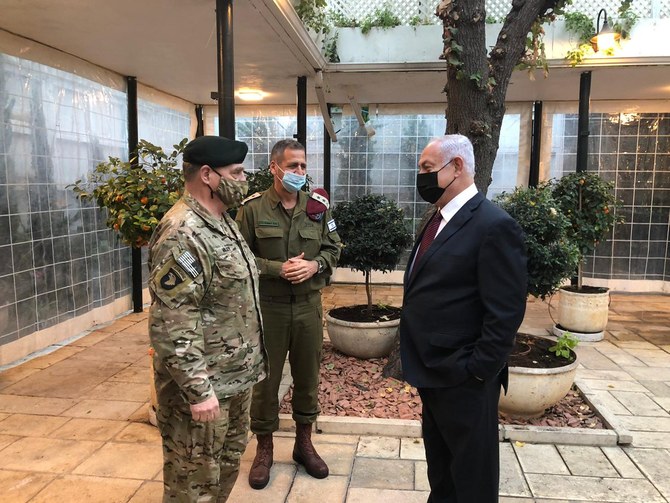
LONDON: Israeli Prime Minister Benjamin Netanyahu met Gen. Mark Milley, chairman of the US joint chiefs of staff, on Friday to discuss regional threats, especially Iranian aggression.
They also “discussed the ongoing military cooperation between the two countries and the opportunities that currently lie in the region,” Ofir Gendelman, the premier’s spokesperson, told the Arab media.
Netanyahu thanked Milley for the military cooperation, which has deepened in recent years, and expressed his desire to continue to deepen it, Gendelman added in a tweet.
Earlier on Friday, Netanyahu held a video conference with Milley, who is currently on a two-day visit to Israel.
The top army official said “on behalf of the entire US military, we thank Israel for their strong commitment to our partnership.”
Milley is on a whirlwind world tour, visiting Saudi Arabia, the UAE and Afghanistan to discuss the threats from Iran.
On Friday he met Defense Minister Benny Gantz, where they stressed the importance of continued pressure on the Iranian regime to halt its nuclear program.
“During the meeting, they (also) discussed the challenges and different changes in the operational situation in the Middle East,” the defense minister’s office said.
During his visit, Milley also met the Israeli Defense Forces (IDF) Chief of Staff Aviv Kohavi and other defense and military officials.

Israel’s Netanyahu, top US military discuss Iranian threat
https://arab.news/g9yh8
Israel’s Netanyahu, top US military discuss Iranian threat
- They also discussed the ongoing military cooperation between the two countries
- Milley is on a whirlwind world tour to discuss the threats from Iran
Israel confirms ban on 37 NGOs in Gaza
- UN has warned that this will exacerbate the humanitarian crisis in the war-ravaged Palestinian territory
- Several NGOS have said the requirements contravene international humanitarian law or endanger their independence
JERUSALEM: Israel on Thursday said 37 humanitarian agencies supplying aid in Gaza had not met a deadline to meet “security and transparency standards,” and would be banned from the territory, despite an international outcry.
The international NGOs, which had been ordered to disclose detailed information on their Palestinian staff, will now be required to cease operations by March 1.
The United Nations has warned that this will exacerbate the humanitarian crisis in the war-ravaged Palestinian territory.
“Organizations that have failed to meet required security and transparency standards will have their licenses suspended,” Israel’s Ministry of Diaspora Affairs and Combating Antisemitism said in a statement.
Several NGOS have said the requirements contravene international humanitarian law or endanger their independence.
Israel says the new regulation aims to prevent bodies it accuses of supporting terrorism from operating in the Palestinian territories.
Prominent humanitarian organizations hit by the ban include Doctors Without Borders (MSF), the Norwegian Refugee Council (NRC), World Vision International and Oxfam, according to a ministry list.
In MSF’s case, Israel accused it of having two employees who were members of Palestinian militant groups Islamic Jihad and Hamas.
MSF said this week the request to share a list of its staff “may be in violation of Israel’s obligations under international humanitarian law” and said it “would never knowingly employ people engaging in military activity.”
‘Critical requirement’
NRC spokesperson Shaina Low told AFP its local staff are “exhausted” and international staff “bring them an extra layer of help and security. Their presence is a protection.”
Submitting the names of local staff is “not negotiable,” she said. “We offered alternatives, they refused,” hse said, of the Israeli regulators.
The ministry said Thursday: “The primary failure identified was the refusal to provide complete and verifiable information regarding their employees, a critical requirement designed to prevent the infiltration of terrorist operatives into humanitarian structures.”
In March, Israel gave NGOs 10 months to comply with the new rules, which demand the “full disclosure of personnel, funding sources, and operational structures.”
The deadline expired on Wednesday.
The 37 NGOs “were formally notified that their licenses would be revoked as of January 1, 2026, and that they must complete the cessation of their activities by March 1, 2026,” the ministry said Thursday.
A ministry spokesperson told AFP that following the revocation of their licenses, aid groups could no longer bring assistance into Gaza from Thursday.
However, they could have their licenses reinstated if they submitted the required documents before March 1.
Minister of Diaspora Affairs and Combating Antisemitism Amichai Chikli said “the message is clear: humanitarian assistance is welcome — the exploitation of humanitarian frameworks for terrorism is not.”
‘Weaponization of bureaucracy’
On Thursday, 18 Israel-based left-wing NGOs denounced the decision to ban their international peers, saying “the new registration framework violates core humanitarian principles of independence and neutrality.”
“This weaponization of bureaucracy institutionalizes barriers to aid and forces vital organizations to suspend operations,” they said.
UN Palestinian refugee agency chief Philippe Lazzarini had said the move sets a “dangerous precedent.”
“Failing to push back against attempts to control the work of aid organizations will further undermine the basic humanitarian principles of neutrality, independence, impartiality and humanity underpinning aid work across the world,” he said on X.
On Tuesday, the foreign ministers of 10 countries, including France and Britain, urged Israel to “guarantee access” to aid in the Gaza Strip, where they said the humanitarian situation remains “catastrophic.”
A fragile ceasefire has been in place since October, following a deadly war waged by Israel in response to Hamas’s unprecedented October 7, 2023 attack on Israel.
Nearly 80 percent of buildings in Gaza have been destroyed or damaged by the war, according to UN data.
About 1.5 million of Gaza’s more than two million residents have lost their homes, said Amjad Al-Shawa, director of the Palestinian NGO Network in Gaza.


