

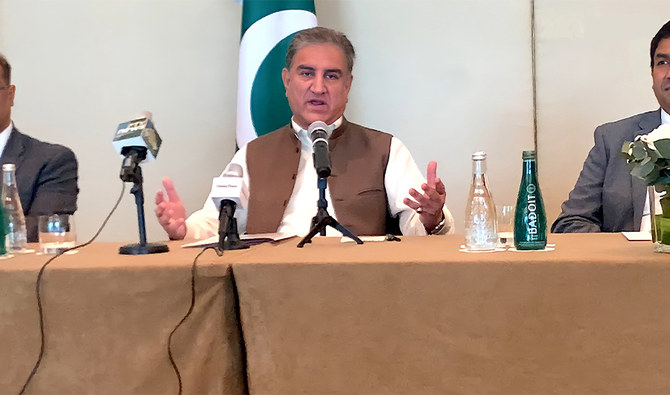

ABU DHABI: Pakistan’s stance on not recognizing Israel is unchanged, Foreign Minister Shah Mahmood Qureshi said in Abu Dhabi on Friday, adding that media reports that Pakistani officials had held secret meetings in Israel recently were “rubbish.”
The Israel Hayom and other Israeli media outlets reported this week in a veiled reference to Pakistan that a senior adviser to the leader of a large Muslim majority country in Asia that had no diplomatic ties with Israel had visited the Jewish state two weeks ago with a delegation of senior officials to discuss the potential normalization of relations.
Pakistan currently does not recognize the state of Israel over its thwarting of Palestinians’ aspirations for a state of their own. Israel captured the West Bank and East Jerusalem, the Sinai peninsula and the Gaza Strip and the Golan Heights in the 1967 Middle East war. Palestinians want East Jerusalem as the capital of their future free state, a demand Pakistan has supported for decades.
“Pakistan’s position vis-a-vis Israel has not changed,” Qureshi told reporters during a press conference in Abu Dhabi. The foreign minister is in the United Arab Emirates on a two-day visit.
In response to a question about recent media reports of covert meetings of a Pakistani delegation with top Israeli officials, Qureshi said the reports were “a load of rubbish.”
#WATCH: Pakistan’s stance remains unchanged on recognizing Israel said foreign minister @SMQureshiPTI on Friday terming media reports on an alleged secret meeting with Israelis a “load of rubbish" || #Pakistan #UAE #Israel
-
Read special by @asmaalizain https://t.co/34pYgdNqzw pic.twitter.com/kVCGXvha0W— Arab News Pakistan (@arabnewspk) December 18, 2020
“This issue keeps popping up ... We have already clarified this earlier and issued a statement on this that we have had no meetings with Israeli officials,” he said.
The foreign minister’s visit to the UAE comes at a time when international media has reported that the UAE had stopped issuing new visas to citizens of 13 mostly Muslim-majority countries, including Pakistan.
“This issue came under discussion and I gave my point of view and understood their point of view,” Qureshi said. “I also discussed this with the foreign minister and also with the prime minister [of the UAE].”
I am “hoping for a resolution soon,” the foreign minister added.
#WATCH: #UAE's new visa policy regarding #Pakistan was discussed with the Emirati leadership said foreign minister @SMQureshiPTI on Friday in Abu Dhabi || @foreignofficepk
-
Read special by @asmaalizain https://t.co/34pYgdNqzw pic.twitter.com/PEIjzrAKPW— Arab News Pakistan (@arabnewspk) December 18, 2020
The UAE is home to 1.2 million Pakistanis and the second largest host to overseas Pakistani workers and source of foreign remittances, after Saudi Arabia.
The foreign minister also said he had just received intelligence information that India was planning surgical strikes against Pakistan.
“This is a serious development and I have also learnt that they have tried to seek tacit approval from who they consider to be their partners,” Qureshi said.
Pakistan and India have long had tense relations and fought two wars over the disputed Himalayan region of Kashmir, which they both rule in part but claim in full.
On Thursday, Qureshi met Sheikh Abdullah bin Zayed Al Nahyan, Foreign Minister of the United Arab Emirates and discussed the “welfare” of Pakistanis living in the UAE and agreed to enhance trade and investment ties.
“Praising the hard work and dedication of Pakistani professionals and workers in the UAE, Foreign Minister Qureshi acknowledged their positive contribution toward progress and development of the UAE as well as Pakistan,” the foreign office said in a statement. “He discussed with his counterpart matters pertaining to Pakistani diaspora’s welfare and stressed the need to further strengthen people to people linkages between the two brotherly countries.”


