

LNG price rally exacerbates gas crunch in Pakistan and across Asia

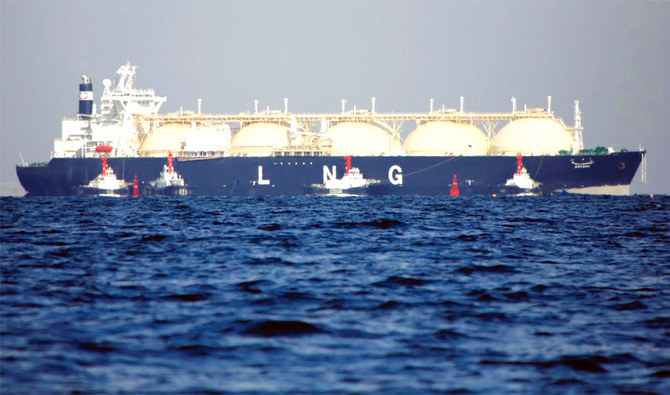
FILE PHOTO: A liquefied natural gas (LNG) tanker is tugged towards a thermal power station in Futtsu, east of Tokyo, Japan November 13, 2017. (REUTERS)
Short Url
Updated 18 December 2020
Follow

LNG price rally exacerbates gas crunch in Pakistan and across Asia

  • Companies from Pakistan to China have canceled a flurry of LNG tenders this week
  • The state buyer for Pakistan did not award an emergency tender seeking three cargoes for delivery in January after it received high prices

SINGAPORE: Surging spot prices for liquefied natural gas (LNG) are exacerbating a gas supply crunch in key fast-growing emerging markets in Asia just as a cold spell in other parts of the region boosts demand for the fuel.

Companies from Pakistan to China have canceled a flurry of LNG tenders this week, several trade sources said, as lofty prices risk pushing up the input costs of industries, which could make energy more expensive for consumers.

Benchmark Asia spot LNG prices have soared sevenfold since May to six-year highs, driven by production losses in Australia, Malaysia, Norway and Qatar combined with accelerating use in China, India and elsewhere.

“Buyers with no alternatives are now paying top-dollar for prompt cargoes in January,” said Chong Zhi Xin, a director at consultancy IHS Markit.

The state buyer for Pakistan — one of the fastest growing LNG markets — did not award an emergency tender seeking three cargoes for delivery in January after it received high prices, according to sources.

Power plants may opt to burn dirtier but cheaper fuel oil instead, the sources said, but are also facing rising prices in that market.

In India, Gujarat State Petroleum Corp. (GSPC) and Indian Oil Corp. did not award tenders seeking cargoes for January to February delivery, trade sources said.

In Bangladesh, gas shortages are already apparent.

“We don’t have gas for cooking until (the) afternoon during the winter season. There is hardly any gas. I can’t even boil water, let alone cook food,” said Sumi Akter, a mother of two in the capital, Dhaka.

Bangladesh has only imported one spot cargo this winter despite issuing several tenders over the past few months, a senior energy ministry official said.

“We have started importing from the spot market but the effort was not successful because of the abnormally high prices,” the official added.

Buyers in China, the world’s second largest LNG importer after Japan, are also feeling the pinch, with one steel trader reporting a rise of around 2% in billet prices in steelmaking hub Tangshan, due to the rise of natural gas prices. Steel mills use natural gas to fuel their furnace for production.

China’s top buyers PetroChina and China National Offshore Oil Corp. (CNOOC) did not award tenders placed on the Shanghai Petroleum and Natural Gas Exchange, while Guangzhou Gas and Guangdong Energy also recently did not award tenders, traders said.

Higher prices combined with a gas supply crunch have seen operations at liquefaction plants in some areas in northern China being cut by 20% to 40%, sources added.

Top LNG importer Japan’s spot power prices have also surged to their highest since July 2018 as cold weather has driven demand for heating.

“The LNG prices have reached a point where I don’t think it’s viable for some price-sensitive buyers,” a Singapore-based LNG trader said.

A tight shipping market has also accentuated the recent market supply pinch.

“It’s really the perfect storm, and the fundamentals have supported the price rally,” said Robert Sims, research director at Wood Mackenzie.


UN report says Ugandan troops helped South Sudan with deadly airstrikes

Updated 5 sec ago
Follow

UN report says Ugandan troops helped South Sudan with deadly airstrikes

  • Ugandan troops are deployed in South Sudan to help the government of President Salva Kiir against forces loyal to opposition figure Riek Machar
  • The attacks cited in the UN report involved widespread use of “improvised incendiary devices,” it said

NAIROBI: Uganda helped South Sudan carry out airstrikes that killed and badly burned civilians a year ago, according to a UN inquiry.
Joint aerial bombardments by South Sudan and Uganda “targeted civilian-populated areas predominantly affecting Nuer communities in opposition-affiliated areas,” said the report by the UN Commission on Human Rights in South Sudan, referring to South Sudan’s second-largest ethnic group.
Ugandan troops are deployed in South Sudan to help the government of President Salva Kiir against forces loyal to opposition figure Riek Machar, who was suspended as vice president in September after he faced criminal charges. Ugandan military authorities say troops are in South Sudan at the invitation of the South Sudan government and in accordance with a bilateral security agreement.
While Machar is currently on trial for offenses including treason, fighting has intensified in areas seen as his strongholds, where government troops are trying to disperse the rebels.
The attacks cited in the UN report involved widespread use of “improvised incendiary devices,” it said.
Ugandan forces entered South Sudan in March 2025 with military hardware, including tanks and armored vehicles. That happened shortly after a militia overran a military garrison near the Ethiopian border.
Weeks later, Machar was placed under house arrest for his alleged role in orchestrating the attack, charges that he denies. The government has since relied on aerial attacks to gain the upper hand in a widening conflict with Machar’s forces and other armed groups.
Ugandan President Yoweri Museveni sent his army to intervene in South Sudan’s 2013-2018 civil war on multiple occasions on behalf of Kiir’s forces, helping to turn the tide in his favor. Ongoing fighting threatens a 2018 peace deal.
During one attack in March 2025 in Wunaliet, 15 kilometers (9 miles) from the capital of Juba, homes were engulfed after planes dropped “barrels of liquid that ignited,” witnesses told the UN commission. Survivors said they saw “civilians set alight, including a boy burnt beyond recognition.” A barracks, housing opposition soldiers, was also struck.
A day after the attack, Gen. Muhoozi Kainerugaba, Museveni’s son who also serves as the top military commander, posted on X that Uganda had bombed opposition forces.
“Our air offensive will not stop until Riek Machar makes peace with my uncle Afande Salva,” he wrote. While Kiir is not actually Kainerugaba’s uncle, the term shows the closeness of the two governments.
The post, which was later deleted, accompanied a video appearing to show fiery explosions captured from an in-flight aircraft.
Flight tracking data shows that a turboprop plane that circled the area during the bombing had arrived earlier that day from Uganda and was operated by the Ugandan army, the UN report said.
The report does not state conclusively how many operations Uganda was involved in or the exact nature of their involvement, only that there appeared to be “high degrees of planning, operational integration and command-level authorization.”
In November, Uganda denied participating in any combat operations in South Sudan. It has also denied using “chemical weapons and barrel bombs” and said it does not attack civilians.
Last year, Amnesty International said that Uganda had violated a 2018 UN arms embargo that prohibits member states from providing most forms of military assistance to South Sudan, including weapons and personnel. An UN panel of experts echoed that assessment in November.