

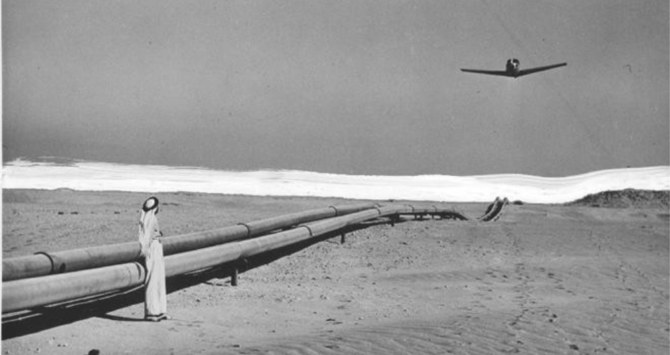

JEDDAH: The Saudi Heritage Commission has recently registered the 70-year-old oil Trans-Arabian Pipeline (Tapline) in the national register of industrial heritage. The pipeline is the first officially registered industrial heritage site in the Kingdom.
The decision comes in recognition of the historical and economic significance of the pipeline and the progress associated with the start of the oil industry.
The announcement followed an initiative launched by the Minister of Culture and Chairman of the Board of Directors of the Heritage Authority, Prince Badr bin Farhan, and approved by the Minister of Energy, Prince Abdul Aziz bin Salman.
“The Heritage Commission registered the Trans-Arabian Pipeline in the National Industrial Heritage Register as the first industrial heritage site to be officially registered in the Kingdom,” Prince Badr tweeted the announcement on Wednesday. He also thanked the Ministry of Energy for stopping the removal of the Tapline and thus allowing for it to be studied and documented by the authority.
Saudi artist, sculptor and photographer Dia Aziz Dia applauded the ministries’ decision to keep the site, as it holds significant historical value. “I think this is a great step,” he told Arab News. “It would have been a mistake to remove the pipeline or to ignore it.”
Construction on the Tapline began in 1948 and was completed on September 1, 1950. It began to pump two months later.
The pipeline starts from Ras Al-Mishab in the Eastern Province and ends south of Sidon in Lebanon, as it pours into its port, cutting a distance of approximately 1,664 kilometers.
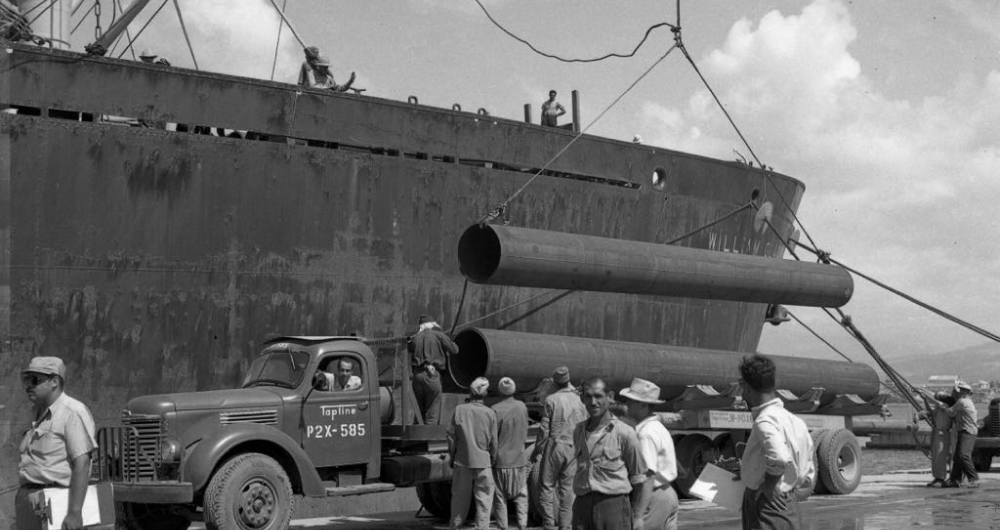
On July 11, 1947, Saudi Arabia signed a deal with Tapline to set up a pipeline to transport Saudi oil through the Mediterranean Sea. (Ministry of Energy)
The pumping of oil through the Tapline to the port of Sidon experienced several interruptions, starting with the Six-Day War in 1967.
It later was stopped in 1975 due to the outbreak of the Lebanese Civil War. In 1978, Saudi Aramco decided to terminate the agreements to operate the Tapline with countries passing through.
In 1983, oil transportation to the port of Sidon was permanently stopped, and the route of the line was diverted to the port of Zarqa in the Hashemite Kingdom of Jordan for a period of seven years until 1990, when it was closed due to the Gulf War. That was the end of oil transportation through the Tapline.
In July 2019, the Ministry of Culture organized the industrial heritage competition, the first of its kind in the Kingdom.
The competition helped to shed light on historical sites linked to the industrial revolution in Saudi Arabia and raise awareness of the industrial heritage that includes social, technological, scientific and architectural achievements.
The Northern Borders Literary Cultural Club’s President Majid Al-Mutlaq explained how the Tapline fulfilled needs globally after World War II.
In a video, he explained how, after the end of World War II, the US presented the Marshall Plan, a recovery program for Western European economies. The ships that transported oil did not fulfill Europe’s needs, however, because the ships could not carry more than 8,000 barrels and had to cross thousands of kilometers to reach the coasts of Europe.
“The Tapline reduced both the time and cost of transport and had a bigger capacity,” Al-Mutlaq said.


