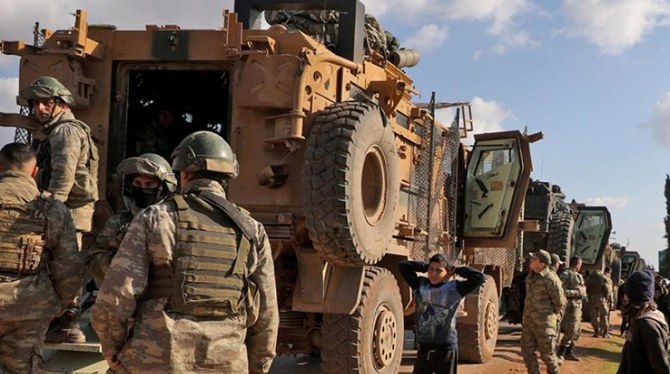

ANKARA: Turkey is believed to be stepping up troop withdrawals in Syria’s northwest Idlib province, the last major rebel stronghold in the country.
In the past, Ankara has strongly rejected any possibility of abandoning its contested observation posts, but with a major Assad regime offensive looking increasingly likely, there is no longer any strategic value in keeping the sites, observers say.
Turkey recently began evacuating its observation post at Al-Eis in northern Syria following prolonged attacks in the region by Russian-backed regime forces and Iranian-backed militias seeking control over the highway connecting Aleppo and Latakia provinces.
Analysts say that the move is a strong signal that Turkey’s opening of observation posts as part of the Astana deal has failed.
Idlib is located in a so-called de-escalation zone established under the 2017 deal between Turkey, Russia and Iran.
Eight out of 12 observation points controlled by Turkey have been encircled by Russian and Iranian forces since late last year.
“Several other Turkish observation posts already have been encircled by Russian and Iranian backed forces. The remaining posts are in areas controlled by rebels,” Halid Abdurrahman, a researcher on the Middle East and North Africa, told Arab News.
“These observation posts do not have any critical importance,” he said.
Since October, Turkey has abandoned four observation posts and two military positions in Idlib.
“It was clear that these observation points would fail because under the Astana deal three countries had their own interests which often clash. Now the key question is whether Turkey will use its military presence in Idlib for defensive or offensive purposes,” Abdurrahman said.
In early December, the Kurdish-led Syrian Democratic Forces (SDF) agreed with Russia and the Syrian army to set up three joint observation posts in the Kurdish-controlled town of Ain Issa to monitor the cease-fire agreed under the 2019 Sochi deal between Russia and Turkey that required the Kurdish forces to pull back 32 km from the Turkish border.
Samuel Ramani, a Middle East analyst at the University of Oxford, believes that the Russia-SDF joint observation posts have angered Turkey since power sharing with the SDF is even more problematic for Ankara than handing the territory over to the Assad regime.
“The encirclement of Turkish forces in Idlib has been strongly supported by the Assad regime since the summer of 2019 and frictions on this issue precede the October 2019 Operation Peace Spring campaign in northern Syria,” he told Arab News.
Turkey reportedly keeps thousands of troops in northwestern Syria apart from Ankara-backed rebel forces.
Navvar Saban, a military analyst at the Omran Center for Strategic Studies in Istanbul, said that the Astana process is “frozen, but not dead yet.”
“These are observation points, not military locations. Now they are surrounded by regime forces and would be at the mercy of any kind of provocative attack from the regime,” he told Arab News.
According to Saban, in the case of a major offensive in the region, the observation points would present a major security challenge for Turkey.
“Their main goal was to observe any violation from the regime. The area is now under the regime control. So it is not useful to keep them staffed and spend money on their resupply,” he said.
In October, Turkey also evacuated the observation post at Morek in Hama province, one of a dozen established in 2018. It was later surrounded by Syrian government forces.
With Idlib home to 3.6 million people, Turkey’s priority now is to prevent any potential refugee influx amid harsh winter conditions.