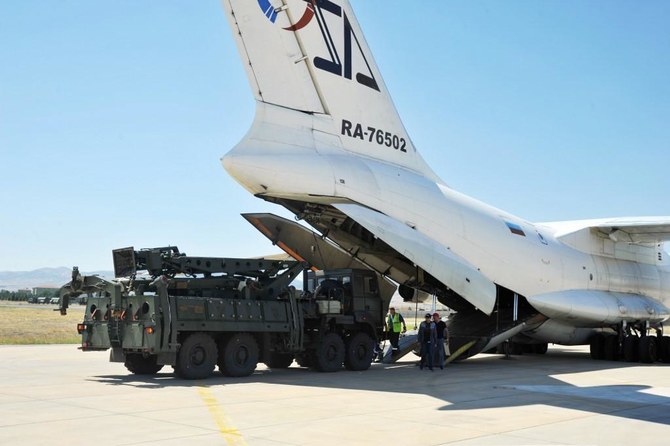
ANKARA: Turkey won’t step back from its decision to deploy Russian air defense systems despite US sanctions imposed on the country over the purchase, Turkish Foreign Minister Mevlut Cavusoglu said Thursday.
In an interview with Turkey’s 24 TV television, Cavusoglu also said Turkey was mulling steps it would take to reciprocate against the US sanctions, but did not say what the steps could entail.
The US announced sanctions earlier this week over Turkey’s procurement of Russia’s advanced S-400 system, under a US law known as CAATSA, aimed at pushing back on Russian influence. The sanctions target Turkey’s Presidency of Defense Industries, the head of the presidency and three other senior officials.
The penalties block any assets the four officials may have in US jurisdictions and bar their entry into the US They also include a ban on most export licenses, loans and credits to the agency.
It is the first time that CAATSA has been used to penalize a US ally.
“If we were to step back we would have done so before now,” Cavusoglu said in response to a question on whether Turkey would cancel the S-400 deal with Russia.
Cavusoglu added: “Now we are assessing the impact of these sanctions in great detail ... and will take steps accordingly.”
The minister also described the sanctions as “wrong both legally and politically,” arguing that Turkey’s purchase of the Russian system in 2017 predated the CAATSA law.
Cavusoglu said that an improvement of relations between Turkey and the United States would be conditional on President-elect Joe Biden’s ability to address Ankara’s grievances.
Ties between the two have been plagued by numerous disputes, including the jailing of American citizens and local consular staff, US support for Syrian Kurdish fighters considered to be terrorists by Turkey and the continued US residence of a Muslim cleric accused of masterminding the 2016 coup attempt in Turkey.
The US had previously kicked Turkey out of its F-35 stealth jet program, saying their use alongside the Russian technology would jeopardize the safety of the fighter jets. Washington also says the Russian system would not be interoperable with NATO systems.


![]()


Turkey will not step back on S-400 missile systems despite US sanctions
Short Url
https://arab.news/cbds2
Turkey will not step back on S-400 missile systems despite US sanctions
- Turkey mulling steps it would take to reciprocate against the US sanctions


Hezbollah says targeted Israeli bases, tanks after strikes on Lebanon
BEIRUT: Lebanese militant group Hezbollah said Tuesday it targeted several Israeli military bases and tanks in response to Israeli strikes on the group’s strongholds in Lebanon, including the south Beirut suburbs.
Israel continues to carry out successive air raids, particularly on Beirut’s southern suburbs and the south of the country, after issuing evacuation warnings to residents, while Lebanese authorities on Monday recorded the displacement of more than 58,000 people from areas hit by the strikes.
Israel announced Tuesday morning it had begun a new round of “simultaneous strikes in Tehran and Beirut.”
It announced later that day that it hit “approximately 60” targets “belonging to the Hezbollah and Hamas terrorist organizations.”
The Israeli military also said it had deployed troops to several locations in southern Lebanon in what it described as a “forward defense” measure along the border.
Defense Minister Israel Katz said he “authorized the Israel Defense Forces (IDF) to advance and take control of additional strategic positions in Lebanon in order to prevent attacks on Israeli border communities.”
Lebanon was drawn into the regional war on Monday after an initial attack on Israel by Hezbollah, which said it wanted to “avenge” the killing of Iranian supreme leader Ayatollah Ali Khamenei during the US-Israeli strikes.
Israel promptly launched large-scale strikes on Lebanon, where the government on Monday declared an immediate ban on Hezbollah’s military activities.
In separate statements, Hezbollah on Tuesday claimed responsibility for 11 attacks on Israel, saying it targeted at least five Israeli tanks, three of them in Lebanese territory using guided missiles and “appropriate weapons.”
The group also said it used attack drones and rocket salvos to target several bases in northern Israel and the Golan Heights, occupied by Israel since 1967.
Additionally, it claimed to have downed an Israeli drone over the southern city of Nabatiyeh.
These attacks came “in response to the criminal Israeli aggression on dozens of Lebanese cities and towns,” Hezbollah said.
Since the early morning hours, Beirut’s southern suburbs have been subjected to a series of air strikes targeting several buildings after evacuation warnings.
AFP photographers saw huge plumes of smoke rising into the air and obscuring the sky.
Hezbollah’s Al-Manar TV broadcaster said its Beirut headquarters had been targeted overnight and announced Tuesday morning that Israel targeted the offices of Hezbollah’s Al-Nour radio broadcaster as well.
In a statement, Hezbollah condemned the strikes on “two civilian media outlets” saying they were aimed at “silencing the voice and image of the resistance.”
The southern city of Sidon, largely spared during the last Hezbollah-Israel war, was struck twice on Tuesday.
One strike hit a headquarters belonging to Jamaa Islamiya, an Islamist group allied with Hamas and Hezbollah, and the other came after an evacuation warning elsewhere in the city.
The surroundings of Tyre, further south, were also struck after evacuation warnings.
Israel continues to carry out successive air raids, particularly on Beirut’s southern suburbs and the south of the country, after issuing evacuation warnings to residents, while Lebanese authorities on Monday recorded the displacement of more than 58,000 people from areas hit by the strikes.
Israel announced Tuesday morning it had begun a new round of “simultaneous strikes in Tehran and Beirut.”
It announced later that day that it hit “approximately 60” targets “belonging to the Hezbollah and Hamas terrorist organizations.”
The Israeli military also said it had deployed troops to several locations in southern Lebanon in what it described as a “forward defense” measure along the border.
Defense Minister Israel Katz said he “authorized the Israel Defense Forces (IDF) to advance and take control of additional strategic positions in Lebanon in order to prevent attacks on Israeli border communities.”
Lebanon was drawn into the regional war on Monday after an initial attack on Israel by Hezbollah, which said it wanted to “avenge” the killing of Iranian supreme leader Ayatollah Ali Khamenei during the US-Israeli strikes.
Israel promptly launched large-scale strikes on Lebanon, where the government on Monday declared an immediate ban on Hezbollah’s military activities.
In separate statements, Hezbollah on Tuesday claimed responsibility for 11 attacks on Israel, saying it targeted at least five Israeli tanks, three of them in Lebanese territory using guided missiles and “appropriate weapons.”
The group also said it used attack drones and rocket salvos to target several bases in northern Israel and the Golan Heights, occupied by Israel since 1967.
Additionally, it claimed to have downed an Israeli drone over the southern city of Nabatiyeh.
These attacks came “in response to the criminal Israeli aggression on dozens of Lebanese cities and towns,” Hezbollah said.
Since the early morning hours, Beirut’s southern suburbs have been subjected to a series of air strikes targeting several buildings after evacuation warnings.
AFP photographers saw huge plumes of smoke rising into the air and obscuring the sky.
Hezbollah’s Al-Manar TV broadcaster said its Beirut headquarters had been targeted overnight and announced Tuesday morning that Israel targeted the offices of Hezbollah’s Al-Nour radio broadcaster as well.
In a statement, Hezbollah condemned the strikes on “two civilian media outlets” saying they were aimed at “silencing the voice and image of the resistance.”
The southern city of Sidon, largely spared during the last Hezbollah-Israel war, was struck twice on Tuesday.
One strike hit a headquarters belonging to Jamaa Islamiya, an Islamist group allied with Hamas and Hezbollah, and the other came after an evacuation warning elsewhere in the city.
The surroundings of Tyre, further south, were also struck after evacuation warnings.
Latest updates


© 2026 SAUDI RESEARCH & PUBLISHING COMPANY, All Rights Reserved And subject to Terms of Use Agreement.