60% Pakistanis say would get COVID-19 vaccine if available - global market research firm 

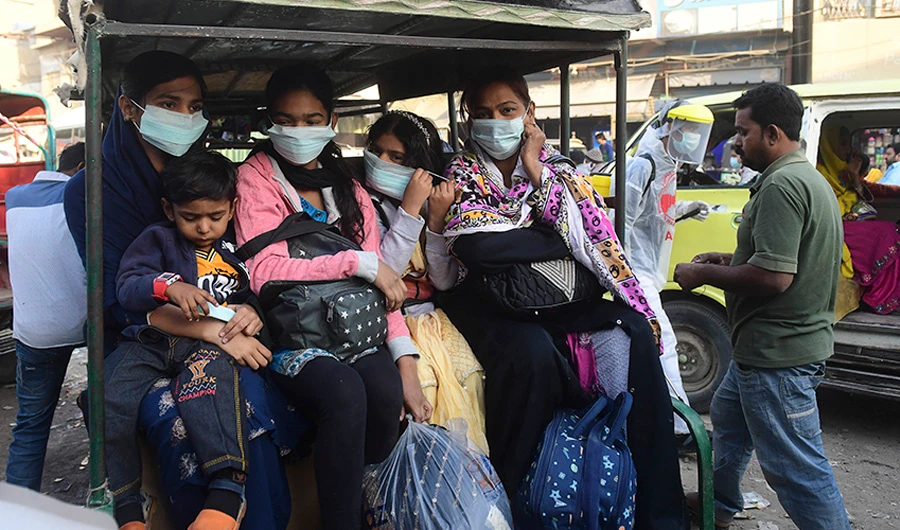
A family wearing facemasks as a preventive measure against the Covid-19 coronavirus sit in a three wheeler vehicle along a street, in Karachi on December 14, 2020. (Photo Courtesy: AFP)
Short Url
Updated 15 December 2020
Follow

60% Pakistanis say would get COVID-19 vaccine if available - global market research firm 

  • -Ipsos survey says when asked why people would prefer not to be vaccinated, 34% were worried about side effects and 22% were against vaccines in general
  • -Gallup Pakistan poll conducted last month showed 37% of Pakistanis would not get a vaccine once one became available

ISLAMABAD: Sixty percent of Pakistanis said they would get the COVID-19 vaccine if it became available, global leader in market research, Ipsos, said in a survey published this month. 
Since the coronavirus first broke out in Pakistan in late February, the country has recorded 443,246 infections, including 2,459 new cases in the last 24 hours, and 8,905 deaths, including 73 in the last 24 hours. 
Worryingly, a Gallup Pakistan poll conducted last month showed 37% of Pakistanis would not get a vaccine once one became available. The Ipsos survey said 22% Pakistanis were against vaccines in general. 
“To what extent do you agree or disagree with each of the following: If a vaccine for COVID-19 were available, I would get it,” Ipsos asked in its survey, reporting that 60 percent respondents said they would prefer to be vaccinated. 
When asked what best described why they would not prefer to be vaccinated, 34% respondents were worried about side effects, 22% were against vaccines in general, 15% believed a vaccine would not be effective and 23% said they were not at risk of the coronavirus. 
The survey also said 50% Pakistanis were unaware of ongoing vaccine trials.
Countering anti-vax sentiments is a worldwide problem, but in Pakistan it is more dangerous than almost anywhere else.
Dozens of people have been killed in attacks on polio vaccination teams over the years, and the fear and mistrust that spawns such violence has made Pakistan one of two countries, including neighboring Afghanistan, where the crippling disease has still to be eradicated.
Several times every year, polio vaccination drives aim to inoculate millions of children, but in some areas they are often met with refusals from parents who believe conspiracy theories about the vaccine.
In more volatile parts of the country, militants have attacked polio immunization teams, notably after a doctor was accused of running a fake vaccination campaign to help the US Central Intelligence Agency track down Osama bin Laden in Pakistan in 2011.
Yet the dangers of polio have been well known for decades, whereas COVID-19 is a new disease, and authorities have struggled to communicate the urgent need to stamp it out.
Cleric Qibla Ayaz, the head of the Council of Islamic Ideology, which advises the government on social and legal issues, told Reuters many of the conspiracy theories about COVID-19 were coming from Western countries, spread by social media.
"For now the majority of scholars have said the vaccine and other treatments are important... but there are always extremists as there are with polio," Ayaz said. "Given the kind of 'Westphobia' we have in Pakistan, it might be better to obtain a vaccine from Russia or China, instead of the US or UK."

Pakistan, Saudi Arabia explore joint investment push in high-growth regions

Updated 29 min 10 sec ago
Follow

Pakistan, Saudi Arabia explore joint investment push in high-growth regions

  • Both sides discuss combining Pakistan’s production capacity with Saudi capital and regional market access
  • Government says Saudi side expressed interest in corporate farming in Pakistan, particularly in rice sector

KARACHI: Pakistan and Saudi Arabia are looking to jointly tap high-growth regional markets and align production and capital strengths, according to an official statement on Wednesday, following talks between Commerce Minister Jam Kamal Khan and Saudi Investment Assistant Minister Ibrahim Al-Mubarak in the Kingdom.

The two countries have long maintained close bilateral ties that have evolved into a multidimensional strategic partnership.

In October last year, the two countries launched an Economic Cooperation Framework aimed at shifting relations beyond aid toward sustainable trade, investment and development links. The framework followed the signing of a joint security agreement a month earlier, under which aggression against one would be treated as an attack on both.

“A key focus of the discussion was the joint exploration of regional markets, particularly Central Asia, Africa, and ASEAN, identified as high-growth regions offering significant opportunities for collaboration,” according to a statement circulated by Pakistan’s commerce ministry after the meeting.

“The two sides agreed that Pakistan and Saudi Arabia, by leveraging their respective strengths, can position themselves as complementary partners — combining Pakistan’s production capabilities with Saudi Arabia’s capital strength, market access, and regional connectivity,” it added.

The Saudi side expressed interest in corporate farming in Pakistan, particularly in the rice sector, with discussions covering mechanization, storage and logistics to enable consistent, long-term exports under structured arrangements.

Talks also covered broader cooperation in agriculture and food security, including rice, fodder, meat and other agri-products, with the potential involvement of Saudi financing institutions in supporting export-linked agricultural and infrastructure projects.

Corporate farming and mechanization were discussed as long-term solutions to productivity challenges in crops such as cotton, where declining yields and high manual input costs have hurt competitiveness, the statement said.

Human resource development emerged as another area of focus, with both sides noting shortages in mid-tier skills such as nurses, caregivers, technicians and hospitality staff.

The Saudi side expressed openness to replicating vocational “train-to-deploy” models in Pakistan that link training programs directly with overseas employment opportunities.

The meeting also examined opportunities in building materials, pharmaceuticals, sports goods, footwear and light manufacturing, with both sides agreeing to pursue sector-specific workshops and business-to-business engagements to translate policy alignment into tangible trade and investment flows.