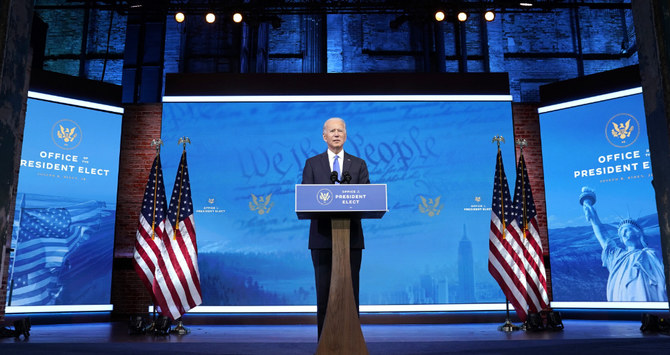
LANSING, Michigan/WILMINGTON, Delaware: Democrat Joe Biden called on Americans to “turn the page” on the Trump era in a prime-time speech on Monday, hours after prevailing over the Republican in the state-by-state Electoral College vote that officially determines the US presidency.
The vote, typically a formality, assumed outsized significance in light of President Donald Trump’s extraordinary effort to subvert the process due to what he has falsely alleged was widespread voter fraud in the Nov. 3 election.
Some Trump supporters had called for protests on social media, and election officials had expressed concern about the potential for violence amid the president’s heated rhetoric. But Monday’s vote proceeded smoothly, with no major disruptions.
California, the most-populous US state, put Biden over the 270 votes needed to win the Electoral College when its 55 electors unanimously cast ballots for him and his running mate, Kamala Harris. Biden and Harris — the first woman, first Black person and first Asian American to become vice president-elect — will be sworn in on Jan. 20.
Biden earned 306 electoral votes in November compared with 232 for Trump.
“The flame of democracy was lit in this nation a long time ago,” he said in his speech to mark his Electoral College victory. “And we now know that nothing — not even a pandemic — or an abuse of power — can extinguish that flame.
“In this battle for the soul of America, democracy prevailed.”
Under a complicated system dating back to the 1780s, a candidate becomes US president not by winning the popular vote but through the Electoral College system, which allots electoral votes to the 50 states and the District of Columbia based on congressional representation. (Here’s a graphic on how the Electoral College works: https://tmsnrt.rs/3lUKcgv)
In 2016, Trump defeated Democrat Hillary Clinton despite losing the national popular vote by nearly 3 million ballots. Biden won the popular vote in November by more than 7 million votes.
Electors are typically party loyalists who are unlikely to break ranks, although there are sometimes a handful of electors who cast ballots for someone other than the winner of their states. In 2016, for instance, seven electors went “rogue,” a historically unusual number but still far from enough to change the outcome.
Few observers had expected Monday’s vote to alter the election’s outcome. With Trump’s legal challenges floundering, the president’s dim hopes of clinging to power rest in persuading Congress not to certify the Electoral College vote in a special Jan. 6 session — an effort almost certain to fail.
Trump had also pressured Republican lawmakers in battleground states that Biden won, such as Pennsylvania and Michigan, to set aside the vote totals and appoint their own competing slates of electors. But lawmakers largely dismissed the notion.
“I fought hard for President Trump. Nobody wanted him to win more than me,” Lee Chatfield, Republican speaker of the Michigan House of Representatives, said in a statement. “But I love our republic, too. I can’t fathom risking our norms, traditions and institutions to pass a resolution retroactively changing the electors for Trump.”
In Arizona, at the beginning of the electors’ meeting there, the state’s Democratic secretary of state, Katie Hobbs, said Trump’s claims of fraud had “led to threats of violence against me, my office and those in this room today,” echoing similar reports of threats and intimidation in other states.
“While there will be those who are upset their candidate didn’t win, it is patently un-American and unacceptable that today’s event should be anything less than an honored tradition held with pride and in celebration,” Hobbs said.
A group of Trump supporters called on Facebook for protests all day on Monday in Lansing, Michigan, outside the state Capitol, which was closed to the public as a security precaution.
But by early afternoon, only a handful had gathered, including Bob Ray, 66, a retired construction worker. He held a sign that read: “Order a forensic audit,” “save America” and “stop communism.”
Electors received a police escort to and from the building. One elector, Marseille Allen, told MSNBC she wore a bulletproof vest at the urging of family and friends.
A small group of Republicans who claimed to be electors for their party sought to gain access to the Capitol building as the proceedings were getting under way but were refused entry by police.
They asked for a slate to be delivered to Democratic Governor Gretchen Whitmer, but the officer at the door told them he would not deliver the paperwork and that they should contact the officials independently.
Trump said late last month he would leave the White House if the Electoral College voted for Biden, but he has since shown little interest in conceding. On Monday, he repeated a series of unsupported claims.
“Swing States that have found massive VOTER FRAUD, which is all of them, CANNOT LEGALLY CERTIFY these votes as complete & correct without committing a severely punishable crime,” he wrote on Twitter.
Trump’s sole remaining gambit is to convince Congress to reject the results in January.
Under federal law, any member of Congress may object to a particular state’s electoral count during the Jan. 6 session. Each chamber of Congress must then debate the challenge before voting by simple majority on whether to sustain it.
The Democratic-controlled House of Representatives is sure to reject any such challenge, while senior Senate Republicans in the Senate on Monday dismissed the idea of overturning the result.


![]()

‘Democracy prevailed,’ Biden says after US Electoral College confirms his win
Short Url
https://arab.news/c7579
‘Democracy prevailed,’ Biden says after US Electoral College confirms his win


Latest updates


© 2026 SAUDI RESEARCH & PUBLISHING COMPANY, All Rights Reserved And subject to Terms of Use Agreement.