

Nothing lost in translation: Demand for learning Urdu picks up in Chinese varsities 

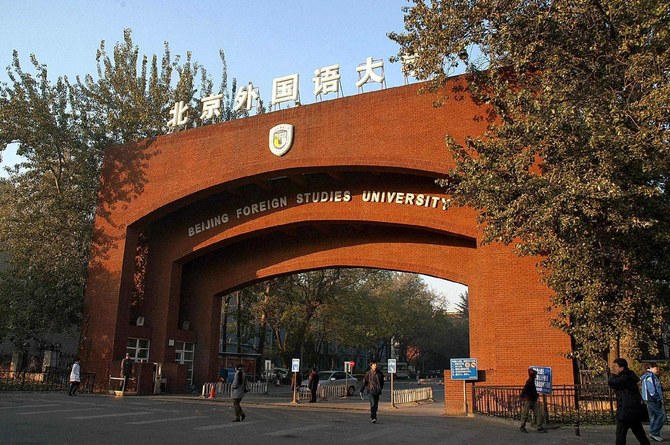
An exterior view of Beijing Foreign Studies University. (Photo Courtesy: Beijing Foreign Studies University)
Short Url
Updated 14 December 2020
Follow

Nothing lost in translation: Demand for learning Urdu picks up in Chinese varsities 

  • First Urdu department was set up at the Peking University in Beijing in 1951
  • Educator says reasons for learning Urdu vary, but cites 'curiosity about Pakistani culture' and potential job opportunities as top reasons  

Islamabad: Sixteen new students have enrolled for an Urdu language course at a Chinese university this year, "reflecting the popularity" of the widely-spoken dialect from across the border in Pakistan, an educator from the varsity said. 

"We have a new batch in every fourth year,” Zhou Yuan, Head of Urdu Department, School of Asian and African Studies, Beijing Foreign Studies University (BFSU) told the Associated Press of Pakistan on Sunday. 

Zhou Yuan, who goes by the name 'Nasreen' for her students, added that besides teaching Urdu, the BFSU department also organizes competitions in Urdu calligraphy and speech and cultural activities "to improve students' skills" and create more awareness "about Pakistan, its culture and people". 

“Some of these students were especially invited by the Pakistan Embassy 

in Beijing to attend the birth anniversary of Allama Dr. Muhammad Iqbal where they recited poetry of the great poet,” she added. 

The BFSU's Urdu Department was set up in 2007 with 51 students completing the four-year degree course so far.  

Zhou Yuan said some students were sent to Pakistan universities for six months "to get a better chance to improve their speaking and writing skills". 

"The increased interest in learning Urdu means that more students from around China are interested to learn the national language of Pakistan, the all-weather friend and strategic cooperative partner of China," she said. 

A dedicated department for the Urdu language was first established at the Peking University in Beijing, the capital city of China, in 1951. 

Later, more varsities joined in by adding the language to their course studies in the Chinese cities of Xian, Guangzhou and Kunming. 

Zhou Yuan says the reasons for learning Urdu vary.  

"Some students have been romanced by Pakistan’s culture, food and landscape; others by the beauty of the language itself. Yet, a large number see learning Urdu as a practical means of eventually working with companies undertaking projects under the China Pakistan Economic Corridor (CPEC) framework in Pakistan." 

Pakistan and China's ties have deepened in recent years with Beijing pledging about $60 billion for infrastructure in the neighbouring country, particularly for China's Belt and Road initiative, which includes the prestigious CPEC project. 


Pakistan consumer confidence rises by 4 percentage points in two years, survey shows

Updated 6 sec ago
Follow

Pakistan consumer confidence rises by 4 percentage points in two years, survey shows

  • Four in 10 Pakistanis believed the country is on the right track, with optimism higher among men
  • Economic concerns remained most worrying, but their quantum fell drastically across all issues

ISLAMABAD: Consumer confidence in Pakistan has risen by 4 percentage points from 31.5 to 35.5 over the last two years, which highlights improving public optimism under the government’s tenure, Ipsos market research firm said in a recent survey.

The survey was conducted through computer-assisted telephonic interviews (CATI) and included more than a thousand participants from all provinces and Azad Kashmir and Gilgit Baltistan regions on Feb. 2-14.

It comes at a time when Pakistan has undergone a difficult period of stabilization, though international rating agencies have acknowledged improvements after Islamabad began implementing structural reforms as part of its $7 billion International Monetary Fund (IMF) program.

The Ipsos survey revealed a “measurable” improvement in Pakistan’s economic sentiment, marked by a decline in inflation alongside notable reductions in poverty and unemployment, since the current government took charge two years ago.

“These findings point to a clear two-year transformation in the Consumer Confidence Index, demonstrating the perceived impact of consistent governance and policy measures,” read the key takeout in the survey.

“Sustained performance, coupled with transparent communication of achievements, will be essential to maintain momentum, reinforce optimism, and support further improvements in economic confidence.”

Four in 10 Pakistanis believed the country is on the right track, with optimism higher among men, while confidence in the country’s direction being right increased more than three times, from 12 percent to 40 percent, since the government came to power, according to the survey.

Economic concerns remained most worrying, but their quantum fell drastically across all issues since the first quarter of 2024. Inflation has dropped by 23 percent, unemployment by 10 percent, poverty by 20 percent, electricity prices by 34 percent and the burden of additional taxes was reduced by 18 percent in Q1 2026 as compared to Q1 2024.

“One in 3 Pakistanis expect the economy to strengthen,” the survey read. “Confidence to invest has grown steadily over two years, rising from 11 percent to 16 percent, with even stronger optimism among urban residents.”