
NEW DELHI: For decades they delivered lunch across Mumbai as part of a 130-year-old network, earning themselves the moniker dabbawalas, or the “ones who carry a box.”
The delivery system was the primary source of income for 5,000 men who are mostly semi-literate and earned around 15,000 Indian rupees a month ($200) by lugging more than 200,000 lunch boxes across the city every day, irrespective of rain, thunder or riots.
But with India imposing a nationwide lockdown in March, the state government of Maharashtra, of which Mumbai is the capital, was forced to shut down all public transport and essential services.
“For the first time in years, our life came to a standstill. We found ourselves helpless, and most of us retreated to our villages to eke out a living,” Vinod Shette, a 30-year-old father of two, told Arab News.
After working with the network for 12 years, Shette says he was forced to return to his native village of Talegaon, in the Pune district of Maharashtra, after the pandemic rendered him jobless and led to a “great financial crisis.”
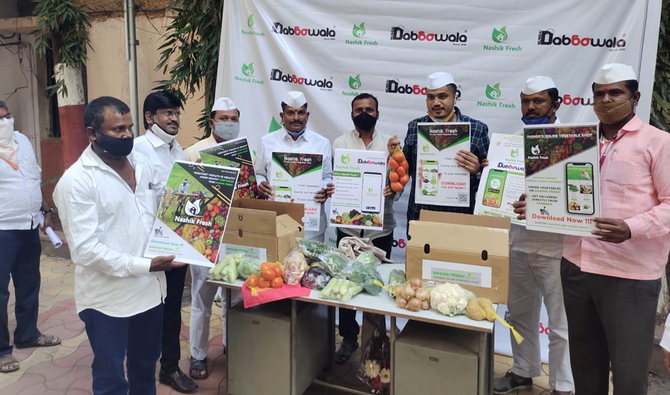
Today, he is among a group of 450 dabbawalas who are entering new territory: The farm-to-table delivery of fresh vegetables.
“Our association is going to try a new business model to help the dabbawalas in this time of crisis,” said Vishnu Kaldoke, spokesperson for Mumbai’s Tiffin Box Suppliers Association (MTBSA).
“We have entered the business of supplying fresh vegetables to the households and our customers whose lunch box we were supplying for years,” he added.
As part of the project, the MTBSA recently signed an agreement with 19 farmers’ associations to source vegetables and supply them directly to customers, without using intermediaries.
And while it will be a new experience to deliver raw instead of cooked food, their “modus operandi will remain the same.”
Mistakes were a rarity for the network, a fact corroborated by a 2010 Harvard Business School study, which found that the dabbawalas made fewer than 3.4 errors per million deliveries.
“People know our professionalism and credibility, and if we supply fresh vegetables directly at home there is no doubt that they will avail our services,” said Kaldoke.
Ulhas Shantaram Muke, president of the New Mumbai Tiffin Box Suppliers Charity Trust, agreed, and said that boils down to the fact that “we have been in the business of supplying for 130 years.”
He said: “Now we can use our expertise in other areas of supply as well.
“To provide a livelihood for our 5,000 dabbawalas, we have started the vegetable supply service with 450 people. Gradually, we will see whether we can get into courier service, milk supply, ration supply and other services,” he added.
To kick-start the initiative, Muke and his team will rely on word-of-mouth marketing, but soon plan to develop a mobile app for the delivery system.
“We are telling our people to get in touch with their original customers and tell them that they should buy the vegetables they are selling, which are core to any lunch,” said Muke.
He added that they are also planning to supply food from restaurants to customers.
“We are looking at all the possibilities to be relevant in this time of crisis.”
If it clicks, the new venture could give thousands of delivery boys a new lease on life. Many are now employed in small-time professions with only meager incomes.
“We did not receive any support from the government. The prime minister assured people all kinds of support, but we remained on our own except for some individual support,” said Shette, who is a third-generation dabbawala, after his grandfather joined the profession decades ago.
“I will try my luck for a month in the vegetable supply business and see whether I can sustain myself or not. This is a very challenging time,” he added.
The “dabba” service was originally conceptualized by a Parsi banker who wanted to enjoy home-cooked food on the job. He hired a jobless man to deliver his lunch to him at work.
The idea soon caught on.
In 1890, Mahadeo Havaji Bachche, a migrant laborer from Maval working as a loader at Bombay port, began a lunch delivery service consisting of about 100 men.
The service became an instant hit as the city lacked canteens or eateries, and rail commuters found it challenging to carry lunch boxes in crowded trains.
Bachche unionized the dabbawalas, and in 1956, registered the group as a charitable trust under the title “Nutan Mumbai Tiffin Box Suppliers Trust.”
Decades later, they came to be known as the Mumbai Tiffin Box Suppliers’ Association.
Instantly recognizable in their white uniforms paired with traditional Gandhi caps, the dabbawalas were the envy of delivery giants such as FedEx and Amazon. Billionaire businessman Richard Branson reportedly traveled with the group on a delivery order to Virgin employees in Mumbai, on a mission to uncover their operational secrets.