

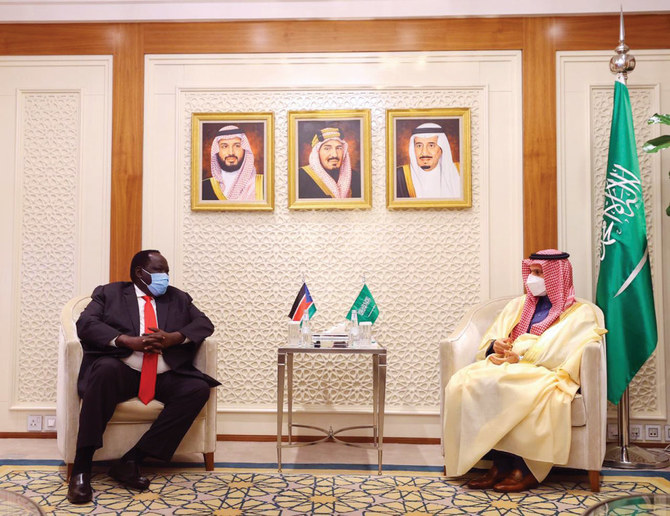
Saudi FM receives Sudan president’s security adviser

Saudi Foreign Minister Prince Faisal bin Farhan received Lt. Gen. Tut Qalwak, adviser to the South Sudan president, in Riyadh on Sunday. (SPA)
Short Url
Updated 14 December 2020
Follow

Saudi FM receives Sudan president’s security adviser

RIYADH: Lt. Gen. Tut Qalwak, security adviser to South Sudan’s  president and special envoy, called on Saudi Foreign Minister Prince Faisal bin Farhan at his office in Riyadh on Sunday.

He was accompanied by South Sudan Foreign Minister Beatrice Khamisa. During the meeting, the two sides reviewed bilateral ties and prospects for joint cooperation. They also discussed regional and international issues of common interest.

The South Sudanese official also conveyed a message from South Sudan President Salva Kiir Mayardit to King Salman.

Sudan is looking toward a promising future after the signing of a peace agreement in Juba on Aug. 31.

The accord includes eight protocols and will restructure the country into eight regions, replacing the country’s current 18 provinces. The deal also includes a wealth-sharing provision and reparations for those hurt by the long conflict, and it promises the return of refugees displaced by fighting.


Saudi Arabia advances in Universal Health Coverage index

Updated 12 December 2025
Follow

Saudi Arabia advances in Universal Health Coverage index

  • Life expectancy in Kingdom rose from 74 in 2016 to 79.7 in 2025

RIYADH: Saudi Arabia has made notable progress in the Universal Health Coverage Service Coverage Index, reinforcing its position among leading nations in global health indicators, according to the latest data released by the World Health Organization and the World Bank.

The Kingdom recorded a score of 83 points in the latest UHC update, marking a nine-point increase within two years and placing Saudi Arabia among countries classified as having high-level health service coverage.

The steady rise reflects sustained improvements over the past two decades and underscores the impact of the Kingdom’s Health Sector Transformation Program under Saudi Vision 2030.

The UHC Service Coverage Index is one of the internationally recognized Sustainable Development Goal indicators and measures access to essential health services across key areas, including preventive care, treatment, and system capacity.

Progress in the index is closely linked to broader development outcomes such as improved quality of life, reduced disease burden, and enhanced social well-being.

Saudi Arabia’s advancement has been driven by a strategic focus on preventive healthcare, strengthened primary care services, expanded early screening programs, and increased health system readiness.

The transformation has also been supported by rapid digitalization, including platforms such as Sehhaty and the Seha Virtual Hospital, which have expanded access to care and improved service efficiency nationwide.

These reforms have translated into measurable public health gains. Life expectancy in Saudi Arabia rose from 74 years in 2016 to about 79.7 in 2025, bringing the Kingdom close to its Vision 2030 target of 80 years and highlighting the effectiveness of preventive and treatment programs.

Health Minister Fahad Abdulrahman AlJalajel said the progress reflected the tangible outcomes of Vision 2030 and sustained leadership support.

He said: “The improvements we see today in international health indicators demonstrate the real impact of the Kingdom’s health transformation, which prioritizes prevention, primary care empowerment, and digital health solutions. Raising life expectancy to 79.7 years is the result of an integrated effort focused on improving people’s health and quality of life.”

Saudi Arabia’s progress in the UHC index further strengthens its standing among G20 countries and underscores the Kingdom’s commitment to building a more efficient, resilient, and sustainable health system, with people at the center of national development.