

Iraq ‘shrine factions’ look to peel away from Hashd

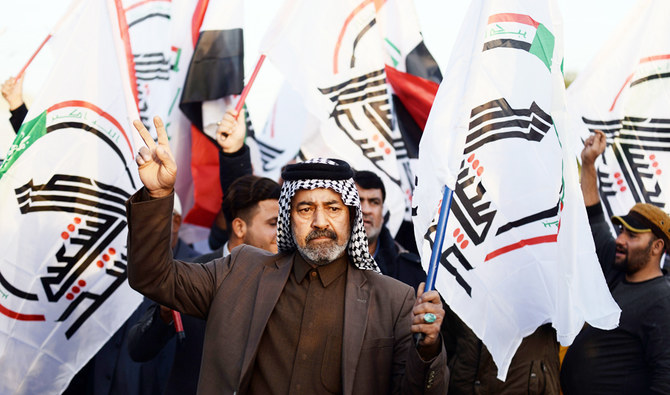
Iraqis wave flags of Hashd Al-Shaabi, an Iraqi paramilitary network dominated by Iran-backed factions, during a demonstration in the holy shrine city of Najaf. (AFP)
Short Url
Updated 13 December 2020
Follow

Iraq ‘shrine factions’ look to peel away from Hashd

  • Hamdi Malik, a London-based expert on Shiite factions, said the shrine groups were now publicly insisting on a separation

NAJAF: Around the corner from Iraq’s holiest shrines, a years-long struggle over allegiances and resources is coming to a head — threatening a dangerous schism within a powerful state-sponsored security force.
The growing fissure pits the vast Iran-aligned wing of the Hashd Al-Shaabi network against four factions linked to the shrines of Iraq’s twin holy cities, Karbala and Najaf.
Those factions, dubbed “the Shrine Hashd” and comprising around 20,000 active fighters, held their first strategic planning meeting earlier this month.
Throughout the packed three days, spokesmen for the shrine groups leaned on two sources of legitimacy: A patriotic, “Iraq-only” discourse, and the blessing of the “marjaiyah,” Iraq’s Shiite spiritual leadership.
“The Shrine Hashd are the origin of the broader Hashd,” Hazem Sakhr, a spokesman for the four factions, told AFP.
“We are committed to Iraqi law and the marjaiyah’s orders.”
Maytham Al-Zaidi, the prominent commander of the largest shrine group known as the Abbas Combat Division, struck a nationalistic, reformist tone.
“The main reasons for establishing the Shrine Hashd is to serve our country, and to correct both its track record and trajectory,” he said.
Ali Al-Hamdani, who heads the 3,000-member Ali Al-Akbar Brigade, said the meeting — held in Najaf and Karbala — was “exclusively” for the Shrine Hashd, setting their future apart from the rest.
Hamdi Malik, a London-based expert on Shiite factions, said the shrine groups were now publicly insisting on a separation.
“They are escalating with this new conference, and want to accelerate that process,” Malik told AFP.
The Hashd Al-Shaabi network was formed in 2014 when Iraq’s top Shiite cleric, Grand Ayatollah Ali Sistani, issued an edict urging citizens to fight the advancing Sunni extremists of Daesh.
His call brought together already-existing paramilitary factions and new formations, including the Shrine Hashd.
But internal disputes emerged as early as 2016, with Malik pointing to three main fault lines.

SPEEDREAD

The growing fissure pits the vast Iran-aligned wing of the Hashd Al-Shaabi network against four factions linked to the shrines of Iraq’s twin holy cities, Karbala and Najaf.

Shrine factions began complaining that they were being starved of resources by Abu Mahdi Al-Muhandis, the umbrella group’s deputy head.
Muhandis died in a US strike in January this year that also killed his friend, top Iranian general, Qasem Soleimani.
The Shrine Hashd had accused Muhandis of prioritizing factions closer to Tehran in the distribution of military equipment and state-allocated salaries.
Malik said the tug-of-war was linked to a second, more profound split: a “real ideological divide” over ties to neighboring Iran, which had long provided support to armed groups in Iraq.
Those factions are even dubbed “the loyalist Hashd” for their perceived allegiance to Tehran over Baghdad.
At the meeting, spokesmen were careful not to specifically criticize Iran but repeatedly rejected what they characterised as external meddling.
“Foreign intervention is dangerous. The Shrine Hashd rejects all shapes and sizes it may come in,” Sakhr said.
The 90-year-old Sistani, known to be wary of Iran’s influence, has not commented publicly on the meeting — but it would not have gone ahead without his tacit approval, said Malik.
“It’s important for Sistani, while he is alive and capable, that he puts his house in order,” said Sajad Jiyad, a fellow at US think tank The Century Foundation.
Thirdly, shrine-linked groups have looked disdainfully at the Hashd’s dabbling in politics.
“Sistani had given clear instructions that no Hashd member should participate in politics. But pro-Iran factions in the Hashd created the Fatah alliance and took part in the 2018 parliamentary elections,” Malik said.
Fatah won the second-largest number of seats and wields significant influence in both parliament and several government ministries.
With new elections set to be held in June 2021, shrine factions have said they will stick to Sistani’s orders.
“Our members are free to participate as voters but not as candidates,” said Mushtaq Abbas Maan, the media head for Karbala’s Abbas shrine, which sponsors the factions.
While The Century Foundation’s Jiyad said he doubted armed conflict would erupt between the two wings, he said a divorce would likely be messy.
The Shrine f still lack a legal or administrative framework to govern their forces outside the broader network’s by-laws, and government decrees linking them to the prime minister’s office have been slow to take hold.
At the conference, Maan appealed to the premier, who is Iraq’s commander-in-chief, to “urgently” bring shrine factions under his wing, thereby finalizing their split from the wider network.
But shrine factions also fear that if they peel away, “loyalist” groups could monopolize the Hashd’s budget, fighting force and political influence, Malik said.
Their moves have already irked the Iran-linked Hashd, whose commanders declined AFP’s requests for comment.
But the sharp-tongued Qais Al-Khazali, who heads a powerful Hashd faction known as Asaib Ahl Al-Haq, told state media last month that a secession by shrine groups could prompt other wings to strike out on their own, too.
“The Hashd will be divided into three. That means the end of the Hashd,” he warned.


For Syria’s Kurds, dream of autonomy fades under Damascus deal

Updated 5 sec ago
Follow

For Syria’s Kurds, dream of autonomy fades under Damascus deal

  • “We made many sacrifices,” said Mohammed, spokesperson for the YPJ
  • The YPJ is part of the Kurdish-led Syrian Democratic Forces that spearheaded the fight against Daesh

HASAKEH, Syria: At a military base in northeast Syria, Roksan Mohammed recalled joining the battle against Daesh group militants. Now her all-woman fighting unit is at risk after a deal with Damascus ended the Kurds’ de facto autonomy.
“We made many sacrifices,” said Mohammed, spokesperson for the Women’s Protection Units (YPJ), who stood with a gun slung over her shoulder.
“Thousands of martyrs shed their blood, including many of my close comrades,” the 37-year-old added.
The YPJ is part of the Kurdish-led Syrian Democratic Forces (SDF) that spearheaded the fight against Daesh in Syria with the help of a US-led coalition, leading to the militants’ territorial defeat in the country in 2019.
But Kurdish forces now find themselves abandoned by their ally as Washington draws closer to the new Syrian government of President Ahmed Al-Sharaa, who ousted longtime ruler Bashar Assad in 2024.
Under military pressure from Damascus, the Kurds agreed to a deal last month on integrating their forces and civilian institutions into the state. It did not mention the YPJ.
“The fate of female Kurdish fighters seems to be one of the biggest problems,” Mutlu Civiroglu, a Washington-based analyst and expert on the Kurds, told AFP.
“Kurds will not accept the dissolution of the YPJ,” he added, as “in their political system, women have an elevated status.”
“Each official position is safeguarded with a co-chair system which dictates that one must be a woman,” he said.
YPJ fighter Mohammed remained defiant.
“Our fight will continue... we will intensify our struggle with this government that does not accept women.”

- Disagreements -

Under the deal, Syria’s Kurds must surrender oil fields, which have been the main source of revenue for their autonomous administration.
They must also hand over border checkpoints and an airport, while fighters are to be integrated into the army in four brigades.
However, the two sides disagree on the deal’s interpretation.
Damascus “understands integration as absorption, yet Kurds see it as joining the new state with their own identity and priorities,” Civiroglu said.
“The issue of self-rule is one of the major problems between the two sides.”
For the Kurds, the agreement all but ended their de facto autonomy in Syria, which they established during the country’s 13-year civil war.
“Previously, our regions were semi-autonomous from Syria,” said Hussein Al-Issa, 50, who works for the Kurdish administration’s education department.
But “this is no longer the case,” he said, after the government drove Kurdish forces from wide areas of northeast Syria in January and the two sides agreed to the deal.
“Coupled with the loss of territory over the past month, the January 30 agreement appears to spell the end for Kurdish ambitions to establish a federal or decentralized system in Syria,” said Winthrop Rodgers, an associate fellow at Chatham House.
The decision by US President Donald Trump’s administration “not to intervene was a key factor, along with Arab and tribal defections from the SDF,” he added.

- ‘Not a single bullet’ -

The Kurds have not hidden their bitterness toward Washington, under whose leadership the anti-militant coalition had positioned bases in Kurdish-controlled areas.
A source with knowledge of the matter told AFP that during a meeting in Iraqi Kurdistan last month, US envoy to Syria Tom Barrack told SDF chief Mazloum Abdi that the United States “will not fire a single bullet against Damascus” for the Kurds.
Kurdish education department worker Issa said the US abandonment was “a major blow to the Kurds.”
“Their interests with us ended after we finished fighting Daesh,” he said.
He added that Turkiye, an ally of Washington and Damascus, had “applied pressure” to end the Kurds’ autonomy.
Barrack, who closely followed the negotiations, said last month that the SDF’s original purpose in fighting Daesh had “largely expired” after Syria joined the anti- Daesh coalition.

- Defections -

Sharaa is intent on extending the state’s authority across the country.
In early January, after a previous deal with the Kurds stalled for months, he went on the offensive, with government forces clashing with Kurdish fighters in parts of Aleppo province before pushing eastwards.
But he avoided the bloodshed that tarnished the early months of his rule, when hundreds of members of the Alawite minority were massacred on the coast in March, and after deadly clashes erupted with the Druze in the south in July.
A source close to Damascus told AFP that “authorities coordinated with Arab clans from SDF-controlled areas months prior to the offensive,” in order to secure their support and ensure government forces’ “entry into the region without bloodshed.”
Arab personnel had made up around half of the SDF’s 100,000 fighters.
Their sudden defection forced the SDF to withdraw from the Arab-majority provinces of Raqqa and Deir Ezzor with little to no fighting and to retreat to Kurdish areas.

- ‘No rights’ -

Sharaa issued a decree last month on Kurdish national rights, including the recognition of Kurdish as an official language for the first time since Syria’s independence in 1946.
The minority, around two million of Syria’s 20 million people, suffered decades of oppression under the Assad family’s rule.
“We lived under a political system that had no culture, no language and no political or social rights... we were deprived of all of them,” said Roksan Mohammed.
Issa, who teaches Kurdish, said he feared they would lose their autonomous administration’s hard-won gains.
“There is great fear for our children who have been doing their lessons in Kurdish for years,” he said.
“We do not know what their fate will be.”