

Egypt prepares to open first, and largest, antique reproductions factory in Middle East

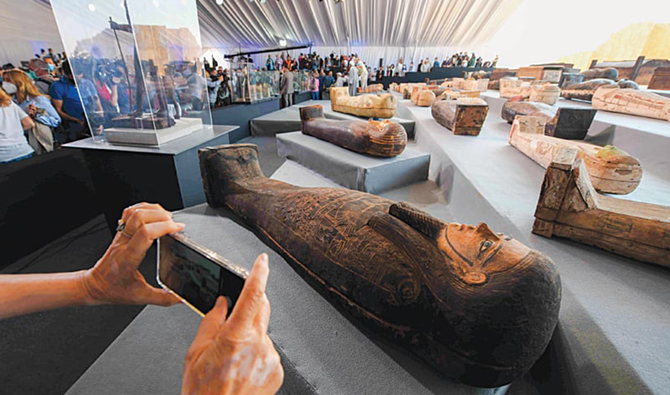
Every antique reproduction that will be produced at the factory will bear a special stamp of the Supreme Council of Antiquities. (Reuters/File)
Short Url
Updated 09 December 2020
Follow

Egypt prepares to open first, and largest, antique reproductions factory in Middle East

  • The factory includes units for manual and mechanical production

CAIRO: Egypt is preparing to open the first, and largest, factory of archaeological reproductions in the Middle East in early 2021, under the supervision of the Ministry of Tourism and Antiquities, to guarantee its archaeological property rights for its ancient heritage, while fighting poor quality reproductions made in China.

Magdy Shaker, chief archaeologist at the ministry, said it had a department for reproductions but produced low quantities, unlike a specialized factory.

He stressed the need to prevent Chinese antique reproduction to ensure the property rights of Egypt, adding that the Chinese products are of poor quality but cheap, making them attractive.

Shaker added that the reproduction factory will work to monopolize this industry in Egypt, employing about 45 specialist artists to reproduce works based on original artefacts, while setting controls for the 3,000 factories in Luxor and Saqqara that offer poorly made products.

Shaker said that the factory’s bazaars will be located inside prominent tourist attractions to generate higher sales.

He added that the idea could be replicated in places such as Luxor and other tourist areas, and that the replicas could be exported abroad as part of exhibitions of replica Egyptian artefacts.

The factory includes units for manual and mechanical production, to raise the efficiency of production, in addition to a line for wood and carpentry to produce all woodwork, and lines for moulds, sculpture, printing, drawing and coloring.

The factory was established in the industrial zone of Obour City in cooperation with the Egyptian Treasures Company.

Every antique reproduction that will be produced at the factory will bear a special stamp of the Supreme Council of Antiquities, and a certificate stating that it is a reporduction, in addition to a barcode placed for easy identification, which contributes to protecting the unit’s products from counterfeiting.


Sotheby’s to bring coveted Rembrandt lion drawing to Diriyah

Updated 18 January 2026
Follow

Sotheby’s to bring coveted Rembrandt lion drawing to Diriyah

DUBAI: Later this month, Sotheby’s will bring to Saudi Arabia what it describes as the most important Rembrandt drawing to appear at auction in 50 years. Estimated at $15–20 million, “Young Lion Resting” comes to market from The Leiden Collection, one of the world’s most important private collections of 17th-century Dutch and Flemish art.

The drawing will be on public view at Diriyah’s Bujairi Terrace from Jan. 24 to 25, alongside the full contents of “Origins II” — Sotheby’s forthcoming second auction in Saudi Arabia — ahead of its offering at Sotheby’s New York on Feb. 4, 2026. The entire proceeds from the sale will benefit Panthera, the world’s leading organization dedicated to the conservation of wild cats. The work is being sold by The Leiden Collection in partnership with its co-owner, philanthropist Jon Ayers, the chairman of the board of Panthera.

Established in 2006, Panthera was founded by the late wildlife biologist Dr. Alan Rabinowitz and Dr. Thomas S. Kaplan. The organization is actively engaged in the Middle East, where it is spearheading the reintroduction of the critically endangered Arabian leopard to AlUla, in partnership with the Royal Commission for AlUla.

“Young Lion Resting” is one of only six known Rembrandt drawings of lions and the only example remaining in private hands. Executed when Rembrandt was in his early to mid-thirties, the work captures the animal’s power and restless energy with striking immediacy, suggesting it was drawn from life. Long before Rembrandt sketched a lion in 17th-century Europe, lions roamed northwest Arabia, their presence still echoed in AlUla’s ancient rock carvings and the Lion Tombs of Dadan.

For Dr. Kaplan, the drawing holds personal significance as his first Rembrandt acquisition. From 2017 to 2024, he served as chairman of the International Alliance for the Protection of Heritage, of which Saudi Arabia is a founding member.

The Diriyah exhibition will also present, for the first time, the full range of works offered in “Origins II,” a 64-lot sale of modern and contemporary art, culminating in an open-air auction on Jan. 31 at 7.30 pm.