Monday Trading: Tadawul index up 0.6% points, trimming part of the losses from Sunday

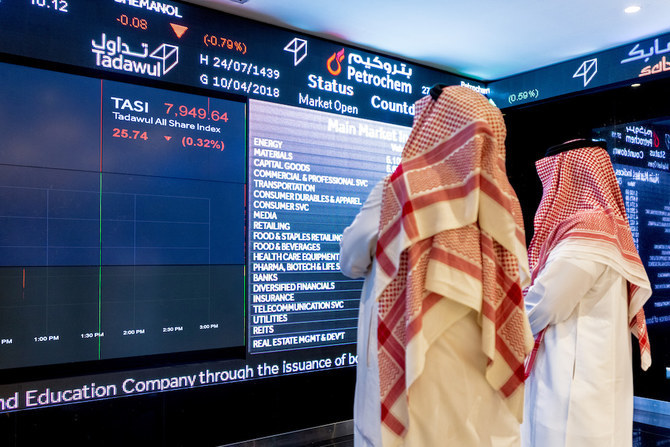
Visitors look at stock price information displayed on a digital screen inside the Saudi Stock Exchange, also known as the Tadawul, in Riyadh, Saudi Arabia, April 10, 2018. (Getty Images)
Short Url
Updated 07 December 2020
Follow

Monday Trading: Tadawul index up 0.6% points, trimming part of the losses from Sunday

  • Shares of Riyad Bank, National Commercial Bank, Saudi Electricity, Samba, Saudi Kayan and Advanced were up
  • Shares of Alhokair closed at SR22.70, up 8 percent, as the company announced obtaining the franchise rights for France-based Decathlon for 10 years

Saudi equities rebounded to end the session on Dec. 7, trimming part of the losses from Sunday’s session, with the benchmark Tadawul All Share Index (TASI) up by 0.6 percent, or 52 points, to close at 8,633.

Total turnover reached SR9.6 billion ($2.56 billion), with advance-decline ratio at 155:31.

Shares of Riyad Bank, National Commercial Bank, Saudi Electricity, Samba, Saudi Kayan and Advanced ended their trading on Monday with an increase in rates ranging between 1 percent and 3 percent.

Shares of Alhokair closed at SR22.70, up 8 percent, as the company announced obtaining the franchise rights for France-based Decathlon for 10 years.

On the other hand, shares of Saudi British Bank (SABB) fell by more than 2 percent to close at SR24.70.

Anaam Holding continued its decline for the fourth consecutive session, closing at SR112.60 riyals, down 34 percent.

Powered by Argaam


Saudi Arabia’s foreign reserves rise to a 6-year high of $475bn

Updated 22 February 2026
Follow

Saudi Arabia’s foreign reserves rise to a 6-year high of $475bn

RIYADH: Saudi Arabia’s foreign reserves climbed 3 percent month on month in January to SR1.78 trillion, up SR58.7 billion ($15.6 billion) from December and marking a six-year high.

On an annual basis, the Saudi Central Bank’s net foreign assets rose by 10 percent, equivalent to SR155.8 billion, according to data from the Saudi Central Bank, Argaam reported.

The reserve assets, a crucial indicator of economic stability and external financial strength, comprise several key components.

According to the central bank, also known as SAMA, the Kingdom’s reserves include foreign securities, foreign currency, and bank deposits, as well as its reserve position at the International Monetary Fund, Special Drawing Rights, and monetary gold.

The rise in reserves underscores the strength and liquidity of the Kingdom’s financial position and aligns with Saudi Arabia’s goal of strengthening its financial safety net as it advances economic diversification under Vision 2030.

The value of foreign currency reserves, which represent approximately 95 percent of the total holdings, increased by about 10 percent during January 2026 compared to the same month in 2025, reaching SR1.68 trillion.

The value of the reserve at the IMF increased by 9 percent to reach SR13.1 billion.

Meanwhile, SDRs rose by 5 percent during the period to reach SR80.5 billion.

The Kingdom’s gold reserves remained stable at SR1.62 billion, the same level it has maintained since January 2008.

Saudi Arabia’s foreign reserve assets saw a monthly rise of 5 percent in November, climbing to SR1.74 trillion, according to the Kingdom’s central bank.

Overall, the continued advancement in reserve assets highlights the strength of Saudi Arabia’s fiscal and monetary buffers. These resources support the national currency, help maintain financial system stability, and enhance the country’s ability to navigate global economic volatility.

The sustained accumulation of foreign reserves is a critical pillar of the Kingdom’s economic stability. It directly reinforces investor confidence in the riyal’s peg to the US dollar, a foundational monetary policy, by providing SAMA with ample resources to defend the currency if needed.

Furthermore, this financial buffer enhances the nation’s sovereign credit profile, lowers national borrowing costs, and provides essential fiscal space to navigate global economic volatility while continuing to fund its ambitious Vision 2030 transformation agenda.