

Experts warn businesses in Saudi Arabia to ramp up their cybersecurity

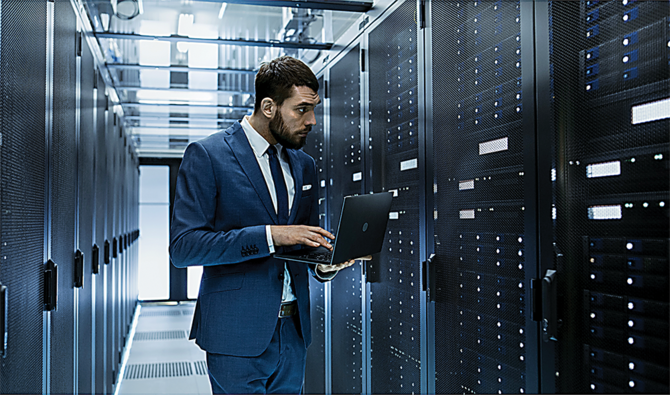
The ignorance of cybersecurity measures and lack of awareness are the two fundamental loopholes that enable hackers to compromise sensitive data. (Shutterstock)
Short Url
Updated 06 December 2020
Follow

Experts warn businesses in Saudi Arabia to ramp up their cybersecurity

  • From hackers demanding ransoms to email viruses, Saudi executives should act to protect their businesses from attack

RIYADH: As Saudi companies become more technologically advanced, cybersecurity experts have warned of a general lack of awareness about industry best practices and are worried that businesses are not adequately protecting their systems.

A survey commissioned earlier this year by cybersecurity firm Tenable found that 95 percent of businesses in the Kingdom last year were the victim of a cyberattack.

In addition, 85 percent of Saudi respondents said that they had witnessed a dramatic increase in the number of attacks over the past two years. Companies said they had suffered loss of customer or employee data, ransomware payment demands and financial loss or theft.

Cybersecurity Ventures, a US-based researcher and publisher in this sector, estimated that the global cost of cybercrime could reach $10.5 trillion by 2025.

The rising number of cases, combined with the huge financial impact, will hopefully spur Saudi business executives into action, said Dr. Muhammad Khurram Khan, professor of cybersecurity at King Saud University and founder and CEO of the Global Foundation for Cyber Studies and Research.

“This huge and lucrative price tag entices hackers and cybercriminals to innovate their hacking tactics against individuals and organizations. The ignorance of cybersecurity measures and lack of awareness are the two fundamental loopholes that enable hackers to compromise sensitive data and perform financial fraud,” Khan told Arab News.

Cybersecurity risks can take many shapes and forms, from phishing (impersonating a legitimate organization to access sensitive personal information) to malware (malicious software created to cause damage to a computer or server). Types of malware include viruses, ransomware or spyware, while hacking takes place when outsiders gain unauthorized access to a computer from a distance by exploiting weaknesses in a computer’s defenses.

All of these are serious issues, and the region’s experts have urged computer users to become more cautious about their online security.

Mimecast, an international company specializing in cloud-based email management, highlighted the dangers of phishing. 

“Scams are becoming increasingly difficult to identify, so the average user might not be able to spot fake messages if they haven’t had the necessary cybersecurity awareness training,” said Maen Ftouni, country manager for Mimecast, Saudi Arabia.

Mimecast’s State of Email Security 2020 report states that 74 percent of organizations in Saudi Arabia are concerned about a web domain, brand exploitation or site spoofing attack. The report also found that 48 percent of organizations had seen an increase in phishing over the past 12 months.

“Phishing scams are everywhere, and individuals need to be constantly alert and on the lookout for malicious emails and text messages to avoid falling victim to these increasingly sophisticated attacks. Your bank will never ask you to update information via a link, so if you receive a message like this, alarm bells should be ringing,” Ftouni said.

Another threat is the growing incidences of ransomware, a type of malware that allows hackers to block access to a victim’s data, or in some cases to publish it, unless a ransom is paid. For many companies this could be their worst nightmare as sensitive data is placed in the public domain.

Veritas Technologies, an international data management and protection company, stated in its annual ransomware resiliency report that only 36 percent of respondents said that their security had kept pace with their IT complexity (43 and 39 percent in the UAE and Saudi Arabia, respectively).

According to Veritas, some businesses that fall victim to ransomware and are not able to restore their data from a backup copy of their files may look to pay the hackers to return their information. Its research showed that companies with greater complexity in their multi-cloud infrastructure were more likely to make these payments.

Johnny Karam, vice president of emerging markets at Veritas, said that cloud technology was offering some solutions, but he warned that Saudi business owners should not get too comfortable just yet.

“Whilst this is positive news, our research shows that there is still more that needs to be done. For instance, 29 percent of businesses’ data protection strategies in KSA aren’t keeping pace with the levels of complexity that they’re introducing. As a result, the majority of businesses are feeling the impact of ransomware more acutely,” Karam said.

Businesses of all sizes should be concerned about their security, said Saudi cybersecurity expert, Abdullah Al-Jaber, and small-scale entrepreneurs should not assume it is a problem only for big corporations.

“Even small businesses such as local shops are getting hit and losing their data due to their lack of cybersecurity protections. Large organizations are getting more mature and protecting their systems, and attackers are moving to small- and medium-sized organizations where they lack security awareness and controls. Even individuals can be subject to targeting,” he warned.

Al-Jaber applauds the new government improvements being implemented by the National Cybersecurity Authority (NCA) and the new Saudi Cybersecurity strategy, and recommends that those concerned brush up on their cybersecurity protocols to ensure that they are being protected.

“Having backups, applying the system updates regularly and making sure the systems are not exposed to the Internet, as well as using complex passwords and enabling two-factor authentication, will reduce the risks significantly,” he said.

So, no matter what size a company is or what sector it is involved in, good cybersecurity and data protection are priorities that no business should ignore.


Artificial intelligence is transitioning into a ‘digital employee’

Updated 27 February 2026
Follow

Artificial intelligence is transitioning into a ‘digital employee’

  • AI can be an effective tool, business leaders tell Arab News
  • Not about jobs, but ‘convergence of human capital and AI’

RIYADH:  Artificial intelligence is fundamentally reshaping the world of work, transitioning from a supporting tool to an active partner that is radically changing the nature of professions and productivity standards.

Amidst the current global transformations, an active regional digital environment is emerging.

This is being led by Saudi Arabia through Vision 2030 and massive investments in smart infrastructure, providing a living model for studying the implications of this partnership between humans and machines on the future of work in the region.

Arab News spoke to various business leaders about the emerging shape of the sector.

Salem Bagami, co-founder of Metatalent, said the ideal relationship between humans and machines at work should be complementary and collaborative.

Humans would bring creativity, emotional intelligence, and complex decision-making, while machines excel at processing big data and performing repetitive, precise tasks.

He believes that this type of balanced partnership would lead to unprecedented productivity and innovation.

While machines excel at processing big data and performing repetitive, precise tasks, humans would bring creativity, emotional intelligence, and complex decision-making. (Supplied)

Mohammad Al-Jallad, chief technologist and director at HPE, said AI has gone beyond being merely an executive tool to becoming a “digital employee” entrusted with automating routine tasks and providing insights based on data analysis.

He believes that the real opportunity lies not in the debate over job replacement, but in “the convergence of human capital and artificial intelligence.”

AI should augment human teams by taking on menial and routine tasks, enabling employees to focus on critical thinking, creativity, and ethical reasoning, significantly improving operational results.

Bagami also emphasized the complementary nature of this partnership. “The ideal relationship between humans and machines at work is one of collaboration, where each complements the others.”

He explained that humans bring creativity, emotional intelligence, and nuanced decision-making, while machines excel at processing big data and performing repetitive tasks efficiently, leading to increased productivity and innovation.

Opinion

This section contains relevant reference points, placed in (Opinion field)

Salem Alanazi, chairman of Jathwa Technology Co., notes a significant trend among Saudi Arabia companies toward using AI applications to provide faster services to customers at lower costs.

The emergence of the “virtual employee” available around the clock has eliminated the need for some traditional jobs in specific sectors.

Alanazi warns that some companies’ reluctance to adopt AI may expose them to real risks. “All those who hesitated to benefit from AI applications have a lack of understanding of these technologies.”

He said those who adopt these technologies will be able to offer lower-cost, higher-quality services, which will affect the market position of companies that lag behind.

Ali Aljumhour, CEO of VALUE Consultancy, said that the transition of AI into a partner has reshaped the list of most in-demand skills in the job market.

Skills such as “prompt engineering,” “human-machine integration,” and “digital ethics” are becoming increasingly important.

He added that AI has become an instantly available “technical knowledge base,” shifting the criteria for professional distinction toward those capable of smart interaction with these technologies.

In terms of ethics, transparency, and trust, Alanazi points to the complexities of global AI governance, where legislation overlaps and evolves rapidly to keep pace with potential risks, particularly in the areas of cybersecurity and privacy.

Ali Aljumhour, CEO of VALUE Consultancy. (Supplied)

Al-Jallad emphasizes this crucial dimension, noting that providing responsible and reliable AI solutions that meet the highest standards of transparency is a key priority, especially in regulated sectors.

Bagami believes there should be basic standards for the ethical use of Al, emphasizing the need for transparency, accountability, and fairness, along with using diverse data sets to prevent bias and protect privacy.

He believes that building trust between humans and machines requires clear explanations of how systems work, giving users the opportunity to provide feedback and conducting periodic performance reviews.

On performance evaluation, Aljumhour said: “I expect radical changes in standards, shifting from measuring individual effort to evaluating the quality of the partnership between humans and machines.”

There should be a focus on the quality of inputs provided to intelligent systems, the accuracy of review and modification, and complex decision-making based on outputs.

He warns, however, of new risks that may arise, such as over-reliance on AI or difficulty in determining responsibility for mistakes.

In the employment sector, Aljumhour expects fundamental changes in standards.

There will be questions and tests focusing on measuring skills in dealing with AI, such as asking candidates about their experiences of collaborating with these systems, or testing their ability to formulate effective requests for complex tasks.

Aljumhour identifies significant human challenges in this transition, with “fear, loss of power, and exclusivity of knowledge” being the biggest concerns for experienced employees.