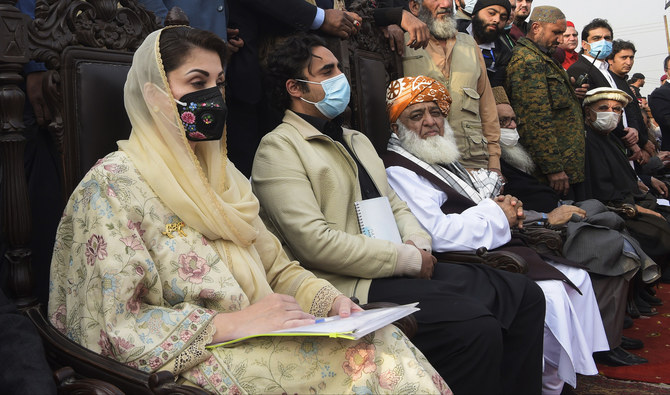

ISLAMABAD: Pakistani opposition parties on Thursday echoed the government's position of not recognizing Israel, saying that normalizing ties with Tel Aviv would be against Pakistan's ideological foundations.
In recent weeks, there has been speculation about foreign pressure on Pakistan to recognize Israel, although the Pakistani prime minister and foreign office have categorically rejected the reports.
“Pakistani people are strongly against accepting Israel as it is against the ideology of our founder Quaid-i-Azam,” Pakistan Muslim League-Nawaz (PML-N) senior leader Raja Zafar Ul Haq told Arab News, referring to Muhammad Ali Jinnah, the founder of Pakistan.
“Israel has not been recognized as the government knew that they will face a very strong public reaction against it. We strongly support the Palestinian people for their right of an independent and sovereign state,” he said.
Fazlur Rehman, chief of Jamiat Ulema-e-Islam-Fazl (JUI-F) and the head of the multi-party opposition alliance Pakistan Democratic Movement, said the whole Muslim world should talk about recognizing Palestine rather than Israel.
“It is totally unthinkable to recognize Israel. We should talk about independence of Palestine with Al-Quds Al-Sharif as its capital,” he said. “Why the Muslim world is under so much pressure that on one side we are handing over Kashmir to Indians and on the other side, are handing over Palestine to Israel?”
Liaqat Baloch, leader of the opposition Jamaat-e-Islami, told Arab News that Pakistan's stance on Israel is that of Quaid-i-Azam, "that it is an illegal state and the dagger has been stabbed in the chest of the entire Ummah."
"If we will take decision by conceding to the pressure then we will have no stand on Kashmir. Therefore, it is the stance of Jamaat-e-Islami that we should not recognize Israel. Palestine belongs to Palestinians. We should stand by our principle stand for the independence of Palestine and freedom of Al-Quds Al-Sharif."
Pakistan does not recognize Israel and has been a staunch supporter of demands for a Palestinian state.
Farhat Ullah Babar, senior leader of the opposition Pakistan People’s Party (PPP) said Pakistan should not recognize Israel until the rights of Palestinians are granted to them.
“It is a cornerstone of our foreign policy that any settlement in the Middle East must be based on the acceptance of the inalienable rights of the Palestinian people,” he told Arab News.
Foreign office spokesman Zahid Hafeez Chaudhari reiterated the government's stance during a media briefing on Thursday.
“For just and lasting peace, it is imperative to have a two-state solution in accordance with the relevant United Nations and OIC (Organization of Islamic Cooperation) resolutions, with the pre-1967 borders, and Al-Quds Al-Sharif as the capital of a viable, independent and contiguous Palestinian State,” he told reporters.