TOKYO: Japanese prosecutors are seeking to question former prime minister Shinzo Abe over a scandal involving the cost of events held for his supporters, local media said Thursday.
Under Japanese law, spending on political events must be reported, but prosecutors allege that Abe’s office failed to do so for dinners his political group organized on the eve of government-sponsored cherry blossom viewing parties.
Public broadcaster NHK said the group paid more than $76,000 for the events over five years until 2019.
The Tokyo Prosecutors Office, which declined to comment on the story, has already questioned Abe’s secretaries for allegedly failing to properly report the cost of the dinners.
NHK and Jiji Press agency said prosecutors wanted to question Abe about his knowledge of the payments.
Abe, who has not yet responded to the prosecutors’ request, has already denied any wrongdoing, saying guests, including voters in his constituency, attended at their own expense.
Abe resigned in September over health issues after becoming the country’s longest-serving premier.
He weathered several scandals while in office, including over the cherry blossom parties, a decades-old tradition intended to honor the great and good for their achievements.
Abe’s government was accused of stacking the event with supporters, and even inviting a member of Japan’s infamous Yakuza mafia.
When the opposition demanded a guest list be produced, it emerged the list had been shredded.
While the government denied wrongdoing, Abe’s successor Prime Minister Yoshihide Suga has said he will not hold the event next year.


![]()


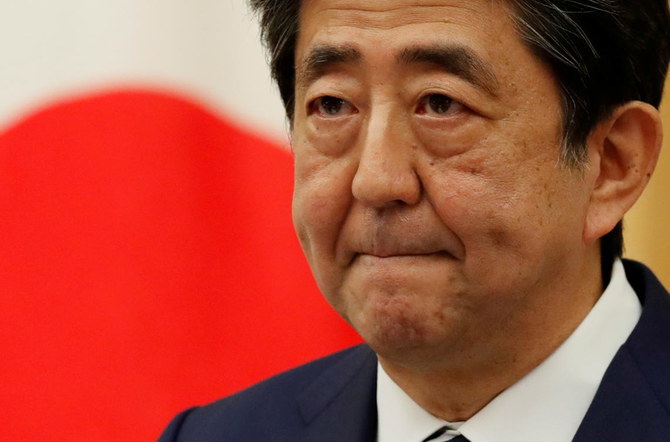
Japan prosecutors seek to question ex-PM Shinzo Abe on spending scandal
Short Url
https://arab.news/pf3zr
Japan prosecutors seek to question ex-PM Shinzo Abe on spending scandal
- Under Japanese law, spending on political events must be reported
- Former prime minister Shinzo Abe has already denied any wrongdoing


US NATO envoy says allies must ‘pull weight’ after Czech defense cut
PRAGUE, March 12 : The United States’ ambassador to NATO said on Thursday that all allies must “pull their weight,” after Czech lawmakers approved a 2026 budget that cuts defense outlays.
Czech Prime Minister Andrej Babis’ government, in power since December, pushed a revamped budget through the lower house on Wednesday evening which cut the defense ministry’s allocation versus a previous proposal to 154.8 billion crowns ($7.31 billion), or 1.73 percent of gross domestic product.
That is below a NATO target of 2 percent of GDP already expected before alliance members pledged last year in the Hague to raise defense spending to 3.5 percent of GDP plus 1.5 percent on other defense-relevant investments over the next decade.
The Czech Finance Ministry says total defense spending in the budget will reach 2.07 percent of GDP, but the country’s budget watchdog has warned that includes money earmarked elsewhere, like for the transport ministry for road projects, that may not be recognized by NATO.
“All Allies must pull their weight and honor The Hague Defense Commitment,” US Ambassador to NATO Matthew Whitaker said on X on Thursday with a picture of a news headline on the Czech budget approval.
“These numbers are not arbitrary. They are about meeting the moment — and the moment requires 5 percent as the standard. No excuses, no opt-outs.”
European NATO countries are under pressure to raise defense spending amid the Ukraine-Russia war and at US President Donald Trump’s urging.
Babis, whose populist ANO party won elections last year, said in February the country was “certainly not” on the path to raising core defense spending to the 3.5 percent target, saying there was a different focus, like on health care.
The budget watchdog on Thursday reiterated “strong doubts” that some spending deemed defense in this year’s budget would meet NATO’s definition.
President Petr Pavel, a former NATO official, has also said defense cuts risked a loss of trust from allies — but has signalled he would not veto the budget.
US Ambassador to Prague Nicholas Merrick said last week the Czech Republic may slip to the bottom of NATO’s defense-spending ranks.
Czech Prime Minister Andrej Babis’ government, in power since December, pushed a revamped budget through the lower house on Wednesday evening which cut the defense ministry’s allocation versus a previous proposal to 154.8 billion crowns ($7.31 billion), or 1.73 percent of gross domestic product.
That is below a NATO target of 2 percent of GDP already expected before alliance members pledged last year in the Hague to raise defense spending to 3.5 percent of GDP plus 1.5 percent on other defense-relevant investments over the next decade.
The Czech Finance Ministry says total defense spending in the budget will reach 2.07 percent of GDP, but the country’s budget watchdog has warned that includes money earmarked elsewhere, like for the transport ministry for road projects, that may not be recognized by NATO.
“All Allies must pull their weight and honor The Hague Defense Commitment,” US Ambassador to NATO Matthew Whitaker said on X on Thursday with a picture of a news headline on the Czech budget approval.
“These numbers are not arbitrary. They are about meeting the moment — and the moment requires 5 percent as the standard. No excuses, no opt-outs.”
European NATO countries are under pressure to raise defense spending amid the Ukraine-Russia war and at US President Donald Trump’s urging.
Babis, whose populist ANO party won elections last year, said in February the country was “certainly not” on the path to raising core defense spending to the 3.5 percent target, saying there was a different focus, like on health care.
The budget watchdog on Thursday reiterated “strong doubts” that some spending deemed defense in this year’s budget would meet NATO’s definition.
President Petr Pavel, a former NATO official, has also said defense cuts risked a loss of trust from allies — but has signalled he would not veto the budget.
US Ambassador to Prague Nicholas Merrick said last week the Czech Republic may slip to the bottom of NATO’s defense-spending ranks.
Latest updates


© 2026 SAUDI RESEARCH & PUBLISHING COMPANY, All Rights Reserved And subject to Terms of Use Agreement.