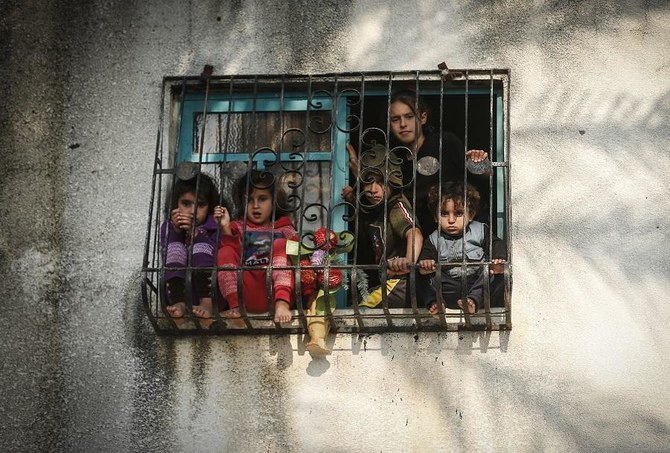
GAZA CITY: People with disabilities can face an “extraordinarily difficult” life in the Gaza Strip due to the Israeli blockade and lack of assistance from Hamas, Human Rights Watch warned Thursday.
Two million Palestinians live in the poverty and conflict-plagued enclave wedged between Israel, Egypt and the Mediterranean Sea.
In a report released on the International Day of Persons with Disabilities, HRW said the 2007 blockade Israel imposed on the territory following Hamas’s rise to power had “robbed people with disabilities in Gaza of their freedom of movement.”
Emina Cerimovic, senior researcher in HRW’s disability rights division, said Israeli control of Gaza’s eastern border had also impaired “access to the devices, electricity, and technology they need to communicate or leave their homes.”
Israel limits the entry into Gaza of goods that could be used for military purposes and controls the flow of fuel needed to power the enclave’s sole electricity plant.
The report noted the impact of recurring power cuts on people with disabilities who need light to communicate through sign language, or electric lifts or scooters to get around.
Hamas, which has fought three wars with Israel since 2008, has failed to provide sufficient ramps or lifts in many buildings in the enclave, according to the report.
“Israel’s policies, alongside the failure of Hamas authorities to address the lack of accessibility across Gaza and widespread stigma, contribute to making life in Gaza extraordinarily difficult for many people with disabilities,” the report said.
The United Nations has marked International Day of Persons with Disabilities on December 3 every year since 1992.

Life in Gaza ‘extraordinarily difficult’ for disabled: HRW
https://arab.news/68afw
Life in Gaza ‘extraordinarily difficult’ for disabled: HRW
- Two million Palestinians live in the poverty and conflict-plagued enclave wedged between Israel, Egypt and the Mediterranean Sea
Slain son of former Libya ruler Qaddafi to be buried near capital
- The burial will be held on Friday in the town of Bani Walid some 175 kilometers south of Tripoli, two of his brothers said
TRIPOLI: The slain son of former Libyan ruler Muammar Qaddafi will be buried in a town south of the capital that remains loyal to the family, relatives said Thursday.
Seif Al-Islam Qaddafi, once seen by some as Libya’s heir apparent, was shot dead on Tuesday in the northwestern city of Zintan.
The burial will be held on Friday in the town of Bani Walid some 175 kilometers south of Tripoli, two of his brothers said.
“The date and location of his burial have been decided by mutual agreement among the family,” half-brother Mohamed Qaddafi said in a Facebook post.
Mohamed said the plan reflected “our respect” for the town, which has remained loyal to the elder Qaddafi years after he was toppled and killed in the 2011 Arab Spring uprisings.
Each year, the town of about 100,000 celebrates the anniversary of a 1969 coup that brought Muammar to power, parading through the streets holding the ex-leader’s portrait.
Saadi Qaddafi, a younger brother, said his dead sibling will be “buried among the Werfalla,” an influential local tribe, in a grave next to his brother Khamis Qaddafi, who died during the 2011 unrest.
Marcel Ceccaldi, a French lawyer who had been representing Seif Al-Islam, told AFP he was killed by an unidentified “four-man commando” who stormed his house on Tuesday.
Seif Al-Islam had long been widely seen as his father’s heir. Under the elder Qaddafi’s iron-fisted 40-year rule, he was described as the de facto prime minister, cultivating an image of moderation and reform despite holding no official position.
But that reputation soon collapsed when he promised “rivers of blood” in retaliation for the 2011 uprising.
He was arrested that year on a warrant issued by the International Criminal Court for alleged crimes against humanity, and a Tripoli court later sentenced him to death, although he was later granted amnesty.
In 2021 he announced he would run for president but the elections were indefinitely postponed.
He is survived by four out of six siblings: Mohamed, Saadi, Aicha and Hannibal, who was recently released from a Lebanese prison on bail.
Libya has struggled to recover from chaos that erupted after the 2011 uprising. It remains split between a UN-backed government based in Tripoli and an eastern administration backed by Khalifa Haftar.


