

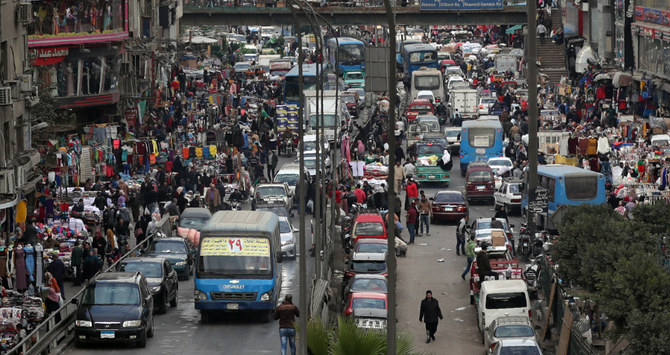
Egypt’s 14-fold population rise in 135 years a ‘national problem’: government minister

Plans in the pipeline included awareness campaigns on family sizes, food and water security, and sustainability. (AFP)
Short Url
Updated 03 December 2020
Follow

Egypt’s 14-fold population rise in 135 years a ‘national problem’: government minister

  • The rise had impacted on each individual’s share of education, health, and available resources, affecting overall demographics: minister

CAIRO: Egypt’s 14-fold population increase between 1882 and 2017 had created a “national problem” that required urgent attention, a government minister has said.

Deputy Minister of Health and Population Tarek Tawfik revealed that over the 135-year period the number of people living in the country had shot up from 6.7 million to 94.8 million.

The rise had impacted on each individual’s share of education, health, and available resources, affecting overall demographics, he added.

“(The population increase) is a national problem that needs to be solved through the collaboration of efforts between all the ministries, governmental, and non-governmental institutions, and the civil society,” Tawfik said.

He pointed out that the Egyptian National Population Council was currently drafting public policy documentation in collaboration with The American University in Cairo (AUC) aimed at resolving some of the country’s population-related issues.

Plans in the pipeline included awareness campaigns on family sizes, food and water security, and sustainability.

The council’s former rapporteur, Dr. Amr Hassan, said that a family planning project due to be launched early next year, would help to cut the birth rate in Egypt by 1 million.

Egyptian Minister of International Cooperation Dr. Rania Al-Mashat, US Agency for International Development (USAID) Mission Director Leslie Reed, AUC President Francis Joseph Ricciardone, and Tawfik recently launched the Strengthening Egypt’s Family Planning Program (SEFPP) youth competition, part of a $31 million initiative previously signed with the USAID to improve population health results.

Al-Mashat said that improving general healthcare, reproductive health, and family planning services were key to achieving economic empowerment for men and women.

She pointed out that the SEFPP youth competition was aimed at paving the way for the implementation of new and effective solutions to the issues and involved the Egyptian government, educational institutions and universities, youth, and civil society organizations represented by the USAID.

The program was designed to tackle the over-population problem through innovative techniques, developing youth ideas on family planning schemes, and raising awareness throughout the country.


The West Bank soccer field slated for demolition by Israel

Updated 59 min 1 sec ago
Follow

The West Bank soccer field slated for demolition by Israel

  • The move is likely to eliminate one of the few ​spaces where Palestinian children are able to run and play

BETHLEHEM: Israeli authorities have ordered the demolition of a soccer field in a crowded refugee camp in the occupied West Bank, eliminating one of the few ​spaces where Palestinian children are able to run and play.
“If the field gets demolished, this will destroy our dreams and our future. We cannot play any other place but this field, the camp does not have spaces,” said Rital Sarhan, 13, who plays on a girls’ soccer team in the Aida refugee camp near Bethlehem.
The Israeli military ‌issued a demolition ‌order for the soccer field on ‌December ⁠31, ​saying ‌it was built illegally in an area that abuts the concrete barrier wall that Israel built in the West Bank.
“Along the security fence, a seizure order and a construction prohibition order are in effect; therefore, the construction in the area was carried out unlawfully,” the Israeli military said in a statement.
Mohammad Abu ⁠Srour, an administrator at Aida Youth Center, which manages the field, said the ‌military gave them seven days to demolish ‍the field.
The Israeli military ‍often orders Palestinians to carry out demolitions themselves. If they ‍do not act, the military steps in to destroy the structure in question and then sends the Palestinians a bill for the costs.
According to Abu Srour, Israel’s military told residents when delivering ​the demolition order that the soccer field represented a threat to the separation wall and to Israelis.
“I ⁠do not know how this is possible,” he said.
Israeli demolitions have drawn widespread international criticism and coincide with heightened fears among Palestinians of an organized effort by Israel to formally annex the West Bank, the area seized by Israel in the 1967 Middle East war. Israel accelerated demolitions in Palestinian refugee camps in early 2025, leading to the displacement of 32,000 residents of camps in the central and northern West Bank. Human Rights Watch has called the demolitions a war crime. ‌Israel has said they are intended to disrupt militant activity.