


ANKARA: Personal security measures have been beefed up around Istanbul Mayor Ekrem Imamoglu following “unconfirmed” reports of a foiled Daesh-linked assassination plot against him.
Municipality sources revealed that Turkish police had issued a warning last month about a possible terror attack on the city leader, but the country’s General Directorate of Security has denied there being any specific threat.
However, the directorate did accept that there had been “unverified information or notices against public officials from time to time.”
Imamoglu, 50, from the main opposition Republican People’s Party (CHP), is a relatively new arrival on the Turkish political scene after securing the mayoralty in March 2019 local elections.
But the politician has quickly emerged as a challenger to Turkish President Recep Tayyip Erdogan with his local projects that touch on people’s daily needs and his pleas for national unity over a number of issues.
Ismail Saymaz, an investigative journalist from dissident Turkish daily newspaper Sozcu, said confirmation of a threat to kill the mayor had come from Interior Ministry contacts who claimed to have received an intelligence report also containing the names of other targets.
However, the ministry did not consider it to be “a tangible or up-to-date assassination threat, but only an unconfirmed information.”
But an Istanbul municipality spokesperson said police had warned authorities on Nov. 23 about a security threat against Imamoglu.
The risks posed to high-profile politicians by Daesh militants in Turkey are increasing but are not new for a country that has witnessed several political assassinations and unresolved murders in the past.
A day after the Imamoglu assassination plot claims, Interior Minister Suleyman Soylu on Wednesday revealed Turkey’s counterterrorism operations during a parliamentary session and listed Hayat Tahrir Al-Sham as a terror organization the country was currently combatting. On the same day, 18 Iraqi nationals were detained in Ankara after an anti-Daesh operation led by counterterrorism police.
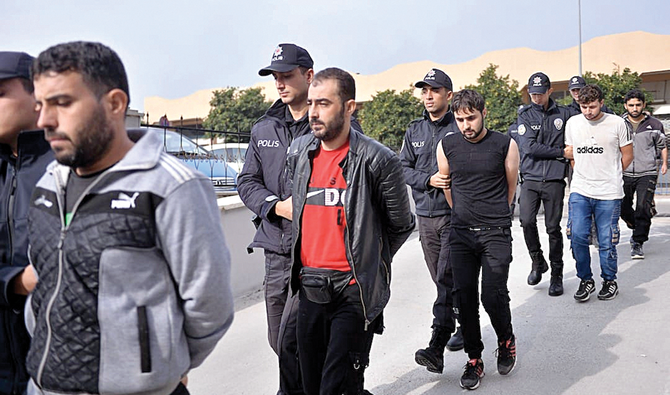
In mid-November, the Istanbul Chief Public Prosecutor’s office led an investigation that resulted in the arrest of four Daesh suspects.
Recently, Fuat Ugur, a pro-government journalist, made claims of an imminent assassination attempt against Kemal Kilicdaroglu, the 71-year-old leader of the CHP. He said threats indicated that Kilicdaroglu would be killed in a similar way to Russian Ambassador to Turkey Andrei Karlov who was shot dead four years ago in Ankara during an art exhibition.
Kilicdaroglu has of late been harshly criticized by the nationalistic ally of the ruling government and especially its leader Devlet Bahceli.
Bahceli recently branded the CHP “a national security issue” following remarks by a party deputy about the army “being sold to Qataris” in recent controversial deals between Ankara and Doha.
Turkey’s notorious mafia boss Alaattin Cakici, politically affiliated to the far-right Turkish MHP, on Nov. 17 publicly threatened Kilicdaroglu with a “watch your step” warning over the main opposition leader’s criticism of the government on the amnesty law that led to the release of thousands of criminals but excluded journalists and dissident politicians.
Ugur said: “Alaattin Cakici will be held responsible for such an unidentified murder. Therefore, a perception that the government ordered the assassination will be generated.” He added that Imamoglu would replace Kilicdaroglu, creating an even greater atmosphere of chaos.
Another investigative journalist, Nedim Sener, said some “proxy groups” were likely to be engaged in provocative assassination attempts in Turkey against dissidents on the same lines as the recent killing of Iranian nuclear scientist Mohsen Fakhrizadeh.


