Iran’s parliament advances bill to stop nuclear inspections

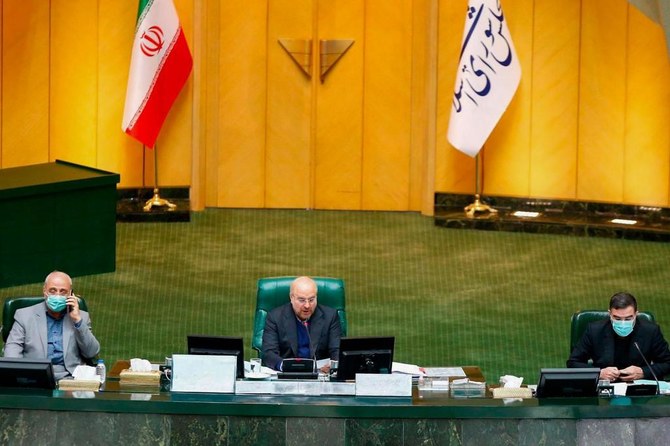
handout picture by the Islamic Consultative Assembly News Agency (ICANA) on November 29, 2020 shows Iranian parliament speaker Mohammad-Bagher Ghalibaf (C) chairing a closed session in the capital Tehran to investigate the killing of Iran’s top nuclear scientist Mohsen Fakhrizadeh. (File/AFP)
Short Url
Updated 01 December 2020
Follow

Iran’s parliament advances bill to stop nuclear inspections

  • The vote to debate the bill was a show of defiance after the killing of a prominent Iranian nuclear scientist last month
  • The official IRNA news agency said 251 lawmakers in the 290-seat chamber voted in favor

TEHRAN: Iran’s parliament Tuesday advanced a bill that would end UN inspections of its nuclear facilities and require the government to boost its uranium enrichment if European signatories to the 2015 nuclear deal do not provide relief from oil and banking sanctions.
The vote to debate the bill, which would need to pas through several other stages before becoming law, was a show of defiance after the killing of a prominent Iranian nuclear scientist last month.
The official IRNA news agency said 251 lawmakers in the 290-seat chamber voted in favor, after which many began chanting “Death to America!” and “Death to Israel!”
The bill would give European countries three months to ease sanctions on Iran’s key oil and gas sector, and to restore its access to the international banking system. The US imposed crippling sanctions on Iran after President Donald Trump unilaterally withdrew from the nuclear agreement, triggering a series of escalations between the two sides.
The bill would have authorities resume enriching uranium to 20%, which is below the threshold needed for nuclear weapons but higher than that required for civilian applications. It would also commission new centrifuges at nuclear facilities at Natanz and the underground Fordo site.
The bill would require another parliamentary vote to pass, as well as approval by the Guardian Council, a constitutional watchdog.
The bill was first tabled in parliament in August but gained new momentum after the killing of Mohsen Fakhrizadeh, who headed a program that Israel and the West have alleged was a military operation looking at the feasibility of building a nuclear weapon. The International Atomic Energy Agency says that “structured program” ended in 2003. US intelligence agencies concurred with that assessment in a 2007 report.
Israel insists Iran still maintains the ambition of developing nuclear weapons, pointing to Tehran’s ballistic missile program and research into other technologies. Iran long has maintained that its nuclear program is for peaceful purposes.
Iran has blamed Fakhrizadeh’s killing on Israel, which has long waged a covert war against Tehran and its proxies in the region. Israeli officials have declined to comment on the killing, and no one has claimed responsibility.
Some Iranian officials have suggested that the International Atomic Energy Agency, which has been regularly inspecting Iran’s nuclear facilities in recent years as part of the 2015 agreement, may have been a source of intelligence for Fakhrizadeh’s killers.
Iran began publicly exceeding uranium enrichment levels set by the nuclear agreement after the US restored sanctions. It currently enriches a growing uranium stockpile up to 4.5% purity.
That’s still far below weapons-grade levels of 90%, though experts warn Iran now has enough low-enriched uranium to reprocess into fuel for at least two atomic bombs if it chose to pursue them.


Military drone attack on Sudan oil field kills dozens and threatens South Sudan’s economic lifeline

Updated 7 sec ago
Follow

Military drone attack on Sudan oil field kills dozens and threatens South Sudan’s economic lifeline

  • RSF said the oil field in Heglig was attacked a day after they seized the facility near the border with South Sudan
  • South Sudanese soldiers were among the dead in the attack by an Akinci drone

JUBA: Dozens of people were killed Tuesday evening in a drone strike near Sudan’s largest oil processing facility carried out by the Sudanese Armed Forces, according to the paramilitary Rapid Support Forces.
The RSF, which has been fighting Sudan’s military since 2023, said the oil field in Heglig was attacked a day after the RSF seized the facility near the border with South Sudan.
Both sides told The Associated Press that the exact number of dead and wounded could not immediately be confirmed. Local news outlets reported seven tribal leaders and “dozens” of RSF troopers were killed.
South Sudanese soldiers were among the dead in the attack by an Akinci drone, according to the RSF, which condemned the attack as a violation of international law.
Two Sudanese military officials confirmed the drone strike, which they said targeted RSF fighters.
The government of South Sudan’s Unity State confirmed three South Sudanese soldiers were killed. A South Sudanese solider, who witnessed the strike and spoke on condition of anonymity because he was not authorized to speak, estimated 25 people were killed.
South Sudanese commander Johnson Olony said in a statement that South Sudanese forces may have been sent to secure Heglig after its capture. South Sudan’s military spokesperson declined to comment.
South Sudan relies entirely on Sudanese pipelines to export its oil and has seen production repeatedly disrupted by the conflict, worsening its economic crisis.
Sudanese soldiers and oil workers began evacuating Heglig on Monday and the RSF took control of the facility without resistance. By Tuesday, about 3,900 Sudanese soldiers had surrendered their weapons to South Sudanese forces after crossing into Rubkona County, according to Unity State’s information ministry.
Video from South Sudan’s state broadcaster showed tanks, armored personnel carriers and artillery among the weapons handed over.
Thousands of civilians from Sudan began crossing the border into South Sudan on Sunday and were still arriving Wednesday, the South Sudan government said, adding that the exact number was not yet known. South Sudan insists it remains neutral in the conflict despite accusations of siding with the RSF.
Heglig’s capture is the latest in a string of RSF territorial gains, including the October fall of el-Fasher, the capital of North Darfur and the Sudanese army’s last stronghold in Darfur. The war, which began in April 2023, has killed an estimated 150,000 people, displaced millions and triggered multiple famines. Both sides face allegations of atrocities.
The capture of Heglig, a vital state asset, could be a significant bargaining chip for the RSF, analysts said. But the opaque nature of oil finances makes it difficult to determine how much the SAF, RSF or South Sudan will be impacted economically over the short term.