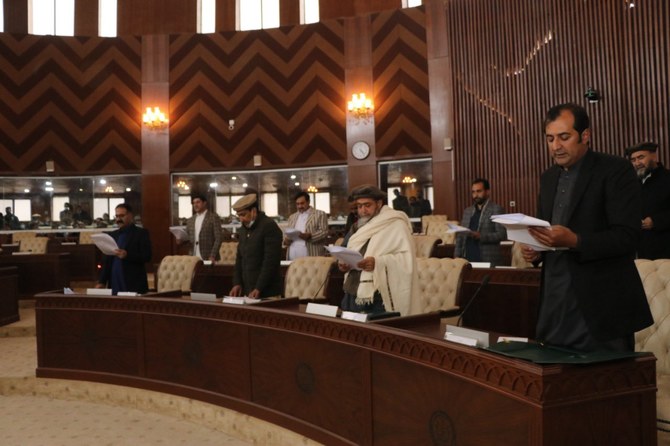
ISLAMABAD: A member of the Pakistan Tehreek-i-Insaf, Khalid Khurshid, was elected chief minister of Gilgit-Baltistan for a five-year term on Monday.
PTI, the party of Prime Minister Imran Khan, bagged the most seats in last month’s legislative assembly election in the northern Gilgit-Baltistan region.
The GB assembly has 33 seats, 24 of which are contested through directed elections, six are reserved for women and three are reserved for technocrats and professionals.
Parties had campaigned for week for the November 15 polls, with candidates promising to build infrastructure projects and end decades of neglect in a region that has never officially been part of Pakistan, but forms part of the portion of disputed Kashmir that Pakistan controls. Both Delhi and Islamabad have claimed all of Kashmir since gaining independence 73 years ago, and have fought two wars over the territory.
“I’m very thankful to the people of Gilgit Baltistan as they elected me their next CM [chief minister,” Khalid Khurshid said in a tweet.
Khurshid, who has a law degree from England and comes from a well-known political family from Astore district, was elected a member of the Gilgit-Baltistan legislative assembly from the GBLA-13 (Astore-1) constituency.
Opposition parties have cried foul over the election results, saying they were rigged by the ruling PTI party, which is in government in the center. The government has denied this.
According to data from the Gilgit-Baltistan election commission, 745,361 people had registered to vote in the election, of which 339,992 were women. Nearly 1,234 polling stations were set up in 24 constituencies.


![]()

PM Khan’s nominee elected chief minister of Pakistan’s Gilgit-Baltistan region
Short Url
https://arab.news/j9a9c
PM Khan’s nominee elected chief minister of Pakistan’s Gilgit-Baltistan region
- Khan’s PTI party bagged the most seats in last month’s legislative assembly election in the northern area
- Khalid Khurshid has a law degree from England, belongs to a well-known political family from Astore district
Latest updates


© 2026 SAUDI RESEARCH & PUBLISHING COMPANY, All Rights Reserved And subject to Terms of Use Agreement.