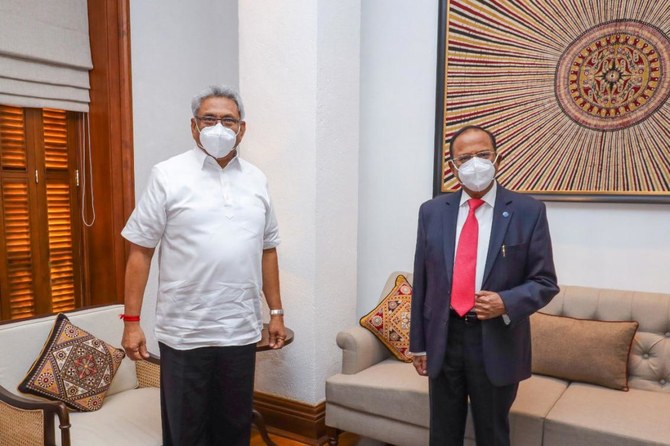
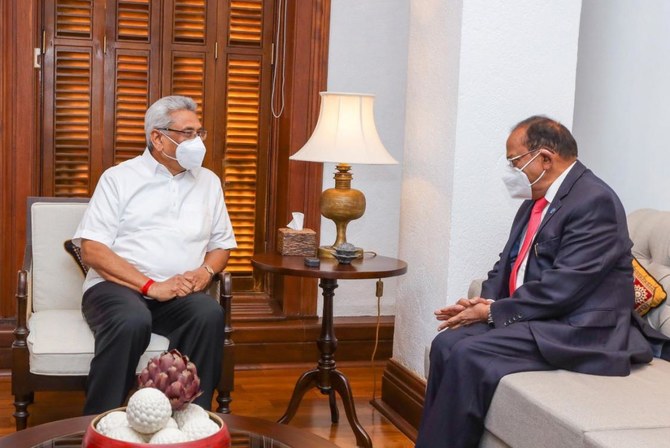
COLOMBO: India’s National Security Adviser Ajit Doval concluded a three-day visit to Colombo on Sunday after “fruitful discussions” with President Gotabaya Rajapaksa on trade, new investments and security amid plans to bolster bilateral ties with the island nation.
“Had a fruitful discussion with Shri @Ajitdovalkumar, NSA #India this evening. National Sec, Sec in the Indian Ocean, new Indian investments, continuation of infrastructure proj. & strengthening bilateral relations between #SriLanka & #India were the areas discussed at the meeting,” Rajapaksa tweeted.
In a separate tweet after the meeting, the High Commission of India in Colombo acknowledged the “productive discussion” between the two officials.
“NSA Ajit Doval called on President Gotabaya Rajapaksa & had a productive discussion. NSA Doval expressed hope that the India-Sri Lanka bilateral relationship would diversify and deepen further under the strong leadership of PM @narendramodi and President @GotabayaR @MEAIndia,” it said.
As one of Sri Lanka’s closest neighbors, India is among its top investors with cumulative investments amounting to more than $1.2 billion since 2003.
According to the Indian Board of Investment, bilateral trade between the two countries totalled $4.59 billion in 2019.
Sri Lankan tourists are among the top 10 sources of revenue for India’s tourism sector, with more than 107,360 tourist visas issued by the High Commission of India in Colombo last year. However, tourism has suffered a setback since the coronavirus outbreak and subsequent global travel ban in March.
Doval took part in a trilateral forum with Maldivian Defense Minister Mariya Ahmed Didi and Kamal Gunaratne, Sri Lanka’s defense secretary, on Saturday, with officials from Mauritius and Seychelles attending virtually.
In a joint statement after the meeting, Sri Lanka’s Ministry of Defense said that the 4th National Security Adviser-level trilateral Maritime Security Cooperation meeting had been revived after a six-year gap to expand the scope of intelligence sharing, including terrorism and cybersecurity, based on “common security threats.”
The first meeting was held in 2011 and, later, in New Delhi in 2014.
“We were able to resolve several maritime problems, such as human trafficking, drug trafficking and general security,” Brig. Chandana Wickremesinghe, a ministry spokesperson, told Arab News.
Current observers Bangladesh, Mauritius and Seychelles “will become permanent members soon,” he added.
“The Indian Ocean commands 60 percent of the world’s gross domestic product, has 80 percent of the world’s shipborne energy transport, and facilitates 46 percent of the world’s merchandise trade — maritime security remains one of our highest priorities,” Sri Lankan Foreign Minister Dinesh Gunawardena said during his opening address at the forum.
The three countries also agreed to improve intelligence sharing and “focus on issues such as terrorism, radicalization, extremism, drugs, arms and human trafficking, money laundering, cybersecurity and climate change,” the statement said.
Muheed Jeeran, a lobbyist, told Arab News that the forum took place at the “right time” when other countries “were looking for a berth in the Indian Ocean.”
“The representatives of the three countries would have chalked out the preventive measures that could be adopted in case of a third-party interference,” Jeeran said.
Regional security “will lead to peace in the Indian Ocean,” he added.


![]()
![]()
![]()

India, Sri Lanka strengthen trade, security ties

Short Url
https://arab.news/wvzcw
India, Sri Lanka strengthen trade, security ties
- Colombo trilateral forum ends with pledge to improve intel sharing
- Bilateral trade between the two countries totalled $4.59 billion in 2019
Latest updates


© 2026 SAUDI RESEARCH & PUBLISHING COMPANY, All Rights Reserved And subject to Terms of Use Agreement.