

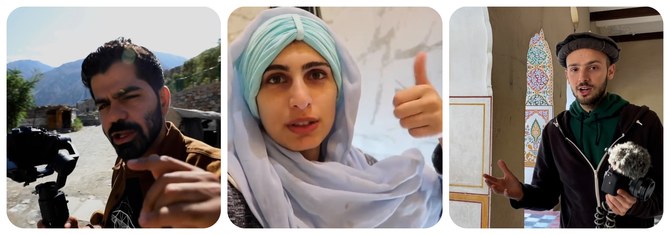

RAWALPINDI: When Jordanian travel vlogger Joe Hattab visited Pakistan for the first time two years ago, he experienced something he had never expected: unparalleled hospitality that has kept him coming back.
The 30-year-old filmmaker runs his own YouTube travel channel which has over 5.7 million subscribers, mainly from Arabic-speaking countries. He has been to Pakistan thrice since 2018, each time visiting a different part of the country and making videos about Pakistani heritage, landscape, and people.
“My friend in Pakistan, Ali, hosted me and told me: I will show you something you have never seen before. And it was the hospitality,” Hattab told Arab News in a recent interview from Dubai, where he is currently based.
“As we traveled between cities, the hospitality and people being so accepting and welcoming to my camera, it was very different,” he said. “The people in Pakistan, they wanted to be on camera, they wanted to tell their stories and share who they are with me and the channel.”
“Coming back was an easy decision. There are still so many places to discover and to film, and I love to show that to my audience, to the Arab people, and people who speak Arabic. Every time I visit Pakistan it surprises me more,” Hattab said.
Pakistani hospitality also overwhelmed Kasem Hato, another Jordanian travel vlogger who Arab News interviewed in Islamabad last Saturday during a three-week trip to Pakistan.
“I had heard about the hospitality in Pakistan, it is the best hospitality in the world,” said the 26-year-old who calls himself Ibn Hattuta after the famed 14th-century Muslim explorer and storyteller from Morocco, Ibn Battuta. “People here not only want you to see the best of their country, but they want you to feel like the country is yours too.”
Hato began documenting his travels in 2015 and has since visited more than 50 countries. His YouTube channel Ibn Hattuta Travels has over 760,000 followers.
“The beauty in the north [of Pakistan] was so unexpected,” Hato said, referring to a trip to the northwestern Khyber Pakhtunkhwa province. “I hope when people watch the videos they will see, and even Pakistanis will see, how much is out here.”
But did he feel safe in Pakistan?
“It’s sad that people think Pakistan is a dangerous country, a country that is off limits for them,” Hato said. “It’s very safe. You have so many people visiting neighboring India, and Pakistan can provide similar experiences and additional stuff that you can’t have in India.”
Saudi vlogger Ragdah Alhowaish, who traveled to Pakistan by herself in November last year, also had to confront questions of safety from friends and family back home.
“A lot of people were asking: Ragdah, you went to Pakistan, are you crazy? How did you do that? Why did you do that?,” she told Arab News. “They were like ‘Ragdah don’t go please, for God’s sake please do not go’.”
But those perceptions changed, she said, when she began sharing her videos from Pakistan: “After I sent them videos they started understanding that Pakistan was really like any country, not something to be afraid of.”
Alhowaish, who studied film and media, estimates she has been to some 90 countries, but it was only in Pakistan that she became serious about vlogging. Watched by hundreds of thousands of viewers, Alhowaish’s videos showcase her daily excursions and adventures and present street food reviews.
“People would help guide me, give me advice on what to do, it was amazing,” she said. “People there do not ignore you, they want to help you,” she added, describing her Pakistan trip as “life-changing.”
“I love Pakistan. I have been all around the world, but I have not been to a place that stole my heart the way Pakistan did,” Alhowaish said. “Even now, no matter where I go, I think about Pakistan. Pakistan left something in my heart, and I didn’t want to let it go.”


