
DUBAI: Imagine being Peter Shilton.
It’s May 30, 1979. You have just won the European Cup with Nottingham Forest after beating Malmo 1-0 in Munich. A year earlier you had won the English First Division title. You are on top of the world, to many people the best goalkeeper in the world. A million joyous emotions swirl through your head.
You have the distinct look of a man who has no inclination that in exactly seven years and 23 days, you’ll suffer an almighty indignity, or two, that will define your existence.
Only two days after Forest’s triumph, an 18-year-old who will orchestrate your future humiliation is giving Scotland the run-around at Hampden Park, capping a devastating display of dribbling skills with a goal as Argentina beat the hosts 3-1. Keep an eye on that Diego Maradona, he could go far in this game.
It’s May 13, 1980, and you’re Peter Shilton.
You’re watching England beat Argentina 3-1 at Wembley in another friendly match. In the first half, the now 19-year-old Argentinian announces himself to a new audience in a way that would become very familiar to England defenders in the coming years.
Receiving the ball in midfield, in one movement he pivots and then proceeds to cut his way through the home defense. One by one, Phil Thompson, Phil Neal and Kenny Sansom are left in a shambolic heap. Faced with the great Ray Clemence in goal, he clips the ball agonizingly wide of the far post. But do keep an eye on this Maradona kid.
But if you’re Peter Shilton, you have more important things on your mind. Like retaining the European Cup with Nottingham Forest two weeks later by beating Hamburg 1-0 at the Bernabeu. You’re not to know it, but your career has peaked. Still, your place in history is assured, you can sleep sound in that knowledge. At least for six years.
Your career trajectory and that of Maradona are about to diverge dramatically. There will be no more league titles and European Cups for you. Maradona leaves Boca Juniors for Barcelona and Napoli to conquer the world. But fear not, your paths shall cross.
June 22, 1986. The Azteca Stadium, Mexico City. You’re Peter Shilton, you’re 36, and you’re stepping out for arguably the biggest match of your career; England v Argentina in the World Cup quarter-final.
Ninety minutes go by in a blur. The final whistle goes and it feels like you’ve just lived through a nightmare.
Maradona goes on to become world champion a week later, and you go on to be haunted by bitterness for the rest of your life
Ali Khaled
There are vague memories of being outjumped in a basketball-style tip-off by a man 18 cm shorter than you. The Hand of God may have been at play, but where was the hand of Shilton?
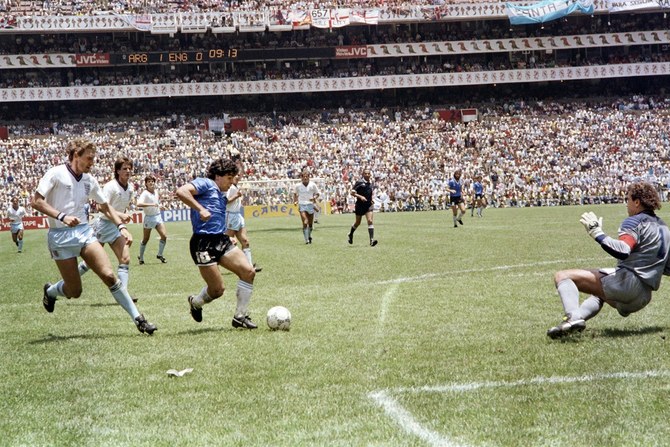
You barely had time to recover from going 1-0 down before a familiar scene plays out in front of you. That short Argentinian is at it again, this time reenacting his dance through the English defense in 1980. Here, it’s Glenn Hoddle, Peter Reid, Terry Butcher and Terry Fenwick performing the guard of honor. What Clemence saw at Wembley, you see now.
But by this time Diego Maradona is the greatest player the world has ever seen. In the middle of the greatest individual and tournament performance the World Cup will ever witness. There will be no repeat of Wembley’s profligacy.
A little feint and you’re on the seat of your pants, resigned to your fate. A tap in and Maradona has just scored the greatest goal of all time, but only the second most famous of the previous five minutes.
In that moment you are the Salieri to his Mozart; the George Foreman to his Muhammad Ali; the Wile E. Coyote to his Road Runner.
At full time, a gracious Gary Lineker, who had threatened to wipe out the two-goal deficit but only managed to halve it, embraces Maradona. The Englishman’s face betrays an admiration, the Argentine’s an exhausted joy. They become life-long friends.
Maradona goes on to become world champion a week later, and you go on to be haunted by bitterness for the rest of your life.
Now it’s July 4, 1990. Imagine being Peter Shilton and it’s the World Cup semi-final against West Germany. Within reach, though probably not yours, is a final against Argentina and the chance to avenge the indignity of four years earlier.
But now you are 40 and a shadow of the goalkeeper you used to be. You’ve already lost another battle with gravity, the ball sailing over your head from Andreas Brehme’s deflected free-kick. Not for the first time, Lineker saves the day with an equalizer, and the match goes to penalties.
You guess the right way for every single penalty the Germans take and yet your seemingly shrinking arms get nowhere near the ball for any of them.
England are out, and your hopes of revenge are dashed forever.
Imagine you're Peter Shilton in the twilight of your career and in retirement. To you, Maradona is forever a “cheat”. To Maradona, you’re a mere footballing midget, worthy of a single mention in his autobiography, and only to call you a “thermos head”, a colloquial Argentinian jibe for someone who is considered “stupid.” Maradona 3, Shilton 0.
Now imagine being Peter Shilton on Nov. 25, 2020. You’ve just heard that the man responsible for your career-defining moment has passed away due to a heart attack at 60. Plastered all over the risible tabloid media’s front pages is the moment of your greatest humiliation. What do you do?
As the world grieved, you had the choice to be magnanimous, belatedly generous in praise of a fallen great. For once, to be the bigger, if not necessarily the highest-jumping, man. To be like Lineker, who on the BBC gave an eloquent and heart-wrenching tribute to his departed friend. Or to simply stay quiet.
But that is not the Shilton way. And the English media knew exactly who to call on for one final rant, one final accusation of cheating. To the surprise of no one, you answered the call.
From beyond the grave, Diego Maradona has humiliated you one last time. Just imagine being Peter Shilton.