KARACHI: Pakistan expects $517 million from Saudi Arabia and $7 million from the United Arab Emirates under the Debt Service Suspension Initiative (DSSI) announced by leaders of the world’s 20 biggest economies, or G20 countries, between May to December 2020, the Pakistani Ministry of Economic Affairs has said.
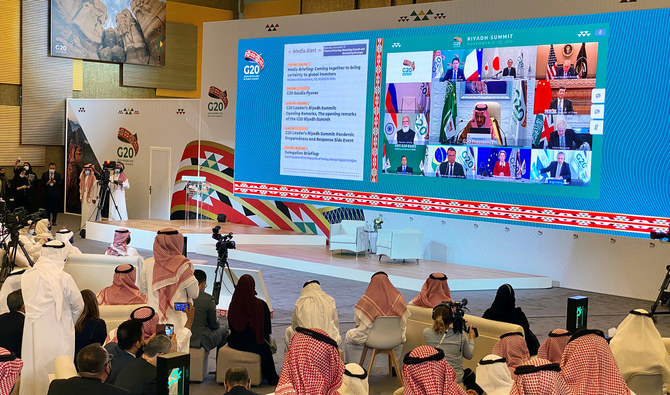
G20 nations on Sunday endorsed a plan to extend a freeze in official debt service payments by the poorest countries to mid-2021 and backed a common approach for dealing with their debt problems.
The G20 debt relief initiative — launched shortly after the start of the pandemic in the spring — has helped 46 of 73 eligible countries defer $5.7 billion in 2020 debt service payments, freeing up funds for countries to fight the pandemic and shore up their economies.
But lack of private-sector participation and countries’ concerns about marring future access to capital markets have limited the success of the debt freeze, which was initially projected to generate some $12 billion in extra liquidity.
“The government has engaged 21 bilateral creditor countries for the purpose of rescheduling $1,704 million of its debt, which was to be paid between May and December 2020,” Samar Ihsan, the economic affairs ministry spokesperson, told Arab News.
The amount includes $517 million to be returned to Saudi Arabia and $7 million to the UAE by the end of the year, she said.
Pakistan has formally secured $839 million in debt relief out of the expected $1,704 million from 16 bilateral creditors.
“Among the 21 bilateral creditors, the quantum of debt relief expected from countries like Japan, Saudi Arabia, Russia, the United Arab Emirates and United Kingdom is about $865 million,” the spokesperson said, adding: “The amounts that we were required to pay to KSA [Kingdom of Saudi Arabia] and the UAE is $517 million and $7 million, respectively.”
Ihsan said Pakistan had already requested Saudi Arabia and the UAE for debt relief under the DSSI for the period ending December 2020. “We are now waiting for their response,” Ihsan continued.
Pakistan also expects about $900 million in additional debt relief from G20 creditors during the next moratorium period, which begins in January.
“It is expected that between January and June 2021, Pakistan may get an additional relief of $800 million to $900 million under the G20 DSSI framework,” Ihsan added.
Pakistan’s de facto finance minister, Abdul Hafeez Shaikh, told Arab News in June this year that Pakistan was expecting $1.8 billion in debt relief from G20 countries, adding that the amount would be utilized to provide relief to people affected by COVID-19.


Pakistan expects $524 million from Saudi Arabia, UAE under G20 debt relief initiative
https://arab.news/radv6
Pakistan expects $524 million from Saudi Arabia, UAE under G20 debt relief initiative

- The G20 initiative has helped 46 of 73 eligible countries defer $5.7 billion in 2020 debt service payments
- Pakistan has formally secured $839 million in debt relief out of an expected $1,704 million from 16 bilateral creditors
Pakistan reports current account surplus in Jan. owing to improved trade, remittances
- Pakistan’s exports crossed the $3 billion mark in Jan. as the country received $3.5 billion in remittances
- Last month, IMF urged Pakistan to accelerate pace of structural reforms to strengthen economic growth
ISLAMABAD: Pakistan recorded a current account surplus of more than $120 million in January, the country’s finance adviser said on Tuesday, attributing it to improved trade balance and remittance inflows.
Pakistan’s exports rebounded in January 2026 after five months of weak performance, rising 3.73 percent year on year and surging 34.96 percent month on month, according to data released by the country’s statistics bureau.
Exports crossed the $3 billion mark for the first time in January to reach $3.061 billion, compared to $2.27 billion in Dec. 2025. The country received $3.5 billion in foreign remittances in Jan. 2026.
Khurram Schehzad, an adviser to the finance minister, said Pakistan reported a current account surplus of $121 million in Jan., compared to a current account deficit of $393 million in the same month last year.
“Improved trade balance in January 2026, strong remittance inflows, and sustained momentum in services exports (IT/Tech) continue to reinforce the country’s external account position,” he said on X.
Pakistan has undergone a difficult period of stabilization, marked by inflation, currency depreciation and financing gaps, and international rating agencies have acknowledged improvements after Islamabad began implementing reforms such as privatizing loss-making, state-owned enterprises (SOEs) and ending subsidies as part of a $7 billion International Monetary Fund (IMF) loan program.
Late last month, the IMF urged Pakistan to accelerate the pace of these structural reforms to strengthen economic growth.
Responding to questions from Arab News at a virtual media roundtable on emerging markets’ resilience, IMF’s director of the Middle East and Central Asia Jihad Azour said Islamabad’s implementation of the IMF requirements had been “strong” despite devastating floods that killed more than 1,000 people and devastated farmland, forcing the government to revise its 4.2 percent growth target to 3.9 percent.
“What is important going forward in order to strengthen growth and to maintain the level of macroeconomic stability is to accelerate the structural reforms,” he said at the meeting.
Azour underlined Pakistan’s plans to privatize some of the SOEs and improve financial management of important public entities, particularly power companies, as an important way for the country to boost its capacity to cater to the economy for additional exports.
“This comes in addition to the effort that the authorities have made in order to reform their tariffs, which will allow the private sector of Pakistan to become more competitive,” the IMF official said.


