
KABUL: As they huddle around a makeshift fire a few meters away from their tents, a group of men, displaced by decades of war in Afghanistan, recall the number of times former and current government officials pledged to provide basic amenities to millions of refugees during routine visits to their camp.
One man in the group, 42-year-old Shah Tawoos, points at a dirty stream of water which is making its way beneath the rotten tent – his “home” for more than a decade.
“Look at the humidity inside and the mud outside the tent, even dogs can’t and won’t bear this, but we have nowhere to go,” Tawoos told Arab News.
The tent is one of many located in the Charahi Qambar (CQ) camp, on the western fringes of Kabul, where thousands of internally displaced persons (IDPs) like Tawoos are denied their rights and are continuously threatened with deportation.
“Ministers and other authorities came and went, pledging to help us with houses, but nothing has happened. We do not know where the government spends the national budget and foreign aid,” he said.
According to the Internal Monitoring Displacement Centre (IMDC), the CQ is one of 47 camps that house nearly 3 million IDPs, who had their lives upended either by natural disasters or a fresh bout of violence since the Taliban’s ouster in the US-led invasion in 2001.
The displacements were triggered by fighting and attacks involving the Taliban, government and US-led forces, Daesh and other nonstate armed groups.
“In the first half of 2020, there were 117,000 new displacements associated with conflict and violence and 30,000 as a result of disasters,” according to the IMDC.
The CQ camp is filled with refugees from Afghanistan’s south where, according to the United Nations, more than 5,000 families have fled the fighting between the Taliban insurgents and Afghan government forces, specifically in the Helmand province.
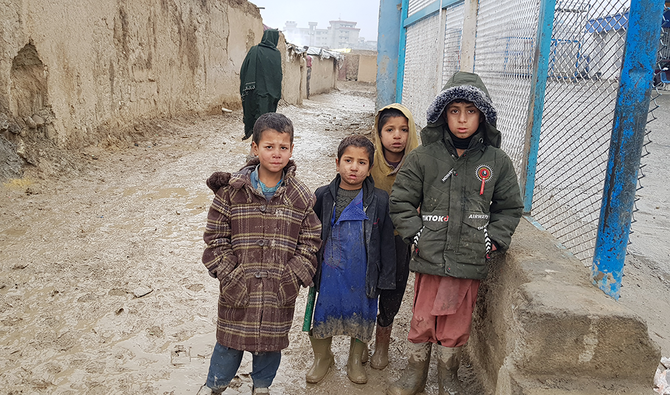
The conditions at these camps are deplorable, with IDPs residing in tents either donated by local or foreign relief agencies or in small mud houses built using their resources.
The tents are rotting. Their condition, residents say, gets worse in summer when heavy rain and snow weakens the fabric, resulting in gaping holes.
“Our tents become infested with mosquitoes in the summer heat and unbearably cold in winter times,” Rahmat Gul, another resident of the camp, said.
He laments about the lack of electricity and water supply and highlights the plight of thousands of children who have no access to education or, often, food.
There are other issues as well, Gul says, such as unemployment and poverty, forcing some men and women to beg to make ends meet.
The camp first attracted attention in 2012 after at least 15 IDP children froze to death due to the harsh winter conditions.
The displacements were the topic of discussion once again during a virtual donor conference in Geneva on Monday and Tuesday where ministers from nearly 70 countries and officials of humanitarian organisations spoke about funding cuts and tighter restrictions on vital aid for Afghanistan, marking further challenges for a nation that is preparing for an early withdrawal of US-led foreign troops and grappling with the COVID-19 crisis.
“We want the participants (in Geneva) to act with caution, take firm measures for accountability and transparency from our government. Otherwise we fear that just like in the past, much of the aid will be squandered either by foreign contractors or officials in our government,” Gul said.
Ahead of the conference which began on Monday, President Ashraf Ghani said he hoped for it to generate billions of dollars of aid.
“The outcome of this pledging conference will heavily influence the country’s future development and our path towards self-reliance and peace,” Ghani said during the weekend in Kabul.
It follows a similar event in Belgium in 2016 where donors pledged to extend $15 billion in aid to Afghanistan for the next five years.
However, finance ministry spokesman Shamrooz Khan Masjidi was unable to comment on how much of the pledged aid had been disbursed.
“We would like a major part of the aid to be channeled through government budgets,” he said.
He added that the focus of all future aid would be on building infrastructure, repatriation of refugees and aiding the war displaced.
“Kabul had fulfilled the benchmarks set by donors for the last conference with regards to combating corruption and was open for accountability for the cash it has spent,” he said.
The Geneva meeting comes amid a deadlock in the talks between the Afghan government and Taliban negotiators in Doha, Qatar, that have been going on since Sept. 12, as well as rising discontent with Ghani’s government at home and abroad due to soaring corruption, weak governance and the alleged squandering of state resources.
A recent report released by US watchdog SIGAR said: “The Afghan government makes paper reforms, such as drafting regulations or holding meetings, rather than concrete actions that would reduce corruption, such as arresting powerful actors.”
Following the SIGAR report and ahead of the Geneva conference, Ghani’s government ordered the formation of another commission to fight graft.
However, Sayed Ikram Afzali, executive director of Integrity Watch, said that the government had “no will for fighting corruption and resorts to symbolic works for drawing the attention at international conferences.”
A survey conducted by the Afghan Civil Society Forum on Sunday said that 90 percent of participants believed that “the government is corrupt.”
Afghanistan’s last permanent ambassador to the United Nations, Mahmoud Saikal, said on Monday: “In this time of high corruption, it is extremely important donors demand strong accountability from those who claim to represent our people.”
It’s a thought echoed by UN Commissioner for Refugees, Filippo Grandi. He also warned of “grave consequences” if the world turned away from Afghanistan.
“Failure on either account would see Afghanistan slide backwards with disastrous consequences, including further displacement, possibly on a larger scale…” he said in a statement on Sunday.