Arab coalition destroy Houthi mines in Red Sea

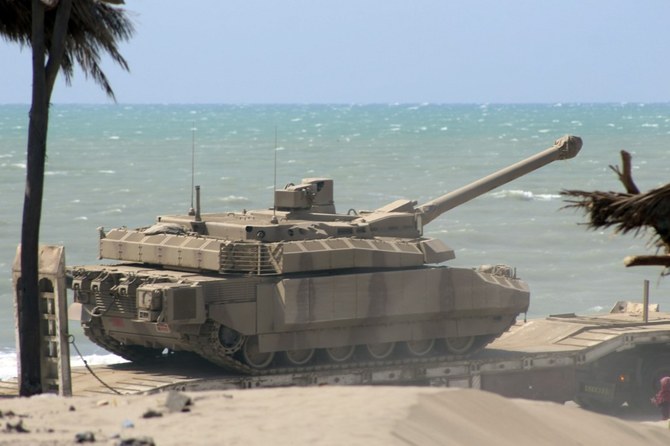
Yemeni pro-government forces on the eastern outskirts of Hodeidah on Nov. 14, 2018. (File/AFP)
Short Url
Updated 24 November 2020
Follow

Arab coalition destroy Houthi mines in Red Sea

DUBAI: The Arab coalition said they destroyed five Houthi mines in the Red Sea, Saudi state TV Al-Ekhbariya reported.
The Sadaf mines are manufactured by Iran, the report added.
The coalition said the ongoing Houthi hostilities threaten maritime security.


UPDATE 9-Iran foreign minister says progress made in nuclear talks with US in Geneva

Updated 2 sec ago
Follow

UPDATE 9-Iran foreign minister says progress made in nuclear talks with US in Geneva

* Araqchi says progress made on the main guiding principles
* Iranian media say parts of Strait of Hormuz ‌to be temporarily closed
* The talks involved officials from both Iran and US
* US President Trump said he was involved indirectly

GENEVA: Iran and the United States reached an understanding on Tuesday on main “guiding principles” in talks aimed at resolving their longstanding nuclear dispute, but that does not mean a ​deal is imminent, Iranian Foreign Minister Abbas Araqchi said.
Oil futures fell and the benchmark Brent crude contract tumbled more than 1 percent after Araqchi’s comments, which helped ease fears of conflict in the region, where the US has deployed a battle force to press Tehran for concessions.
“Different ideas have been presented, these ideas have been seriously discussed, ultimately we’ve been able to reach a general agreement on some guiding principles,” Araqchi told Iranian media after the talks concluded in Geneva.

BOTH SIDES HAVE ‘CLEAR NEXT STEPS’
The indirect discussions between US Special Envoy Steve Witkoff and US President Donald Trump’s son-in-law Jared Kushner, alongside Araqchi, were mediated by Oman. The White House did not respond to emailed questions about the meeting.
Oman’s Foreign Minister Badr Al-Busaidi said in a post on X “much work is yet to be done” but Iran and the US were leaving with “clear ‌next steps” .
Just as ‌talks began on Tuesday, Iranian state media said Iran would temporarily shut part of the ​Strait ‌of ⁠Hormuz, a vital ​global ⁠oil supply route, due to “security precautions” while Iran’s elite Revolutionary Guards conducted military drills there.
Tehran has in the past threatened to shut down the strait to commercial shipping if it is attacked, a move that would choke off a fifth of global oil flows and drive up crude prices.
Responding to comments by Trump that “regime change” in Iran might be the best course, the country’s Supreme Leader Ayatollah Ali Khamenei, 86, warned that any US attempts to depose his government would fail.
“The US President says their army is the world’s strongest, but the strongest army in the world can sometimes be slapped so hard it cannot get up,” he said, in comments published by Iranian media.
Speaking at a disarmament conference in Geneva after the talks, Araqchi said ⁠that a “new window of opportunity” had opened and that he hoped discussions would lead to a “sustainable” solution ‌that ensured the full recognition of Iran’s legitimate rights.
Earlier, Trump said he himself would ‌be involved “indirectly” in the Geneva talks and that he believed Tehran wanted to make ​a deal.
“I don’t think they want the consequences of not making ‌a deal,” Trump told reporters aboard Air Force One on Monday. “We could have had a deal instead of sending the B-2s in ‌to knock out their nuclear potential. And we had to send the B-2s.”
The US joined Israel last June in bombing Iranian nuclear facilities. The US and Israel believe Iran aspires to build a nuclear weapon that could threaten Israel’s existence. Iran says its nuclear program is purely peaceful, even though it has enriched uranium far beyond the purity needed for power generation, and close to what is required for a bomb.

IRAN SAYS IT WILL ONLY DISCUSS NUCLEAR PROGRAMME
Since those ‌strikes, Iran’s Islamic rulers have been weakened by street protests, suppressed at a cost of thousands of lives, against a cost-of-living crisis driven in part by international sanctions that have strangled Iran’s oil ⁠income.
Washington has sought to expand ⁠the scope of talks to non-nuclear issues such as Iran’s missile stockpile. Tehran says it is willing only to discuss curbs on its nuclear program — in exchange for sanctions relief — and that it will not give up uranium enrichment completely or discuss its missile program.
Khamenei reiterated Iran’s position that its formidable missile stockpile is non-negotiable and missile type and range have nothing to do with the United States.
A senior Iranian official told Reuters on Tuesday the success of the Geneva talks hinged on the US not making unrealistic demands and on its seriousness on lifting the crippling sanctions on Iran.

US B-2 BOMBERS STRUCK NUCLEAR TARGETS
Tehran and Washington were scheduled to hold a sixth round of talks in June last year when Washington’s ally Israel launched a bombing campaign against Iran, and was then joined by US B-2 bombers that struck nuclear targets. Tehran has since said it has halted uranium enrichment activity.
Iran has joined the nuclear Non-Proliferation Treaty, which guarantees countries the right to pursue civilian nuclear power in return for requiring them to forgo atomic weapons and cooperate with the UN nuclear watchdog, the International Atomic Energy Agency.
Israel, which has ​not signed the NPT, neither confirms nor denies having nuclear weapons, ​under a decades-old ambiguity policy designed to deter surrounding enemies. Scholars believe it does.