

EU-UK trade talks go on remotely

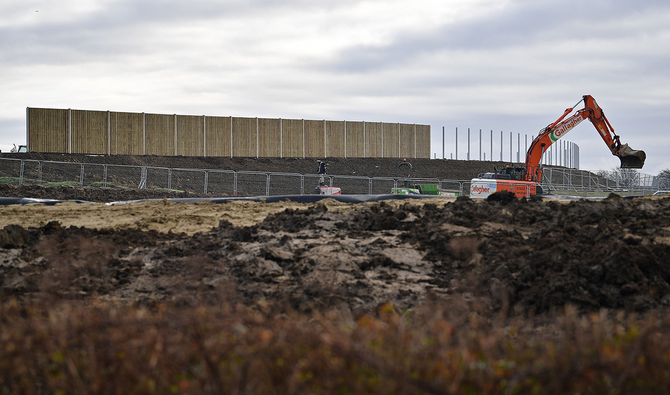
Construction work continues at the site of a lorry park being built between the villages of Sevington and Mersham, near the M20 motorway near Ashford in Kent, south east England on November 23, 2020, which will have the capacity to hold nearly 10,000 vehicles in the event of a no-deal Brexit. (AFP)
Short Url
Updated 24 November 2020
Follow

EU-UK trade talks go on remotely

  • ‘The differences on the level playing field and fisheries remain major,’ sources say

BRUSSELS: British and EU negotiators on Monday resumed talks on their post-Brexit relationship via video-conferencing, with the focus still squarely on dividing up fishing quotas and ensuring fair competition for companies, including on state aid.

Face-to-face talks, suspended last week after a member of the EU delegation tested positive for the coronavirus, will resume in London “when it is safe to do so,” said a source who follows Brexit.

Another source, an EU official, added: “The differences on the level playing field and fisheries remain major.”

These issues are the key obstacles to clinching a new deal to maintain free, frictionless trade between the estranged allies after Britain’s standstill transition out of the EU following Brexit completes at the end of this year.

British newspaper The Sun reported at the weekend that the negotiators were looking at a review clause that would allow a renegotiation of any new fishing arrangement from 2021 in several years’ time.

An EU diplomat, a third source who spoke under condition of anonymity, confirmed that such an idea was under discussion, but added that the bloc insisted on linking it to the overall trade agreement, meaning fishing rights could only be renegotiated together with the rest of trade rules.

“We need to uphold the link between fishing and trade rules, this comes in a package,” said the person.

The EU official stressed that annual renegotiation of fishing quotas was still a no-go for the 27-nation bloc. Fisheries are a particularly sensitive issue for France.

Thierry Breton, the French representative on the European Commission, the EU executive, said last week: “We shouldn’t have in the Brexit deal revision clauses in one or two years, when everything would change again ... We won’t let that happen. We need to give our entrepreneurs predictability.” 


Saudi Arabia set to attract $500bn in private investment, Al-Falih tells conference

Updated 09 December 2025
Follow

Saudi Arabia set to attract $500bn in private investment, Al-Falih tells conference

RIYADH: Sustainability, technology, and financial models were among the core topics discussed by financial leaders during the first day of the Momentum 2025 Development Finance Conference in Riyadh.

The three-day event features more than 100 speakers and over 20 exhibitors, with the central theme revolving around how development financial institutions can propel economic growth.

Speaking during a panel titled “The Sustainable Investment Opportunity,” Saudi Investment Minister Khalid Al-Falih elaborated on the significant investment progress made in the Kingdom.

“We estimate in the midterm of 2030 or maybe a couple of years more or so, about $1 trillion of infrastructure investment,” he said, adding: “We estimate, as a minimum, 40 percent of this infrastructure is going to be financed by the private sector, so we’re talking in the next few years $400 (billion) to $500 billion.”

The minister drew a correlation between the scale of investment needs and rising global energy demand, especially as artificial intelligence continues to evolve within data processing and digital infrastructure in global spheres.

“The world demand of energy is continuing to grow and is going to grow faster with the advent of the AI processing requirements (…) so our target of the electricity sector is 50 percent from renewables, and 50 percent from gas,” he added.

Al-Falih underscored the importance of AI as a key sector within Saudi Arabia’s development and investment strategy. He made note of the scale of capital expected to go into the sector in coming years, saying: “We have set a very aggressive, but we believe an achievable target, for AI, and we estimate in the short term about $30 billion immediately of investments.”

This emphasis on long-term investment and sustainability targets was echoed across panels at Momentum 2025, during which discussions on essential partnerships between public and private sectors were highlighted.

The shared ambition of translating the Kingdom’s goals into tangible outcomes was particularly essential within the banking sector, as it plays a central role in facilitating both projects and partnerships.

During the “Champions of Sectoral Transformation: Development Funds and Their Ecosystems” panel, Saudi National Bank CEO Tareq Al-Sadhan shed light on the importance of partnerships facilitated via financial institutions.

He explained how they help manage risk while supporting the Kingdom’s ambitions.

“We have different models that we are working on with development funds. We co-financed in certain projects where we see the risk is higher in terms of going alone as a bank to support a certain project,” the CEO said.

Al-Sadhan referred to the role of development funds as an enabler for banks to expand their participation and support for projects without assuming major risk.

“The role of the development fund definitely is to give more comfort to the banking sector to also extend the support … we don’t compete with each other; we always complement each other” he added.