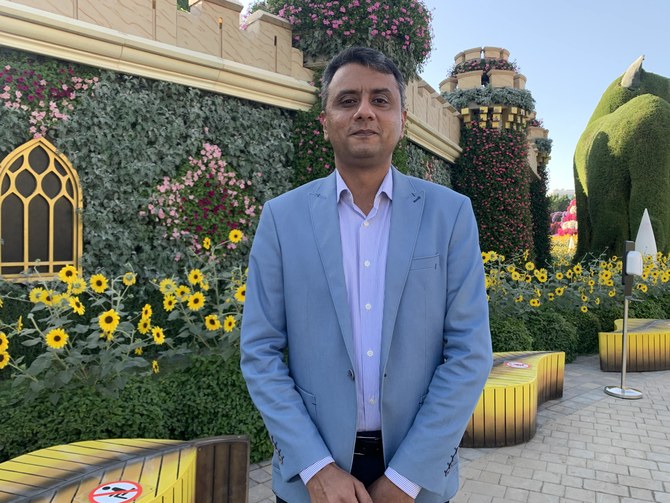
DUBAI: Creating a flower garden in the middle of a desert may seem like an impossible feat but only if you don’t have the vision or expertise, a UAE-based Pakistani engineer who oversaw the development of the Dubai Miracle Garden said, speaking about a project that is considered one of the world’s largest natural flower gardens, featuring over 150 million flowers.
Engineer Farhan Shehzad, General Manager Development at Cityland Group that manages the Dubai Miracle Garden, told Arab News on Sunday that the past eight years of developing the over 72,000 square meters garden had been a “journey of learning” each day.
“I still remember the day we first came to this place,” Shehzad, 35, said, referring to the land where the flower garden has been developed in Al Ain, also known as the City of Flowers. “It was all sandy and windy and I felt myself in the middle of a desert. But it’s all blooming today.”
“It was quite a challenge to convert this piece of desert into the floral show that it is today where the temperature and ambience makes you forget where you are,” said Shehzad, who was born and brought up in the UAE.
Work on the garden project started in November of 2012, with most of the initial infrastructure set up in just two months. The soft opening of the exhibit was on Valentine’s Day in 2013.
“This was only possible because we had the manpower, the expertise and the know-how,” Shehzad said. “It’s been nine years now, but we are still learning and experiencing new things each day.”
Initially, the team worked on flower structures of up to four meters in height but the garden now has structures that are as high as 27 meters.
“There are lots of challenges in making such tall structures including the design, putting in place the structural stability, the floral combinations and the hardest is the maintenance, which includes the irrigation component as well,” Shehzad said. “What you see today is only 25 percent of what we have in mind because 75 percent of our ideas have not even materialized.”
The structural and floral designs have been conceived by Cityland Group’s owner, Abdel Naser Rahhal, and are changed each year except for a few permanent structures. But Shehzad leads the implementation of the ideas and a team of 400 people — of which 85 percent are Pakistanis — works with him to make the exhibit a reality.
The project has been recognized thrice by the Guinness Book of Records in different categories. Currently, an Airbus A380 flower structure in the garden is listed by Guinness World Records as the biggest flower structure in the world and an 18 meter topiary of Mickey Mouse, which weighs almost 35 tons, is the tallest topiary supported sculpture in the world.
“We have in-house production of these flowers done at huge nurseries based in Al Ain city,” Shehzad said. “We order seeds and cuttings from Europe and have the germination and on-site plantation all done in-house.”
But the Miracle Garden has been an exercise in trial and error, he added.
“All these varieties are brought in from Europe where the temperature, ambience and environment are completely different from the Middle East, so the varieties that were doing well there did not respond well here and that’s how we knew what worked,” he said.
No cultivation takes place in May and June, the engineer said.
“In July we start planting seeds and cutting and when we bring them to the garden, they are in the blooming stage,” Shehzad added. “It is important that when a visitor comes here, he sees blooming flowers.”
After seven months of being on display, the garden starts to wilt and turns into waste, generating 100-150 cubic meters of waste. But even the remains of the dead flowers do not go to waste.
“We supply this waste to companies that turn it into fertilizer,” Shehzad said. “Nothing goes to waste.”


Eight years in, Pakistani engineer continues to help Dubai’s ‘miracle’ flower garden bloom
https://arab.news/gfagr
Eight years in, Pakistani engineer continues to help Dubai’s ‘miracle’ flower garden bloom

- Dubai Miracle Garden is one of the world’s largest natural flower gardens featuring over 150 million varieties
- Work on the garden started in November of 2011 with initial infrastructure set up in two months, soft opening was in Feb 2012

Islamic military coalition, Pakistan to deepen cooperation to combat ‘terrorism’ — Pakistani military
- Islamic Military Counter Terrorism Coalition is a 43-member alliance that includes Pakistan, Saudi Arabia, Egypt, Jordan, UAE and other nations
- The Pakistani military statement comes after a meeting between IMCTC secretary-general and the chief of Pakistani defense forces in Rawalpindi
ISLAMABAD: Pakistan and the Islamic Military Counter Terrorism Coalition (IMCTC) have reaffirmed their commitment to deepening cooperation, including intelligence sharing and capacity building, to jointly combat “terrorism” and “extremism,” the Pakistani military said on Monday.
The IMCTC is a 43-member military alliance that was formed on Saudi Arabia’s initiative in Dec. 2015 to consolidate Muslim countries’ efforts in countering “terrorism.”
A 17-member IMCTC delegation is visiting Pakistan from Feb. 2-6 to conduct a training at National University of Sciences and Technology on “Re-integration and Rehabilitation of Extremist Elements,” according to the Pakistani military.
On Monday, IMCTC Secretary-General Maj. Gen. Mohammed bin Saeed Al-Moghedi held a meeting with Chief of Pakistani Defense Forces Field Marshal Asim Munir to discuss cooperation among IMCTC member states.
“During the meeting, matters of mutual interest were discussed, with particular emphasis on regional security dynamics and enhanced cooperation in counter-terrorism efforts,” the Inter-Services Public Relations (ISPR), the Pakistani military’s media wing, said in a statement.
“Both sides reaffirmed their shared commitment to combating terrorism and extremism through collaborative strategies, intelligence sharing, and capacity building among member states.”
The IMCTC features Pakistan, Saudi Arabia, Türkiye, Afghanistan, Egypt, Jordan, Qatar, Palestine, UAE, Bangladesh and other nations. In 2017, Pakistan’s former army chief Gen. (retd) Raheel Sharif was appointed as the IMCTC commander-in-chief.
During discussions with Major General Al-Moghedi, Field Marshal Munir appreciated the role of IMCTC in fostering stability and promoting coordinated counterterrorism initiatives across the Islamic world, according to the ISPR.
The IMCTC secretary-general acknowledged Pakistan’s significant contributions and sacrifices in the fight against militancy and lauded the professionalism of Pakistan’s armed forces.
“The meeting underscored the resolve of both sides to further strengthen institutional collaboration for peace, stability, and security in the region,” the ISPR added.
Pakistan enjoys cordial ties with most Muslim countries around the world, particularly Gulf Cooperation Council countries. In Sept. 2025, Pakistan signed a landmark defense pact with Saudi Arabia according to which an act of aggression against one country will be treated as an act of aggression against both.


